CHAPTER XXIII.
[Image of page 247]
CHAPTER XXIII.
ON THE PRIESTHOOD.----ADOPTED BY THE ARISTOCRACY.----THEIR IMPORTANCE IN WAR TIME.----AUGURIES PERFORMED BY THEM.----AND ANCIENT NATIVES GENERALLY.----ANATHEMAS.----THEIR SUPPOSED EFFICACY.----IGNORANCE OF THE LEVITES OF THE ATUA THEY ADDRESS.----ARE UNIVERSALLY CONSULTED.----ANECDOTES.----ON THE SHADE OF THE DEPARTED.----MUTUAL JEALOUSIES OF PRIESTS.----TITHES.----THEIR INEFFICIENCY.----PRIESTS ARE EVEN AT AN ARGUMENT.----ARE NOT BIGOTED.----VALUE OF PROPHESYING.----ANECDOTE.----A LUCKY HIT.---- SUPERIORITY OF JUDICIAL PROFESSORS.----A VIEW OF THE HAPPINESS PROMISED HEREAFTER.----SUBJECTS OF BELIEF AMONG THE NATIVES.----DIVINATION.----UNIVERSALITY OF ITS PRACTICE AT HOME AND ABROAD.----ORIGIN OF THE PRACTICE.----PRUDENCE OF THE NATIVE WARRIOR.----OBJECTS FOR WHICH ASTROLOGY IS PERFORMED.----THE SYSTEM OF LUCKY DAYS, AND THERE ANTITHESIS.----INSTANCES COMPRISED IN AUGURY.----NECROMANCY OF NATIONS.----ORACULAR DENUNCIATIONS.
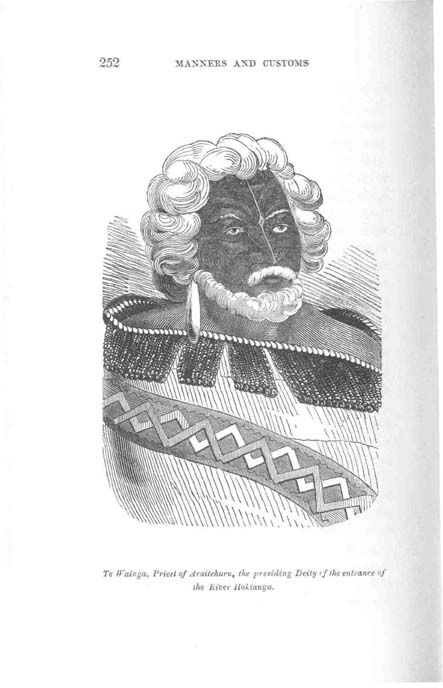
Among the most influential in a native assembly arc those persons who unite in their own persons the hereditary power of chieftainship and adoption of the priesthood. 1 A Priest (Tohunga ) once
[Image of page 248]
established, becomes a person of much importance among his countrymen. As in civilized societies, it is adopted by the younger branches of respectable families, who possess but a small portion of worldly goods. There are many sensible natives who laugh at these people; but the force of habit or early example is sure to triumph in times of sickness, as those free-thinkers succumb to the priests, who pretty well mulct them, until a recovery takes place, when the convalescents again enter the lists of reformers. In war-time, the priest becomes an important personage. The warriors look to him, whether battle shall be given or peace proclaimed, and as the success of his auguries may prove, they act accordingly. 2 The flight of birds in certain directions are especially attended to; if they wing their way to the right of the sacrifice, it is accounted propitious, that is if the villages of the tribe are in that quarter; but should they disappear in the direction of the enemy, war is not to be undertaken. The ana-
[Image of page 249]
thema of a priest is regarded as a thunderbolt that an enemy cannot escape; yet, scarcely a village exists without a dozen, or more of those spiritual weapons hanging over its community. Such prayers are supposed to be extremely efficacious in working the ruin of an enemy, but if the priest is asked by a European to whom does he pray? he becomes confounded for an answer; when it is demanded of him, who sends the rain he prays for, he answers the Atua , but to which Atua he is unable to ascribe, he supposes it is the Atua or rather Wairua of a deceased warrior; they do not ascribe intellectual abilities to those shades, and though they offer prayer (but never thanks for past or present) own, that they feel no assurance, of the being they invoke, and whom they knew in this life, whether it be deceased altogether and resolved into the elements, or became the immortal "thing of eternal life," they address it as being.
Scarcely a movement is undertaken in life without the village priest being first consulted, even the females when in that interesting state "which ladies like to be &c.," demand of those ariolists as to the future sex of the embryo foetus, and are satisfied of the result of the prescience of the priest until the period of parturition, when the fallacy of the prediction is proved undeniably; on such occasions, the priests contrive to shift the blame on some village magician as having prayed for
[Image of page 250]
the change of sex while yet unborn. In demanding of a priest (a younger son of one of the aristocracy) the reason why he prayed to a particular Atua , addressing himself to the sky generally, and not to a certain spot, where he might as reasonably expect him to be domiciled, he answered "that the Atua looked down from heaven to earth, after his death;" but when farther questioned, why should he pray to that whose existence had ceased, answered "that the substantial portion had certainly rotted away; but the Wairua (spirit) hovered around the place where the bones had been interred, and as the deceased could be at all places at the same moment, it was immaterial whether he addressed it from a cave, on shore, or at sea. That the spirit resided at the Moodi wenua (Reinga , literally, extremity of the earth) from whence it would never retreat." The priests are extremely jealous of each other, and when two of the trade prophesy together in public on the same subject, and arrive at contrary opinions, the one who meets with a successful result, becomes so self-important, as to eclipse his rival in the opinion of the villagers, the latter is obliged to hide his diminished head, by taking up his trade and importance to a village further distant.
The tithes of the priesthood are few and far between, except partaking of the human sacrifices, on which auguries are performed before, during, and at the conclusion of a war, otherwise these sarcophagi, have but little to boast of.
[Image of page 251]
In the performance of their functions, it is difficult to discover whether these dogmatists are deceivers of the people only, or may be included among the deceived.
They rarely attempt an argument with a European, but though easily driven from their strongholds, do not profess belief in what their antagonist may have advanced; but laugh heartily, generally observing tantamount to "I do not desire to enforce my opinions on you, nor do you attempt my conversion to yours, simply because I have not a ready expression to confute you." The priests, though wedded to their own opinions, are far from bigoted, nor have they the slightest idea of making a convert. Prophetic knowledge of future events is purchased from the priesthood at a cheap rate, these astrologers never giving away a chance of profit, however trifling.
When a cheap prophecy turns out contrary to the reality, the priest, if taxed with his fallacy, will ask in turn, "what could be expected for such a trivial offering," and should it prove true, the necromancer will demand another "consideration" for the exercise of his abilities, or if he is previously assured of obtaining nothing, he nevertheless takes pride to himself for his disinterestedness, and will instance the exorbitant price obtained by the cupidity of others exercising the profession whose prophecies were attended with less happy results. Among the latter, a priest
[Image of page 252]
[Image of page 253]
named Arrawata once informed us, for the truth of which he successfully appealed to his companions, that he was applied to by the wife of a chief, who had been united to her husband (tane ) some years, but the union had proved barren; the magician bade her to rest tranquil, and he would address the moon (morama ) on the subject, and inform her as to the reply.
After certain mummeries (actually moonshine) he called on the lady, and desired her not to be disheartened, as it lay at her own option whether she should become pregnant or otherwise, as the moon (in conjunction with the chief) would effect the object, by her sending from her daily meals, a portion in a small basket to the priest, who would take the trouble of dedicating it in form to the complaisant planet. The chief and his wife were satisfied in doing so, and the priest had the daily satisfaction of enjoying the effect of his wit, when unluckily (in one sense) the prediction became true, which caused the priest to lose his daily rations, but raised his name to much celebrity. From this period his repute procured him much respect, and some profit, and though more than ordinarily unfortunate in his after predictions; yet he may be said to have lived on his success in the instance above described. The functions of the priesthood comprise every thing connected with the ecclesiastical affairs of the people, 3 the
[Image of page 254]
judicature being within the power of the chiefs to whom the ecclesiastics are obliged to succumb when both offices are not united in the same person.
The actual state of the native elysium (Reinga ) was thus described to us by a priest. That it was infinitely preferable to this world of care, as the spirits, who were extremely numerous, possessed every thing they had enjoyed best in this existence, almost to satiety. That the females were evergreens who, in addition to longitude of life, were subtracted in that latitude of tongue allowed to them in this mundane existence, that fighting was prohibited (several of the clergy dissented from this), but a rapid succession of pleasurable excitements rendered the place as delightfully happy as if fighting was allowed with the meed of eternal victory. Food, most grateful to the taste, was at the service of the spirits whenever they chose to rifle the celestial larder, and the quality and especes , &c., were beyond what mortal conception could picture to the imagination. Among the superstitious feelings of the natives, implicit belief is reposed in dreams, visions, second
[Image of page 255]
sight, the efficacy of charms, and divination, the power of the Makutu or curse of an enemy, the necessity of observing the forms of the tapu or prohibitory levitical ceremonies, the existence of spirits, ghosts, evil eyes, evil wishing, good and ill omens, the necessity of immolating human victims, either to appease the manes of the dead or discover by augury future events, and the value of retributive punishments to the latest generation,
Few practices are more condemned as being ridiculous, yet more indulged in than divination or augury, whether it be found in the refuse of an old lady's teacup or the cards, as prevalent in Europe, especially in the provinces, or as practised by the New Zealanders, who pluck the entrails from the (almost living) human victim, smoking with the warmth of animation. The origin of the practice may be variously accounted for, many parents, children, lovers, delight in encouraging a delusion, that animates the hope of their wishes being granted in. an assurance of early beholding the objects of their love.
This divination is made use of to discover the sudden secrets of futurity in every circumstance of life. The warrior "girds up his loins," when the oracle declares in his favour, but should he obtain a contrary conclusion, he may say "Othello's occupation's gone," as the native chief has no notion of obtaining the "bubble reputation even in the cannon's mouth." The traveller by this
[Image of page 256]
means ascertains whether the day be favourable or not for undertaking his journey, the fisherman is hopeless of piscivorous gains should he enforce his fortune despite of the warning made by divination, the farmer hastens to plant, the slave to cut and dress flax, the females to work the loom, if the augurs state favourably, but should the contrary be proved, no dress will be commenced, no seine cast, no fish-hook baited, no ground turned up, seed sown, distant visit made, flax cut or dressed, timber cut, canoe formed, or even food partaken of. 4
Several methods are made use of to work out the divine will by augury; appearances in the heavens are supposed to portend good or bad fortune to the nation, the locality determines either: a meteor falling towards the quarter where an enemy resides, is a sign that they will be overcome in the next
[Image of page 257]
campaign, if it falls in a contrary direction, the loss is assured as vice versa.
During the practice of divination, should a bird pass over the place, and a feather from it fall on the spot, the fates are said to declare against the tribe divining; should it sing, the case is in their favour, but if it should chat or imitate the human voice, concordia discors , and the declaration is against them. 5 94
[Image of page 258]
[footnote only on this page]