[Chapter XI]
[Image of page 119]
CHAPTER XI
MONUMENTAL EFFIGIES OF THE NEW ZEALANDERS, AND REPRESENTATIONS.--CEMETERIES, WHERE SITUATED.--RECORDS OF ANNIVERSARY AND PILGRIMAGE.--SEPULCHRAL POSTS DESCRIBED.--SUBSTANCE.--FORM.--CHILDREN, WHERE DEPOSITED.--TOMB OF THE FATHER OF POMARRE AND MURIWAI.--FEARS OF THE POPULATION.--HAUNTING SPIRITS.--DOCTRINES OF TRANSUBSTANTIATION.-- ANECDOTE.--COLLOQUY BETWEEN THE AUTHOR AND A PRIEST.--RELIGIOUS BIAS.-- SUPERSTITION OF A GUIDE.--DISCOVERY OF A LARGE MAN IN THE BODY OF A SMALL BIRD.--THE PIWAKAWAKA.--SYMBOLIC EMBLEMS TO COMMEMORATE DEPARTED GREATNESS.--RECORDS ADDUCING THE FACT.--INVESTITURE OF DEITIES WITH HUMAN PASSIONS.--STATEMENTS OF THE SAME.--EMBALMING AS PRACTISED BY THE NATIVES.--RECORDS ON THIS SUBJECT.--SUBSTITUTES FOR CONJUGAL PARTNERS.
THE cemetery of a chief is not complete without a, number of carvings on wood garnishing the place. The designs do not come within the resemblance which the Mosaic dispensation wholly discourages, not "having any likeness of anything that is in heaven above, or that is on earth beneath, or that is in the waters under the earth."
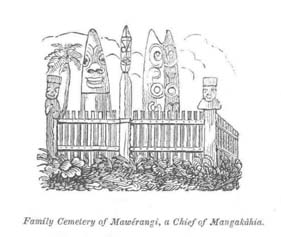
The following cut is taken from the Waitapu erected to the memory of a chief named Mawerangi of Maungakahia, a beautiful valley between Hokianga and Kaipara.
[Image of page 120]
The Waitapu of a native village is generally selected amid a cluster of trees, among which the karaka (a laurus) fruit-tree, is generally found; of course the fruit is prohibited from being eaten. The lovely evergreen (these trees being perennial) and bright yellow fruit, are strongly contrasted with the monuments (raoui ) painted red, that told the tale of the departed. One of the sepulchral posts was nearly thirty feet, the upper part carved into the resemblance of a man, having an expression similar to the ancient Egyptian cast. This figure was represented as perched on a figure with a grotesque countenance, the tongue stretched out as far as the post permitted the member to be ex-
[Image of page 121]
tended, a favourite display with a native artist. The eyes in these figures are inlaid with pieces of the pearl mutton-fish-shell (paua ) each in size to a teacup, the knees formed to project outward, and the legs inclining inward, the feet joining together.
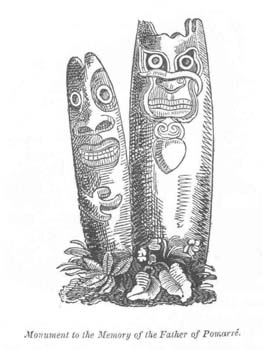
The raouis ' are also made from old canoes, that are no longer allowed to be made use of. The following was placed, by Pomarre, a chief residing at the Bay of Islands, on the tomb of his father, on the estate of Okiato.
[Image of page 122]
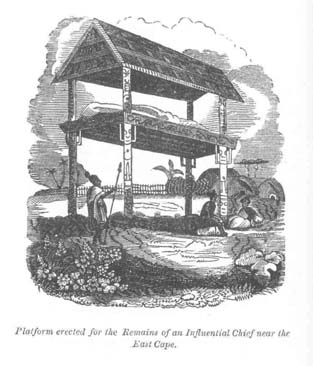
Children are generally buried in old boxes, or between two pieces of a canoe, and placed securely among the branches of trees, even the bones of adult chiefs are deposited in small boxes, after being scraped clean, and then fixed on top of a stout pole. These emblems of mortality are all painted red with the kokowai , and when on the decline, are repainted, and surmounted with numerous feathers. The tomb of Muriwai a celebrated chief, was one of the largest wai tapu erected among this people.
[Image of page 123]
The house in which the bones were deposited had the appearance of a large watch-box, with a shelving roof; it was surrounded with wooden figures as large (but not as natural) as life. Round the top a head-board (maihi ) was affixed, on which a number of obscene figures were carved. The whole was painted red, with a profusion of feathers.
The superstition of the natives adheres so strongly to them, that perhaps not a single person could be found among them, to approach at dusk, near to a wai tapu (literally a sacred place). No sum could tempt them. The spirits (wairua ) of departed chiefs are suspected to haunt the place, and as they are not assured in what form, and firmly believing in the doctrine of transubstantiation, not a bird, however small, can approach those silent places but he is invested with divinity.
We were passing one of these sequestered domains on a journey from Poverty Bay (Turunga ) to Tolaga Bay (Uwoua ,} when we stopped to notice the symbolical carvings on a large tomb, 1 at the
[Image of page 124]
moment a small bird called Piwakawaka struck up its vocal strain, which sounded as peculiarly plaintive in the deserted place. Taura, a chief of those parts and a priest, instantly said, "That is a God
[Image of page 125]
(Atua ) of the place, he is displeased at our disturbing his rest, let us away; we know not what he may do should he be angry. " "Are the native Gods so very revengeful and for a trifle?" we inquiringly demanded. "Very," was the answer. "A friend of mine, went once close to a wai tapu, and six months after, a branch fell on his shoulder as he was felling some trees to make space for a log to form a canoe, it happened in Hawkes' Bay; (Wairoa ) another person I knew, for the same cause, was within a few moons after drowned while bathing, the river god (Taniwoa ) took hold of him. What other cause could it have been," demanded the sagacious narrator, without referring it to a cramp that had seized the luckless wight. We continued our journey, unwilling to offend the rooted superstition of this guide; we essayed however by quiet argument to prove how erroneous such thoughts were, and how unjustly he acted towards a merciful Creator. We next inquired if he knew which of the departed chiefs it was who had just addressed us. Taura replied, he thought he could tell, the voice of the bird resembling a deceased chief named Tupia, who had been a remarkably large-sized man. "Then how could the great Tupia enable himself to enter the little bird, 2 with
[Image of page 126]
a body the size of a karaka, [a fruit as large as an olive] where at best he must feel extremely incommoded." To this the priest observed, "that doubtless Tupia had been minus food for so lengthened a period, that he had shrunk to almost nothing." 3
[Image of page 127]
The New Zealanders have a method of embalming their dead, that is a custom not peculiar to themselves though the method they undertake to perform it may be. 4 The head and body is eviscerated and cooked in an oven after the native method of preparing for preservation the head of an enemy, after which the body is well stuffed
[Image of page 128]
with flax scraped carefully. These native mummies have answered the purposes of the embalmers for many years, but the custom is only practised to the south of the East Cape, where the original manners of the people have been less tinged, if not wholly altered, by the connexion formed with Europeans.