[Chapter XVI]
[Image of page 171]
CHAPTER XVI.
FLAX TRADE.--MUTUAL JEALOUSIES OF THE NATIVE TRADERS.-- ABORIGINAL PEDLARS.--GOOD FAITH IN TRADING.--NET MAKING.-- CARVING.--MENTAL ATTENTION OF THE NATIVES.--DOMESTIC EMPLOYMENT.--WEAVING.--LOOMS.--DRESS MAKING.--QUILTINGS.--VARIOUS KINDS OF FLAX IN USE.--SIMILARITY IN THE DRESS OF THE SEXES.--DISPENSATIONS ON THE SUBJECT.--DYEING.--VARIETY IN DRESS.--ATTITUDES.--LEGIBLE CHARACTERISTICS OF INTERNAL CHANGE.--MUMMY SYSTEM.--SEMI-DIVIDED FEMALES.--GIRDLES AND BELTS,--TRANSFORMATIONS OF MODERN COSTUME.--STATE OF NATIVE TASTE.--EUROPEAN DRESSES.--HOW APPROPRIATED.--FASHIONS AND TASTES.
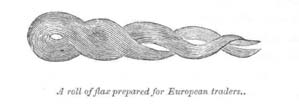
THE occupations of felling timber, scraping flax, and supplying provisions, was the earliest labour required by the Europeans from the New Zealanders. The trade of the two former have been, found to be beneficial to both parties; but not to the extent supposed, as no person who has been engaged, however sedulously, in either trade, has made any profits adequate to the risk he has undergone of both life and property, and the discomforts arising from what may be justly termed banishment from the civilized world. The flax is sold to the trader by weight, and aware of this, the wily sellers have often enclosed heavy stones within the flax to procure a larger remuneration. The flax in a basket generally weighs about from
[Image of page 172]
eighty to a hundred pounds, and is either carried (pikou) on men's shoulders or in canoes, to the house of the purchaser. Most villages have at least one European resident, purchasing provisions and flax; this person is under the protection of the chief of the district, and rarely he is allowed to trade with another tribe, though residing in his vicinity. This jealousy of the villagers is the more to be deplored by the trader, as the traffic during many portions of the year is far from brisk. The rearing of pigs forms a valuable resource to the natives. The Europeans being willing purchasers, for consumption and export. When the villagers are too ill disposed to work for their trader; many of them become pedlars and taking an invoice of such articles as they expect will be accounted as saleable, take journeys by land, but generally by water, and make purchases of the produce or manufacture, which they dispose of to their European, or on board such ships as call at their port or vicinity.
At other times they make journeys on a voyage of many weeks' duration, furnished by the European, with a quantity of articles, which these pedlars sell to good profit for the benefit of the owner, at a reasonable commission. Such transactions are carried on with much good faith by the natives; any deceit on the part of the European would be severely visited. Nor does barter alone form the occupation of men at home; making or repairing
[Image of page 173]
of fishing nets, or seines, some of which are several thousand feet in length, the material being un-scraped flax, is the work of all the inhabitants of a village. In order to ensure completion, which, depending on the will of numerous workmen, might scarcely be expected, the work is made sanctified (kea tapu ) so that each person cannot apply his hands to any other purpose; and in many instances, the parties are not allowed to feed themselves, or personally make use of any sustenance. Many persons also engage themselves in forming or repairing canoes, making paddles, spears, carving holes to place the village trinkets and feathers, building houses and sheds, carving the ornaments, making handles for spades, hoes, gathering seed for planting, drying fish, all of which cause a stir and bustle that agreeably breaks into the monotonous routine of a village life. Conversation of local interest engages the mental attentions of the workmen thus severally employed, ancestral traditions, animosities of tribes, the good fortune of one tribe in battle or agriculture; the ill stars that presided over the efforts of others in similar occupations; the probable assurance of a good harvest, attending their own exertions, or the chances of success in some intended predatory excursion, forms the subject of converse while the work is going forward at a distance from their houses.
In the mean time the females busy themselves
[Image of page 174]
in sweeping their houses as early as their husbands and children have left them, and arranging with neatness the very little furniture that cannot be said to encumber their place. Ablution then follows, much care and attention to the head-dress being paid, that at once denotes the difference of sex in every part of the globe. After all the little arrangements are completed, weaving of garments is next attended to, at such periods when the lands are either prepared for planting, sowing, or the reaping has finished, in each of which the females also assist; they next engage in such employments as all natives regard as belonging peculiarly to their department, such as washing the clothing of the household; and in the vicinity of Europeans, bleaching, ironing, and sewing, which is performed in a very creditable manner. The weaving of dresses is a favourite and truly feminine performance, as it agreeably passes time, that with civilized people is supposed to pass too quick; but to a barbarous unemployed people too slow. Weaving is the most social of all occupations, as the working of a dress is the performance of many persons. Generally a mat is worked in a small shed, where the gossips of a village assemble to discuss the affairs of the primitive state. Some stakes are forced into the floor about six feet apart, on which cross-wise the frame is formed. The size of the mats varies from three feet square to five in width, by seven in length. The work is exces-
[Image of page 175]
sively tedious, as neither meshes nor needles are made use of, but continual use renders the ladies extremely accurate in working the entire dress of the requisite width. To a European the method appears the most tedious operation that can test temper or lose time; but the latter is of no moment to these people. It affords a vast fund of amusement to the ladies of a village. As early as a dress is undertaken by a wife for her lover, husband, or child, she gives notice of her intentions to the neighbours, who generally promise their aid to discuss the matter. These meetings resemble similar meetings of the sex in many parts of the globe, and villages of European provinces which are termed by the Americans "quiltings." In these meetings every subject that can be thought of is discussed, with the appellations passing current among each other of "my dear," "my love," etc. as made use of by civilized folks. The common mats wove by the females are subject to less care The costume of either sex has no material difference in shape, as the materials are alike. 1 The flax (korari ) forming the dresses is of two or
[Image of page 176]
three kinds; the most coarse, called muka, is employed for working the common garment (kakaou maori.) This flax is also made use of for laying up ropes, lines, &c. The superior dress called Kaitaka, 2 is made from silken flax, (hunga hunga.) This is often produced in an elegant manner, being formed by hand, of a quantity of threads as glossy as silk, and bound cross-wise half an inch asunder. Every coloured wool or cloth the weavers are enabled to procure are also worked in the mat; to the bottom is appended a deep rich heavy border, of sometimes a foot in depth, of a variety of patterns that evinces much taste and ability in design, with
[Image of page 177]
a substance the needle rarely produces. Dyeing is much used by the females, but from white to a red and deep jet black, the sole colours obtained, by steeping the prepared flax in water, with the bark
(sometimes crushed) of certain trees; the process is so rude as to rot, and damage the texture of the article in some degree. The smallest garment woven is called the patai , principally worn by females for an inner garment; the korowai differs but little from the former, except in having a deep fringe of knotted flax strings. The tatata is similar in size to the former, having pending from every part, an infinity of small cords six inches long, of no use or ornament; its origin must be ascribed to the arbitrary taste of fashion. The dress formed of the feathers of the kiwi kiwi bird has been mentioned for its rarity; but the clothing of the birds of the shore and ocean are made use of to form a garment; a strong matting being the substance on which the ingenuity of the Chiefs is expended in obtaining the aerial garment. In pursuing this occupation among the females, the warrior forms no bad idea of the gallant Hercules at the feet of Omphale. A valuable garment for the stormy
[Image of page 178]
climate of the southward is called neri , and is made of undressed flax or of the kierakiki , a species of rush, impervious to rain. This garment is made on the principle of thatching a house; and a native habited in this rude but comfortable cloak, when sitting down, would be taken by an English rustic for a hay-cock; a black shock head peering out, alone destroying the deception. The sitting attitude to avoid rain, is for the knees to become supporters to the chin, and in this attitude a number of natives resemble a commonwealth, of beehives. A knowledge of the art of weaving dresses appears to have been coeval with the earliest settlement in the country. The flax-plant, growing in infinity and variety, has been the staple source from whence the inhabitants have obtained their dress and finery. The costume is decidedly modest and becoming, as simple as uniform. A native will rarely habit himself in more than two garments, but the introduction of the invaluable blanket, has changed the patriotic taste of the people from flax to wool. Costume may be said to be a distinguishing feature, delineating the character of a nation; and as barbarism annually gives place to civilization; a legible characteristic of the internal change is externally presented by a change of costume. The phlegmatic Dutchman with antiquated hose is not more distinguished from the mercurial Frenchman; than the New Zealander residing in distant villages of the interior, from his brother countrymen
[Image of page 179]
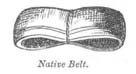
residing in the vicinity of Europeans. All early nations were habited in similarly formed garments, arising from a dearth in industry; and in New Zealand, from the paucity of articles fitted to form clothing for mankind, as neither the cotton-plant, silk, or the palmiferous tribes, as the cocoa, sago, grows in the country. The children walk in nudity until they arrive to six or seven years; they have consequently a vast advantange over such little people who are compressed in bandages and long cloths; and whose infant limbs are paralyzed in the mummy fashion of Europe. Nor are the ladies subjected to those abominable ligatures round the waist, that are carried to such an extent by the fair of New York, as to start a question among our American brethren worthy of the Consistory Court; whether a lover does not subject himself to a charge of bigamy by marrying such semi-divided females; the idea is worthy of so strait-laced a people. The native costume is to fasten by strings the lesser garment round the waist; the open part closing at the right side, the extremity reaches half down the legs: for a Chief the best flax is appropriated to work this garment. A flax or leathern belt is fastened over this dress, in which a tomahawk is placed, and often a car-
[Image of page 180]
tridge-box with powder and ball. The females attach their garment immediately under the breast; girdles of flax are also made use of. Coverings for the head (potai ) are rarely made use of. The natives set great store by all articles of European dress, and are proud to possess the cast-off finery of the army. As they are wholly ignorant of our immediate fashions, so they are defective in their ideas of correctly appropriating the dresses they may obtain. Many of those natives unaccustomed to see Europeans in numbers, are unconscious of the wear a cloth garment may have sustained; and a court-dress of the days of King Ahasuerus of Syria, or Louis Phillippe of France would be accounted as equally modern in fashion: a particoloured seam in a garment of unmentionable appropriation, is accounted no drawback to many of the southern tribes, and a round-about jacket over a naked body. Stockings or shirts worn round the throat; shirts turned into trousers, the arms answering for the legs; crownless hats; a jacket put on, the front buttoned behind; a stocking on the arm; trousers put on, the seat in front, and buttoned behind; shirts pendent as aprons; the arms being tied round the waist, &c., are the effects of a taste in dress, decidedly uncontemplated by the original manufacturers. These primitive votaries of fashion delight to insert themselves within a small cloth coat, over the naked body, while they contrive to button the shrunken habiliment over an
[Image of page 181]
ample chest, and a body perspiring at every pore; the arms of the wearer being pinioned as civilians would incarcerate a lunatic within a strait waistcoat. The males often appear in the gowns of their wives; and if the latter possess several, it is not unusual for the husband to put them all on his body, arranged in such manner as to show off a portion of each; the ladies placing their gentle proportions in the trousers of the male; a fashion (an ideal one) we believe to be not wholly repudiated by the sex in Europe. Agreeably to the imitative taste of the people, any new fashion, however preposterous, is immediately followed,