CHAPTER IV
[Image of page 39]
CHAPTER IV.
PRESERVED HEADS. ----PROCESS EMPLOYED. ----AND RESEMBLANCE RETAINED OF THEIR ORIGINAL STATE. ----EXCISION OF THE TONGUE. ----SERVICE RENDERFD BY DECOLLATION. ----PRACTICES IN CONNECTION WITH DECAPITATION. ----BRITISH COMMERCE IN PRESERVED HEADS, PROHIBITED BY GOVERNOR DARLING. ----ON THE MOKO OR PUNCTURING THE BODY, ---- DISTINGUISHING TRAITS UNOBSERVABLE TO EUROPEANS, ITS ORIGIN. ----PURPOSES FOR WHICH IT WAS ORIGINALLY USED. ----MADE SUBSERVIENT TO IDOLATRY. ----TORTURES INFLICTED BY ITS PERFORMANCE, AND EFFECTS WHEN PERFORMED. ----EXPERTNESS OF VARIOUS TRIBES IN THE ART. ----THE PINTADOS. ----PERFORMED ON EUROPEANS. ----MEDICAL EFFECTS. ----REPRESENTATIONS PRODUCED ON THE HEAD AND BODY. ---- CURIOUS INSCRIPTION ON THE BREAST OF A SAILOR. --EFFECTS ON AGE. ----INSIGNIAS OF A TRIBE. ----SIGN MANUALS OF CHIEFTAINSHIP. ----PROFESSORS IN THE ART OF TATTOOING. ----CONVEYANCING OF ESTATES ----FEMALE PUNCTURING. ----ITS DECADENCE.
THE trophies of native warfare consist in the slaves captured, and the tattooed heads of the enemy, which are cut off, and preserved after the peculiar manner of the country. The brains, eyes, and tongue are extracted, and the interior of the scull carefully cleansed from any putrefying remains; the inside is filled with dressed flax, and the skin hanging from the neck is closed up, being drawn together like a closed purse, it is then demi-cooked by the steaming process peculiar to the people, and the fat carefully wiped off, it is then exposed to the strong rays of the sun, and at night to the smoke of a wood fire, which is sufficient to preserve it for many years, with an occasional airing,
[Image of page 40]
as a preservative from damp. Heads that have undergone this unnatural process, become remarkably contracted, the original likeness is well preserved, but often the head of a powerful full-grown man, shrinks in size to that of a boy of ten years. These deplorable remnants of mortality are often produced 1 as the "return killed" of the conquerors. They are placed on poles in the most conspicuous part of the village, and are produced as guaranties of the valour of the tribe, on gala days, and on the reception of noble visitors. Some of those heads have the horrible expression the face assumes on meeting with a violent death, the black bushy beards and whiskers strongly contrasting with the awfully cadaverous colour of the skin. These heads are often more serviceable, after life is extinct, in preserving peace, than they could have boasted of being, while gifted with health and
[Image of page 41]
vigour, as when a peace is to be ratified, the captors carry those remnants of mortality to the surviving friends, and if peace is effected, they are immediately returned to them. On a family viewing the heads of their departed relations, they burst forth into cantatory impromptu's, expressing admiration of the courage and affections of the deceased, and work themselves into furious passions, expressive of the cruelty of their enemies, who could thus cruelly deprive them of the company of those relatives, whose esteemed affections are to gladden their tribe and relatives no longer. Preserved heads are not always returned, 2 as when the conquerors despise the numbers of the inimical tribes, these heads are sold to Europeans, who have been found sufficiently depraved to trade in such objects of horror. We believe that some years since they were absolutely entered into the books of the Customs of Sydney, New South Wales, under the head of "imports," until the humanity of Governor Darling rendered criminal the nefarious traffic, and its being persisted in liable to a rigorous prosecution. Many a battle and predatory excursion has been undertaken, expressly to obtain "choice tattooed heads" for British traders, to
[Image of page 42]
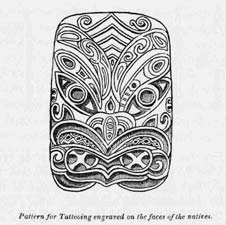
supply the wants of the public museums in Europe, and the private tastes of domestic connoisseurs. E'Moko or the art of tattooing is universally practised by the New Zealanders, and is one of those prominent facts, (yet persisted in,) that incontestably proves the Asiatic origin of the people. 3 The men chiefly delight in these stains and incisions which are so far from being confined to one fashion or pattern, that tribes are known by such distinctive marks, and many chiefs whose countenances have never been seen by a distant tribe, are known,
[Image of page 43]
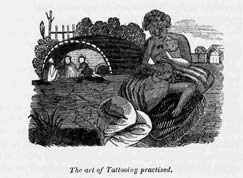
simply by the distinguishing mark which has been peculiarly engraved on their countenances. We had several opportunities of testing this fact, from having taken some likenesses of the chiefs residing at the north, and on showing them to some families resident at a distance upwards of 400 miles, they were immediately distinguished and named, though no connexion existed between those persons, or had they even at any period seen each other. Yet to Europeans unobservant of national characteristics, and to new coiners in the country, the marks of the moko appear as if performed by the same person from the same pattern, but the contrary is the fact, an exceedingly marked difference exists. The process of puncturing is attended with intense pain, the victim to this curious fashion, lies recumbent, wincing and writhing at every stroke given by the operator, the body quivering under
[Image of page 44]
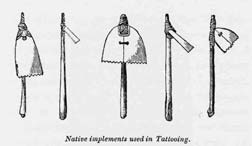
the torments inflicted. The head of the patient rests for convenience on the knees of the artist. The pattern about to be engraved is painted in lines, by a small piece of stick dipped in powdered charcoal and water. The first attempt is applied to the lips, then the forehead, cheeks, &c., are submitted to the same process. The implements made use of are formed of bone, or hard wood, fashioned like a chisel, which is made to cut deep in the flesh by a smart tap applied to the handle.
The blood gushes forth at every stroke, which the puncturer carefully wipes away with a piece of scraped flax or the end of his garment. Charcoal is afterwards powdered and let into the wounds, (gunpowder has often been substituted,) which leaves a blue mark, that time can never wholly efface. 4
[Image of page 45]
Tattooing is generally commenced at an early age, but the pain attending the operation is so intense, that many years elapse previous to this facial decoration being completed. After a series of years, some chiefs have had the courage and patience to be retouched and renovated. The moko is not confined to the face, as the breast, arms, hands, thighs, and breech are similarly decorated, that so much astonished the Spaniards when they discovered the Philippine Islands, that they termed the natives Pintados, or painted people.
The nice exactitude of the lines represented in the moko, is scarcely to be surpassed, displaying
[Image of page 46]
the fancy and taste of the artist. Notwithstanding their variety, the designs, it would appear, have been in vogue from time immemorial. Several Europeans have disfigured themselves with these barbarous embellishments, and the contrast of the blue lines on a livid complexion in appearance has a disgusting effect. Notwithstanding its adding a ferocity to the native aspect, yet habitude relieves us from viewing the moko with displeasure, and in some faces it is not wholly unbecoming. 5 Swellings and inflammation
[Image of page 47]
follow puncturing as practised by the New Zealanders, and death has even been known to have ensued in consequence. It has the peculiar effect of adding the appearance of premature age to a young person, and a contrary effect to the face of an adult. Persons at all ages and of all ranks who possess means or influence to obtain it, get tattooed, chiefs, freedmen, hereditary bondsmen, and slaves. Though often a distinctive insignia for a tribe, yet it is no sign of rank, as warriors are captured at all ages, marked or otherwise, and no apparent difference exists in the society of a kainga maori or native village. Some adult chiefs may be seen
[Image of page 48]
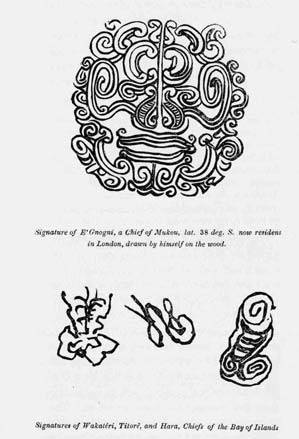
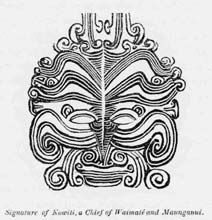
without a single line on the face, whereas some young persons have punctured their bodies absolutely black with the quantity of circles and figures lavishly bestowed on themselves. In the flight of an army or in the butchering of prisoners, those heads that are best punctured are decollated at the neck, for future preservation, but the possessor of an unmarked head is battered and crushed with the most savage brutality. Tattooing is the sign-manual and crest of a native chief. In title-deeds of land-purchases, or receipts of any description, the moko or fac-similes on the face of a chief are correctly represented by him on paper. 6 The initials or crest on the seal attached to the watch, or ring of a European is accounted by a native as the "moko" of its owner. They take much pride in adding the various curvatures of the moko to their signatures, and our risibility has often been excited in viewing an aged chief, whose scant locks had weathered upwards of seventy winters, drawing with intense care, his signature, with inclined head and extended tongue, as is the wont of young European practitioners in the art of penmanship.
[Image of page 49]
[Image of page 50]
The professors in the art of puncturing are regarded by their less able countrymen, as men of great talent, and are held in much repute. Presents and payments flow into their coffers from all quarters, according to the means or ability of the chiefs. Double-barrelled pieces, canoes, clothes, and even slaves, have been presented as a convincing proof of the esteem in which their talents have been held. The natives of the East Cape are accounted as particularly clever in this art, and when slaves have been acquainted with it, their advancement from, bondage has been immediate. The females are also tattooed, but in a trifling degree. Their favourite marks are horizontal lines even
[Image of page 51]
with the form of the mouth on their lips, and a few lines between the eye-brows. 7
Tattooing is now getting into disrepute, and within a very few years, from the increase of colonists arriving from every quarter of the globe, the practice will be altogether discontinued.