CHAPTER XVI: THE GEOLOGY OF NEW ZEALAND.
[Image of page 219]
CHAPTER XVI.
THE GEOLOGY OF NEW ZEALAND. 1
THE solitary position of these Islands, separated by such a wide expanse of ocean from the continent of America on the east, and Australia on the west, their size and extent forming a belt of more than a thousand miles in length, together with our recent acquaintance with their existence, give them a great Geological interest.
When we look at the map of the World, we cannot fail to observe the apparently continuous line of islands which stretch
[Image of page 220]
THE GEOLOGY OF NEW ZEALAND.
southward from Japan to New Zealand. 2 These at once strike the eye of the Geologist, as being the disrupted fragments of an ancient continental line; nor can we help noticing that its general direction is parallel to another, extending from the Asiatic Continent, along the entire length of Australia, and further that these two, closely correspond, in the direction they take, with two others, which are on a still grander scale, 3 the first comprising the entire western coast of the two Americas, the other taking in, the western sides of Africa and Europe.
These four continental lines may, therefore, be termed the grand costae, or ribs of the world, since they have withstood all those convulsions which have so materially changed the face of our globe, and very probably submerged the far greater portion of the southern hemisphere. They moreover possess such distinctive features both in the character of their Botany, Zoology, and Ornithology, as to mark each of them as being a separate centre. Australia differs in its various productions, from every other part of the globe. New Zealand, also, as widely differs from it as the former does from the rest of the world.
If any weight be due to these conjectures, the New Zealand Isles, as the remains of one of these continental lines, may claim an equal antiquity with them, and thus destroy the common idea of their comparatively recent origin. That they have been constantly undergoing changes in their length and breadth, and that they are still far from being in a state of
[Image of page 221]
THE GEOLOGY OF NEW ZEALAND.
quiescence experience proves, but that their general framework is as ancient as that of other parts of the earth's surface, appears highly probable. 4
The Geological features in New Zealand are clearly marked; so that there is no difficulty in detecting the character of the agent employed.
New Zealand may be properly called a volcanic country, since it contains a long line of craters which extend from one end of the country to the other; in fact, nearly half the mountains in the country are extinct craters: volcanic action, however, seems to have been greater in particular localities. In the north the centre was at Otaua, near the Bay of Islands, which is a very remarkable district. An immense crater rises above the level of the surrounding country, with steep precipitous cliffs of pipeclay, which, on the summit, incline inwards, so as to form a vast bowl several miles in diameter. This appears to have been, formerly, one huge crater; but when that became exhausted, a series of smaller ones broke out on the sides, which are still, more or less, in operation, and are chiefly filled with water of great depth from which streams of gas escape in every part. One of these crater lakes contains white mud, which bubbles up in all directions; in another, the heated gas is emitted from innumerable pores, the highest degree of temperature being 196 Fah., the ground seems to be constantly subsiding; probably in the same degree as the mud is ejected from the neighbouring spots. It is very evident, that after the grand crater became extinct, it was covered with a most luxuriant growth of Kauri timber, the leaves of which, in some places, formed a turf stratum of nearly twelve feet in thickness; and in every part the immense roots are still perfect in the ground, the smaller ones being encased with pure sulphur. The lakes also are filled with timber; and even the leaves and cones of the trees are as fresh as though they had just fallen from them. 5
[Image of page 222]
THE GEOLOGY OF NEW ZEALAND.
The surrounding plain of Taiamai, is covered with scoria and large masses of rock, which have, evidently, been ejected from some of the many neighbouring craters. There are also large quantities of vesicular iron, the pores of which appear to have been filled up with pipe-clay mud.
Near Pa Karaka there is a remarkable volcanic cone, upwards of four hundred feet high. The mountain is hollow, and may be descended full three hundred feet, the sides are vitrified, and the small space at the bottom is covered with masses of rock and timber. At a little distance from the mountain there is a small lake whose surplus waters have a subterraneous outlet, and from the neighbouring scoriaceous rock, gas is emitted in such quantities and force, that a bladder applied to one of the orifices may be easily filled.
Pukenui is another extinct volcano, in the same neighbourhood, having at its base a fine lake called Mapere. On the opposite side rises a remarkable hill called Putai, formed entirely from the deposit of boiling springs, which once abounded there. The mass of the hill is a soft, ochreous substance, filled with minute plates of mica; on the top are several remarkable apertures of great depth, through which, doubtless, the hot water was ejected; at the base are innumerable chasms of considerable depth, from some of which gas still escapes. Lava streams and basaltic rocks abound in all this region, clearly marking it as having once formed a grand centre of action; the range of which extended as far north as Wangaroa Harbour, which contains incontestable proofs of fearful disruptions and upheavements.
Passing on to the vicinity of Auckland the attention is at once arrested by the number of ancient craters, which arise from the surrounding plain. There are several remarkable subterraneous lava passages, 6 and partial subsidings, which
[Image of page 223]
THE GEOLOGY OF NEW ZEALAND.
are well worth being noticed. The lava has, in many places, flowed under ground at such an inconsiderable depth as to bake all the superincumbent earth to the consistency of brick, which frequently contains beautiful impressions of the leaves of trees, which formerly grew on the surface.
The next centre appears to be Waka-ari, White or Sulphur Island, which with its neighbour Moutohora, Whale Island, is still in action; the latter indeed is chiefly filled with solfatara and hot springs; but the former is a volcano rising out of the sea, from the crater of which a volume of smoke is always ascending, which is visible at a great distance. Large masses of sulphur are there produced, and the varied form and character of the molten rocks of this crater are very interesting.
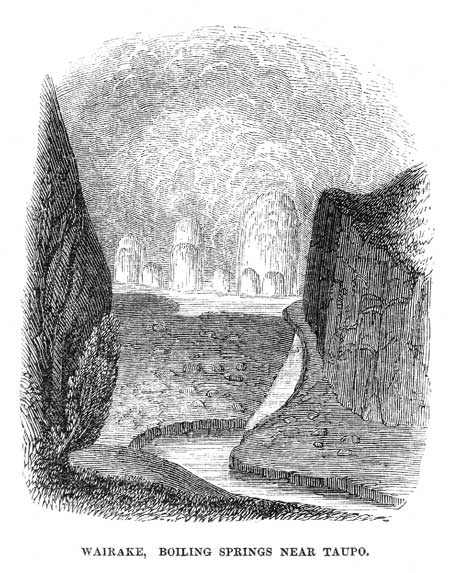
The grand centre of volcanic action extends from White Island to Rotorua, and thence by Taupo and Tongariro to Wanganui, a distance of nearly 200 miles, forming a continuous line across the entire width of the island. The number of boiling gulfs, solfatara, and boiling mud pools in that line is extraordinary. They are seen in every direction--in the forest, in the plain, and in the water. A large number of them are concentrated at a place called Tikitere, and a most extraordinary assemblage of them is found at Ohinemotu, which renders that place one of the most remarkable in New Zealand. At Paeroa, near the Waikato, there is one of the largest of these mud pools; it is from sixty to a hundred feet wide; in the centre, first an enormous bubble of mud arises, which gradually increases in height and size, and at last becomes a jet of mud eight or ten feet high, with several smaller ones on each side; the mud is thrown up in large masses on the sides, where it dries, and assumes a cubical form; it readily separates into laminae of different thickness, which bear a very close resemblance to slate, and, perhaps, in this mud vortex is to be seen, on a small scale, what was once the state of a large portion of the earth's crust, during the formation of slate.
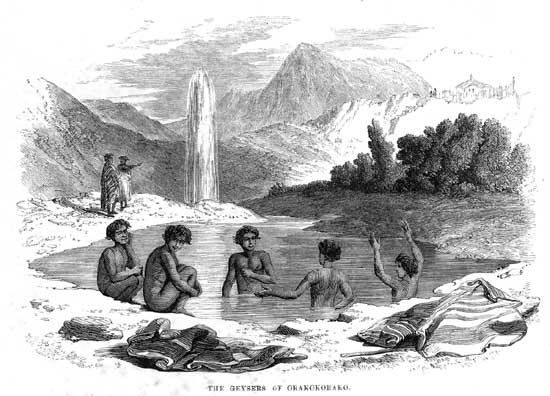
At Orakokorako, on the Waikato, the boiling springs are
[Image of page 224]
THE GEOLOGY OF NEW ZEALAND.
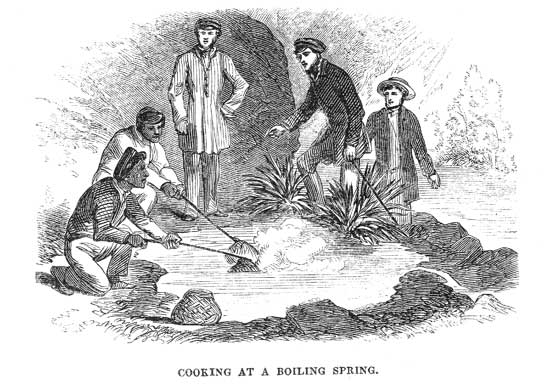
almost innumerable; some of them shoot up a volume of water to a considerable height, and are little, if at all, inferior to the Geysers of Iceland. A village is placed in the midst of them; the reason assigned for living in such a singular locality was, that as there is no necessity for fires, all their cooking being done in the hot springs, the women's backs are not broken with carrying fuel, and further, from the warmth of the ground they were enabled to raise their crops several weeks earlier than their neighbours; but, as a counterbalance for these advantages, many fatal accidents occur from persons, especially strangers and children, falling into these fearful caldrons, and being boiled.
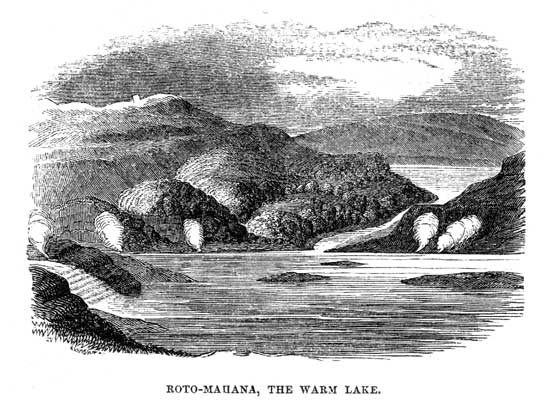
Rotomahana, a warm water lake of considerable size, is surrounded with innumerable boiling gulfs; in fact, it is itself nothing but a crater, the sides of which are full of action; it is perhaps one of the most singular places in the world, its boiling gulfs, and natural snow-white terraces formed from silicious deposits are as wonderful as they are beautiful. Thence to Hohake and Rotokawa there is nothing to be seen but jets of vapour, and so on to Taupo, where fearful boiling gulfs abound at the two extremities of that noble lake, at Rangatira and Tokanu. One of the boiling springs at Tokanu possesses the property of changing the nature of anything which may be placed in it, and converting it into a beautiful silicious substance of pure white, and this is done without any apparent addition of matter; but if the article be not entirely immersed, having only the water flowing about it, then it becomes enlarged by a silicious deposit upon its surface. The process of thus converting wood into stone is very rapid, and in some localities, water does not appear to be a necessary agent in accomplishing this change. At Rotorua, large pieces of wood are thus lignified by the aid of heated gas, highly charged with sulphur, alum, and iron, or other chemical substances, which penetrates the pores of the wood, and fills them up with silex, converting them into agates, and even giving them the transparent form of chalcedony.
Again at Roto-aira, a beautiful lake at the base of the Tongariro range, which attains an elevation of 10,236 feet,
[Inserted page]
[Image of page 225]
THE GEOLOGY OF NEW ZEALAND.
boiling springs abound. Tongariro itself is not so lofty, but from its cone, it constantly belches forth a volume of smoke, and occasionally of flame, which has been distinctly seen at a distance of a hundred and fifty miles, 7 and although the powers of this fearful volcano appear to have long lain dormant, there is no security that it will not break out again. The size and active operation of Mount Erebus appear to be the greatest security of New Zealand, and that crater may be viewed as its safety-valve; for, if anything were to impede its operation, the entire line of New Zealand craters would, very probably, break out again. Lofty as Tongariro now appears, there is reason to suppose that its present height is much less than it was formerly; or rather, that the grand crater of former days has sunk down, and, in doing so, caused Mount Taranaki to rise up. This is agreeable with native tradition, 8 and, moreover, with the general features of the spot, a space of nearly twelve miles intervening between the two principal mountains, Tongariro and Ruapehu. This, at a distance, appears to be an elevated table land, but it is, in fact, a deep lake.
The matter ejected from these craters has been immense, chiefly pumice stones and sand: formerly, the central plains had a super-stratum of yellow ochre, and were heavily timbered. The hot pumice ejected from the neighbouring volcanoes, appears to have first charred the forest and then covered it to the depth, in many places, of a hundred feet, and wherever there
[Image of page 226]
THE GEOLOGY OF NEW ZEALAND.
is a deep ravine, the charred timber is seen jutting out in large masses. This deposit, in some places, extends a very long way; and, even at the mouth of the Wanganui, the low lands are deeply covered with it, as well as with solid lumps of charred wood. That Tongariro has caused the formation of the great Taupo lake, by the subsiding of the land to supply the place before occupied by so much ejected matter, appears certain; and further, that this occurred at different intervals is also evident; for, although the ancient extent of the lake was nearly double what it is at present, it seems to have become wider and deeper than formerly. Many trunks of trees are still visible in its waters, which were there when the country was first peopled, and are so well known that each bears the name of some ancestor. What is here said of Taupo, applies to all the neighbouring lakes as well; but whilst their basins were thus formed to the extent of the matter ejected, it is evident that the throes of the volcanoes mainly contributed to the elevation of the country. From the sea to the base of Taupo there is a regular series of stages, one rising higher than another, until we reach the central plains of Tongariro, thence the country gradually slopes to the north. But although much of the upheavement of the land occurred during the time these volcanoes were in eruption, it is also evident that even yet the land is rising. This must now solely be attributed to the agency of earthquakes. The southern and central parts of the island appear to be the principal seat of their action; and though, in general, the shocks are slight, yet, periodically, every five or six years, they have been more violent, and attended with more serious consequences. In the year 1843, Wanganui was the chief centre of volcanic movement; most of the chimneys in the little settlement were thrown down, the church was much injured, and the earth opened in parallel fissures; the cliffs had every appearance of being upheaved a foot on one side of the river, whilst the ground on the other side, perhaps, subsided as much. The shocks invariably came from the same quarter, W. N. W. 9
[Image of page 227]
THE GEOLOGY OF NEW ZEALAND.
Much sulphureous gas also escaped, which, for a time, affected the health of the place. The movement seemed chiefly to follow the course of rivers, whose channels may be regarded as fissures on a large scale.
The next alarming one took place about two o'clock on Monday morning, October 16th, 1848, when a series of heavy shocks were felt. This last visitation established one interesting fact, that the disturbing cause is not stationary: the quarter from which it proceeded had shifted since the year 1843 from W. N. W. to W. S. W.: it afterwards, however, returned to its former quarter. The shocks appeared to commence gradually, and were preceded by the usual loud rumble; the principal one lasted full four minutes. The movement was very violent, and although the motion seemed to come from the west, the same as in all preceding ones, still it was more from the south than usual, and there was also a lateral vibration noticed in this as well. The shocks lasted near an hour. At Wanganui they cracked some chimneys, injured the baker's oven, and shook down a few bricks and some plaster in the church; but, with those exceptions, they did very little injury there. This earthquake was followed by a disagreeable smell, and head-
[Image of page 228]
THE GEOLOGY OF NEW ZEALAND.
aches were quite general. After these shocks large quantities of bitumen or asphaltum were washed up on the coast; some pieces were of considerable weight. At Ohau, much gas was ejected from circular openings. But the grand centre of action was at Wellington, where most of the houses were more or less injured; indeed, there was scarcely a brick building left standing, or a single chimney which was not thrown down. Several fissures were formed, and the land was raised so much that the small craft which were accustomed to anchor close in shore, were obliged to change their ground. 10 On the 23rd of January 1855, the south-western part of New
[Image of page 229]
THE GEOLOGY OF NEW ZEALAND.
Zealand was again visited with the most severe earthquakes which have occurred since it has been known to us. The native church at Wanganui was thrown down, as well as the chimneys
[Image of page 230]
THE GEOLOGY OF NEW ZEALAND.
of the Mission-house. In various parts the ground opened, so that some places appeared as though they had been ploughed up in furrows. Largo quantities of gas and water were ejected from many circular apertures, around which mounds, several yards high, were formed; the ground was so intersected with deep ravines as actually to stop all travelling for a time. At Wellington, the harbour is stated to have been raised full four feet and a half, and similar changes to have taken place in every part of the district. 11
[Image of page 231]
THE GEOLOGY OF NEW ZEALAND.
In fact, the raising of sea-beaches is a very common occurrence, and in every part of the island numerous instances are to be seen, several of which have occurred during my residence.
[Image of page 232]
THE GEOLOGY OF NEW ZEALAND.
But although there is abundant proof of upheavement still going on in the Northern Island, it is trifling when compared with that of the Middle Island. The Nelson paper of
[Image of page 233]
THE GEOLOGY OF NEW ZEALAND.
September, 1847, states, that the hull of a vessel was lately discovered on the western coast, lying two hundred yards from high water mark, with a small tree growing through its bottom.
[Image of page 234]
THE GEOLOGY OF NEW ZEALAND.
The vessel was supposed to be the Active, which was lost in 1814. How great an alteration must that locality have undergone since it was stranded there, when in a period of thirty-
[Image of page 235]
THE GEOLOGY OF NEW ZEALAND.
three years the ocean had retired to a distance of two hundred yards from the shore; or, in other words, that part of the coast has risen to such an extent as to remove the hull of the vessel so far beyond high water mark. There is good reason to suppose that this upheavement of the coast is not confined to one spot, but has extended the entire length of the island.
From the evidence of a person who was formerly engaged in sealing at Dusky Bay, as far back as the year 1823, it appears that from 1826 to 1827 there was an almost constant succession of earthquakes, some of which were sufficiently violent to throw men down. At times, he and his party, who then resided on a small island, were so alarmed lest it should be submerged, that they put out to sea: there, however, they found no safety, for such was the flux and reflux of the ocean, that they were in the greatest danger of being swamped, and were thankful to get on shore again. The sealers were accustomed to visit a small cove called the jail, which was a most suitable place for anchorage, being well sheltered with lofty cliffs on every side; and having deep water in it close to the shore, so that they could step out on the rocks from their boats. It is situated about eighty miles to the north of Dusky Bay. After the earthquakes the locality was completely
[Image of page 236]
THE GEOLOGY OF NEW ZEALAND.
altered; the sea had so entirely retired from the cove, that it was dry land. Beyond Cascade Point the whole coast presented a most shattered appearance, so much so that its former state could scarcely be recognized. Large masses of the mountains had fallen, and in many places the trees might be seen under the water.
From these circumstances, it is evident that the Middle Island is rapidly rising, and of this fact there are other proofs to be adduced. The climate has undergone a great change, which can only be accounted for by the increased elevation of the land. Coal measures appear at Massacre Bay and Molyneux River, intermingled with abundance of Kauri resin. This noble pine is not now found growing within ten degrees of latitude north of Molyneux River. In no single spot within that wide range is a Kauri tree to be met with. Hence we conclude that the climate has considerably altered, since that carboniferous deposit was made; but it is not necessary to go back to the probably remote period of its formation. The Kauri resin is still found on the surface of the land, with every appearance of its having had quite as recent an origin as that picked up in the north. It is most probable, therefore, that the tree has grown in these latitudes at a comparatively recent period. This beautiful pine does not appear to require heat, so much as shelter and humidity. If, then, as we suppose, the land was formerly low in that latitude, the climate would necessarily be humid and mild, the cold being tempered by the sea, and not increased by the propinquity of snowy mountains; thus the Kauri might have flourished there, as well as other trees which now belong to a warmer climate. 12*
[Image of page 237]
THE GEOLOGY OF NEW ZEALAND.
Another proof to be adduced in favour of this hypothesis is the Moa (Dinornis), the gigantic ostrich of these islands. The struthious race of birds exclusively belongs to a mild climate; a warmer one than that where the remains of the Moa are now found. Formerly, not only were these birds numerous in the southern parts of the North Island, but in every part of the Middle Island as well. The remains of the gigantic Moa are seldom found without their being intermingled with those of several different sized species of the same bird. Hence it is to be inferred that the climate was once suitable for them, since they abounded, and at a com-
[Image of page 238]
THE GEOLOGY OF NEW ZEALAND.
paratively recent period too, for their bones are found in only a partially fossilized state. To what then can we ascribe their extinction, but to a change of climate? Man has nothing to do with their destruction. 13 That they existed at a comparatively recent period is proved by their bones. Native tradition also asserts it, as there are still songs of hunting the Moa extant. It is yet to be ascertained whether it is not still alive in the Middle Island. 14
The character and general features therefore of the Middle Island have undergone, and are still undergoing, a rapid change. As the mountain ranges become more and more elevated, the
[Image of page 239]
THE GEOLOGY OF NEW ZEALAND.
climate must be proportionably refrigerated. Nor will this be the only change effected: large tracts of level land will be also upheaved. That this has already been the case to a considerable extent is evident from the extensive plains on the eastern side; that it is still going on is also evident from the observation of every one who is acquainted with the island. Large mud flats are now being formed at the mouth of almost every river, and there are low plains covered with timber, which are scarcely above the highest tides. That this will continue to be the case is most probable. The rapid streams and rivers flowing from the adjacent lofty mountains must bring down immense quantities of stone and soil, which Nature in her secret laboratory is preparing to form future plains for man's use. The courses of these streams, or rather torrents, being so short, and the mountain sides so sharp and precipitous, as to be acted upon by every storm, vast masses are thus being continually detached, having been previously loosened by earthquakes; entire sides of mountains frequently slip down; the heavy rains increasing the body of water in the rivers, aid in transporting their debris to the ocean bed, where they are dispersed and spread out, layer above layer, until repeated upheavements lift the whole to the surface, first as mud flats, then above the level of ordinary tides, when it speedily becomes covered with a luxuriant vegetation.
[Image of page 240]
THE GEOLOGY OF NEW ZEALAND.
This leads to the consideration of the sedimentary deposits. These are chiefly marine or lacustrine. The marine are formed in the way already mentioned, and the shoal seas around a great portion of these Islands mark their extent. On the western coast of the North Island, it is evident vast tracts of land have been gained from the sea, by the deposits of the Wanganui, Rangitikei, and Manawatu rivers. Near the coast, in that part, the land is generally low, covered with gravel or shingle, and with large quantities of drift timber; inland it is alternate swamp and grass with parallel ranges of ancient sand hills, now covered with a growth of fern. Near the sea, and especially near the mouth of rivers, large quantities of sand are blown up from the shore, and form drifting sand hills. This is, evidently, a portion of the matter brought down the rivers by the floods; the mud being precipitated to the bottom of the sea by the coagulating action of the salt water upon it, there gradually forms a compact mass: but the sand having nothing to fix it, is, by constant attrition, washed finer and finer, and then thrown up by the high tides in large quantities on the shore, whence the sea breeze speedily conveys it inland.
The vallies of New Zealand are not numerous or extensive; indeed the almost entire absence of them, and the acute pointed hills, which are only separated from each other by deep ravines, are to be considered as amongst the peculiar features of this country, and as most of these have never been touched by the hand of man, they enable the Geologist to observe the exact state in which they were first upheaved. The remarkable way in which the surface of these Islands was fractured when first elevated, is yet to be observed as plainly as though it had recently taken place; for whilst one side of a hill is covered with the debris of primitive rocks, gravel, and vegetable mould, the other is either ochre or pipe clay, destitute of any rolled stone, without soil; the fern also on one side is of a more luxuriant growth than on the other. 15
Another kind of sedimentary deposit remains to be noticed, --
[Image of page 241]
THE GEOLOGY OF NEW ZEALAND.
the volcanic. Wherever a volcano has arisen near the sea, or in the sea, it has formed sedimentary strata around, in proportion to the quantity of matter ejected. Much of this kind of formation is seen at Wangaroa, and Hick's Bay, where the rocks are composed of volcanic grit, and contain most of the shells now found on the coast. These deposits are doubtless very extensive in a country where volcanic agency has been so active.
Whilst the Geologist marks these strata and the volcanic features of the country, he is also struck with the frequent upheavements the various localities have undergone. No one can walk from Wanganui to Taranaki without observing the many alterations of level which have taken place in that district. Near the north head of that river he beholds, at low water, the stumps of ancient trees still maintaining their position in the sea; and on the shore another level appears with numerous trees jutting out, which are covered with lofty sand hills. Wai Totara, --the river of Totara trees, --takes its name from a thick grove still standing in its bed, which so obstructs its course that a canoe can hardly wind its way amongst the many trunks which rise up in it. At Manawa-pou, where the cliffs are little less than four hundred feet high, large stumps are also seen standing in the ocean, where they have braved for years the force of the violent surf which breaks upon that coast. Further on, the cliffs become even yet higher, and there also similar remains of forest are seen at the level of the ocean, above which is a thick stratum of blue clay, containing numerous marine deposits; upon this there is another level with large trunks of trees, which are covered with alternate strata of gravel, shingle, and sand, then another layer of timber is seen, upon which are other deposits, forming the present surface of the land.
By reflecting upon these changes, it is at once perceived how many convulsions must have shattered the land, alternately elevated it, allowing time for a stately growth of timber, then sinking it again into the depths of the ocean, where, year after year, age after age, the gradual deposit of mud, finally attains a thickness of more than a hundred feet, another convulsion up-
[Image of page 242]
THE GEOLOGY OF NEW ZEALAND.
heaves the whole, allows time for another growth of forest, when all again subsides, and the same gradual process is repeated. The traveller along the coast has only to read these pages of the Earth's history, which are unfolded for his instruction, and reflect upon them; but this is only a page, and one which is visible: another remains still to be examined.
The sure indications of coal, which further along the coast crops out, betoken a series of more ancient convulsions. Modern subsidings of the earth's surface to such an extent are, happily, rare, although, doubtless, many occur in places where there are none to see or to make them known. 16 To what is the present exemption from such terrible visitations in these islands to be attributed? but to the volcanoes which extend through them. They have poured forth their streams of molten rock: they have filled up the cracks and crevices of the earth's crust: they have strengthened the deficiencies of its framework, and hindered the recurrence of future convulsions. Small, perhaps, as the extent of these islands now is, to what it formerly was, these streams of lava stop further encroachments on the land. Thus, while the ocean is rapidly gaining on some parts of the south-west coast of the Northern Island, the promontory of Cape Egmont presents its front to the surge, and withstands its fury; strengthened by numerous streams of lava, which are plainly seen like buttresses at every headland from that Cape as far as the Sugar-loaf rocks, they form so many impassable barriers to the further inroads of the ocean.
That these islands have been disrupted by former convulsions, is seen by a single glance at the map; but the period is, perhaps, as far back as the general disjunction of the continental line of which New Zealand is only a surviving link.
A few words remain to be said of the rocks of New Zealand. In the North, the basis is whin, above which is an ochreous clay, containing bright particles of magnetic iron, which
[Image of page 243]
THE GEOLOGY OF NEW ZEALAND.
prevails from the North Cape to the Bay of Islands. 17 Steatite is also common. Limestone shows itself in various localities, and when it comes in contact with whin, it is seen in apparently half melted lumps in the midst of that rock; in other parts it assumes an amygdaloid form. Another line of limestone appears at Mokau, a third at Waiapu, near the East Cape.
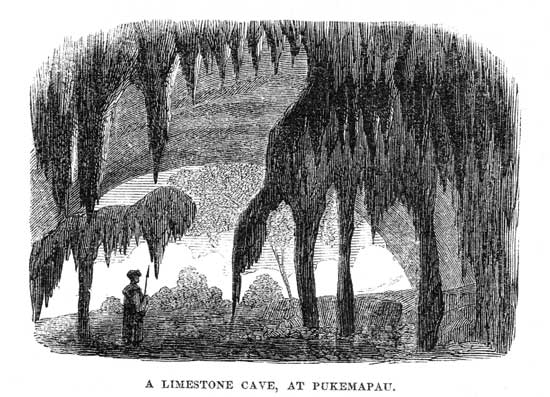
These limestone ranges are remarkably destitute of fossils, but generally they partake more of the purity of marble, although the surface rock contains many particles of clay stone gravel. At Mokau there are numerous caves, in some of which the bones of the Moa have been discovered. 18 At Wangaroa gneiss forms the summit of the two mountains, St. Peter and St. Paul. The same is the prevailing rock at
[Image of page 244]
THE GEOLOGY OF NEW ZEALAND.
Taranaki, and of the intervening peaks between it and Tongariro; there scoria and fused rocks prevail so much, that it is difficult to say what is the basis of the mountain. There is much obsidian and pumice near Taupo. The Tararua range, which terminates at Te Pari-pari, near Kapiti, has a compact slate for its base. Copper has been discovered at Doubtless Bay, and at the Kawa-kawa and Barrier Islands. Coal is found of good quality at the Mokau, Waikato, and Wanganui Rivers, and there is every reason to suppose that it will prove a very abundant mineral in these islands. Gold has been discovered in Coromandel harbour; there the rocks are of remarkably pure feltspar, of dazzling brightness. The gold discovered contains 1/3 silver, and is found in thin plates, and in considerable quantity: it is said to have been also discovered at Ahuriri, and in several other localities.
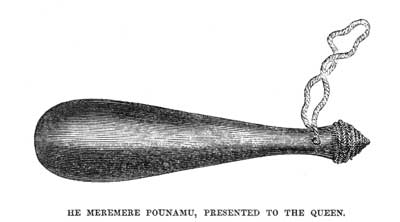
Of the rocks of the Middle Island little is at present known; but as they are reported to be chiefly primitive, it is very probable all the precious metals will be found there in abundance. The rock which confers its native name on the island--Pounamu, green jade, is abundant and highly prized by the New Zealanders, who manufacture their ornaments and the much-valued Mere from it. Portions of it are so transparent and lustrous as to render it worthy of a place amongst the precious stones.
[Image of page 245]
A VISIT TO ROTO-MAHANA.
I cannot better conclude this chapter than by giving an account of a visit which I paid to the Warm Lake.
The first view of Roto-Mahana is very remarkable, and cannot fail to excite the traveller's astonishment. The lake lies in a great hollow, evidently a crater, flanked on the side by which we approached its margin with lofty precipices; but containing a considerable extent of low swampy land along one of the shores; the opposite bank is formed of hills, literally covered with boiling springs, emitting volumes of steam, and the soil being of red or white ochre, gives the whole a most
[Image of page 246]
A VISIT TO ROTO-MAHANA.
extraordinary appearance. On the lower side it has an outlet into the Tarawera Lake. There are several islands in it, some merely a few connected tufts of grass, but abounding in water fowl, ducks, pukeko (porphyrio) and sea birds, which appear to delight in the warmth of their abode. Two of these islands present a singular appearance, being composed of misshapen rocks and ochreous hills, filled with boiling cauldrons and jets of vapour, intermingled with manuka trees and native huts, on reaching which, the stranger scarcely knows where to set his foot, lest he should tread on unsafe ground, the whole surface being very hot, and overspread with fragments of former puia.
When we came to the border of the lake, two canoes put off from one of the islands, to convey us over. Being desirous of ascertaining the temperature of the water, I kept my hand in it whilst crossing, and found that it varied from 90 to 120 degrees Fahrenheit; the difference of heat in places may be attributed to the innumerable boiling springs at the bottom of the lake, the existence of which was detected on the surface, by their bubbling up and noise. The lake appears to be of great depth--the water had no peculiar flavour.
On reaching the island, we were received by the natives with a loud welcome; and after a short stay, we went, during the culinary operations of our hosts, to examine one of the puia, or hot springs, in the vicinity, and a more remarkable place I never saw. It had the appearance of an immense flight of white marble stairs, each step being from one to three feet in height, of a silicious stone, formed by the deposit of the waters; in some places of a beautiful pale pink color, over which about two inches of warm water fell. I ascended this magnificent and unequalled staircase, some parts of which were so slippery, that I had some difficulty in keeping my footing. One of the steps presented merely a rim externally, and formed a basin, about four feet in depth, of beautifully clear water, having a greenish hue, like that of the lake over which we had passed. Neither I nor my companion could resist the tempting luxury of the bath which was before us. We found the temperature to be nearly 90 deg., although it varied in each of the three compartments into which the bath was divided. Afterwards, I
[Image of page 247]
A VISIT TO ROTO-MAHANA.
ascended to the summit of the staircase, where there was a large level flat; the centre not being visible at first on account of the volume of steam which issued from it; the surface cracked under the feet like thin ice, but being formed of successive lamina, was firm. As I advanced, I discovered that the centre was occupied by an immense gulf of hot water, of a very fine pale blue color, so remarkably clear that, although the bottom could not be discerned, it was evidently of great depth. Having cautiously approached the edge which overarched this awful abyss, and looking down, I beheld a large rock of a pure white substance rising from the vast profound almost to the surface, which formed a beautiful contrast with the azure water. A tree also which had fallen in was likewise petrified, and added to the scene. Upon one part of the pavement, over which the water had flowed, a thin deposit of sulphur was left, which tinged it with a bright yellow; some of the steps being of a rose tint, and others of a pure white, increased the general effect. Numbers of petrified manuka seeds were scattered about in every direction. The height of the flight of steps which I have described, might be about sixty feet; the name of the boiling spring is "Tukupuarangi," or the Cloudy Atmosphere, from its always being shrowded with vapour. The surrounding hills are covered with dark green fern, which sets off this wonderful work of nature to greater advantage. So large a number of boiling springs in so small a space, I never beheld; indeed, I could distinctly hear the noise of several at the bottom of the lake, and others boiling up furiously from their subterranean receptacles, all which convey to the mind of a traveller a feeling of awe and insecurity. It is not without some hesitation that he treads the ground, fearing at each step lest the crust should give way and plunge him into the hidden depths below.
The sun had set when we returned to the island, and finding that our natives had gone on to Piripai we followed by canoe, gliding amongst islands covered with rushes, and every instant starting the wild fowl from their warm retreats. We landed in a retired nook shaded with trees, and after securing the canoe we walked to the village, which is seated on the
[Image of page 248]
A VISIT TO ROTO-MAHANA.
"Tarawera Lake," where we received a cordial welcome. Immediately opposite, there is a lofty mountain which the natives formerly regarded as sacred, from the idea that it was the abode of spirits; they said, although many persons had attempted to ascend it, no one ever succeeded in reaching the top; for the higher they climbed, the higher also grew the mountain. The teacher of the village is a "tuwenua"--a kind of leper, whose toes and fingers seemed to be wearing away with dry ulcerous looking sores, his skin being quite horny. There were two other lepers there, which, as the disease is uncommon, I looked upon as a remarkable occurrence, especially in so small a place; probably the hot sulphureous springs may have something to do with it. The whole of the front teeth of these people are either much decayed, or quite yellow and unsightly, which may be attributed to their constantly cooking their food in the boiling springs. The night which we passed was so extremely cold that I could scarcely sleep; this appeared singular as the Pa is surrounded by hot springs, and the inference to be drawn from their proximity, where hundreds of them are sending up their clouds of steam, is, that it would materially heighten the temperature, and this supposition would be strengthened by the circumstance that a large and deep lake of warm water and of nearly a mile in length is in the immediate vicinity; but such is not the case, for although the water is warm, the air one foot above it is very cold.
The next morning I arose early and accompanied by my companion, we paid a visit to the largest puia or boiling spring called "Te Tarata." At the first view its appearance is that of an immense flight of steps, of a circular form, with water flowing over them, which seemed to freeze as it fell, assuming the color of snow. The water here is of a different character to that of the Tukupuarangi, being of a bluish, milky hue, and having a very soft and slightly saline flavour: the change in its temperature I found very striking, for in some parts it was quite cold, while in others it was warm or hot. On some of the steps there was a very slippery deposit of a brown ochreous substance; on others, a formation closely resembling a kind
[Image of page 249]
A VISIT TO ROTO-MAHANA.
of moss, slightly petrified. As I ascended I found the steps increase in height and width, each containing one or more baths, some of cold water, others of warm, and some of both in the same basin. In one of the largest my companion and two or three of the natives who accompanied us entered. This noble bath was nearly fifty feet in length, and in parts too deep to wade through. As I wished to ascend to the higher steps to get a view of the boiling gulf, I requested my companion to call his dog which was following me. In going up I found the water almost too hot for the naked feet, and therefore crept up along the sides where the manuka and fern were growing very luxuriantly, and, strange to say, although overhanging the steamy water, it felt icy cold to the feet. On reaching the top of the flight of steps, I found the silicious deposit had formed a level pavement, over which one or two inches of water, nearly boiling, flowed, beyond was a small pool, close to the gulf, which occupied the centre, and sent forth volumes of vapour, completely concealing its form from view. In the middle of the platform, was a rocky mound overhanging the chasm, where those who reached it obtained a nearer sight of the abyss; to facilitate which, a row of stepping stones had been laid for travellers to pass over. As I was advancing along these, the poor dog, who had broken away from its master, ran past me, and finding the water scald his feet, he bounded on with a yell of pain, and, in an instant, plunged into the pool of hot water. The poor animal made a vain attempt to escape, it rolled over, and in an instant was dead, and sank to the bottom; its agonizing struggles quite unnerved me; it was one of the most distressing and painful sights I ever witnessed. I could render no aid, and knew if I had rescued the poor creature, its torments would only have been prolonged. After seeing it at the bottom of the pool which had thus suddenly become its grave, I retraced my steps. I afterwards learned that two poor children met a similar end some few years back in a neighbouring puia; the elder one, who was carrying an infant, went to take out a basket of potatoes which had been cooking in it; when, standing on the verge, the infant struggled in its bearer's arms, and it is
[Image of page 250]
A VISIT TO ROTO-MAHANA.
supposed, fell in; the other, without hesitation, jumped after to rescue it. The place has ever since been "tapu."
These wonderful works of the Creator, while they excite our admiration, cannot be looked upon without awe: it is here we see a portion of the grand laboratory of nature, where the process of resolving and renewing is constantly going on; here we see how easily soft and impalpable powder can be cemented into solid stone, and the apparently indestructible rocks be either softened and reduced to mud, or sublimed so as to fly off in gas.