[Chapter X]
[Image of page 107]
CHAPTER X.
DEPOSIT OF THE PRIESTHOOD.--RECORDS OF THE DEPARTED.--THE DECEIVERS AND DECEIVED.--THE TAWA MOA, OR SACRED FIGHT.-- ATTENTION PAID TO THE LAST EXPRESSION.--SUPPOSED PROPHECIES.--MODERN DISCOVERY OF ANTIQUITIES.--NATURE AND CAUSES.--CUSTOMARY PROHIBITIONS.--POSTHUMOUS HONOURS.--ITS RECORDS AND VARIETIES.--CEMETERIES IN NEW ZEALAND.--IMPIETY IN THEIR VIOLATION.--PUNISHMENTS IMPOSED ON THE DELINQUENT, AND THE SILENT INDULGING CURIOSITY.--ITS SUBSEQUENT EFFECT.--SUPERSTITION IN FAVOUR OF ROBBERY.--LOSS OF LIFE IN BREAKING A PROHIBITION.--ANECDOTES.--WEAKNESS VERSUS CUNNING.--IMPURITY OF GAZING.--DYING CHILDLESS ACCOUNTED A MISFORTUNE.--RECORDS OF THE FACT.--BOASTS OF A VICTOR.--DEATH OF AN INFLUENTIAL CHIEF.--HIS CHILDREN REPROACHED AS WANTING IN DUTY.--CAUSE OF UNAPPEASABLE FEUDS.--SUPERSTITION OVERCOMES REVENGE.--A VARIETY IN SACRED WARFARE.--INDISPENSABLE REQUISITE FOR A DEAD MAN.--MAKING GHOSTS TO SERVE THE DEAD.--A TOMB NEAR KAIPARA.
THE bones of the chiefs, in whose honour the feast has been given, are reconveyed to the cemetery, great care being taken by the priests that no person espies them in that sacred place. 1 It is ac-
[Image of page 108]
counted a sin in any person viewing a corpse in the coffin, however accidental; and the priests are so attentive to their functions in this matter, that it requires the eye and intellect of no common observer to discover whether these men are the dupes of superstition or deceivers only. A strict tapu is
[Image of page 109]
thrown on any person who touches the body of a dead chief, and in the south-west part of the North Island, the surviving relations discharge several rounds of ball-cartridge towards the villages of their enemies, for the soul to lie at rest, and which alone can dissolve the tapu . This ceremony is termed tawa moa , a sacred fight. A great variety of articles are also interred with the deceased, 2 comprising almost every thing the defunct peculiarly delighted in.
On the approach of death the nearest survivors
[Image of page 110]
hang over the dying person, anxious to catch the last breath of the deceased, but rather from force of affection than superstition. 3 The last words of a chief or priest are attended to with peculiar earnestness, from the supposition that a spirit of prophecy (or rather the absence of lying) will issue from the lips of the man about to enter eternity. 4
The personal apparel of the dead is never made use of by the survivors; and to such an extent is this method of veneration, that frequently the honse of a deceased person is prohibited from ever being again inhabited, and when in mind the wood is not
[Image of page 111]
allowed to be desecrated for fire-wood, or even taken away. 5 The dead are probably more honoured in New Zealand than in any other part of the globe, as however ill a chief may have behaved in his lifetime, he is yet buried in the cemetery of his fathers.
The cemeteries of the New Zealanders are regarded with peculiar fear and veneration. The least violation of any portion of the precincts of
[Image of page 112]
the dead, is accounted the greatest crime that a human being can commit, and is visited with the direst revenge of a surviving tribe, 6 to be atoned for only by blood or loss of property. If an animal happens by chance to feed on one of these places, where the herbage flourishes best, it is immediately killed. A native has never deliberately violated the burial-place of his fathers, it being implicitly supposed that such an act would bring disease and death on the criminal. 7 If any person were to see such an act, and kept the same secret, he would suffer, if it became known, as a participator in the affair; few if any would hazard the punishment that is supposed to await such conduct. Europeans, who have visited New Zealand, have been induced to indulge their curiosity by opening the tombs of a native cemetery; the object that meets the eye are skeletons of the chiefs, male or
[Image of page 113]
female, each being equally honoured after death, fastened with flax cords in an upright posture, a quantity of articles, such as muskets, tomahawks, &c., placed on either side. We remember some instances of Europeans being discovered in opening a tomb. They had been unable to effect their object unseen, and had scarcely time to gratify their curiosity, when a hue and cry was raised by a girl who had remained alone in the village. On the news reaching the chiefs, who were planting at some distance, consternation seized the weaker intellects, while avaricious cunning dictated to the more powerful, that an admirable opportunity was now afforded them to demand a heavy payment; in each instance this might have been effected, had not other chiefs inimical to them defeated their intentions, by taking part with the Europeans; however, both parties were obliged to pay, what was accounted among the people a large sum, in muskets, powder, and blankets.
The sepulchres were taken away, and the bones taken to the river and carefully scraped with muscle shells, and washed in water, from the impurities that the gaze of unhallowed persons had caused. They were again gathered, carefully placed in new mats, and, finally, replaced in another receptacle at some distance.
For a native chief to die childless 8 is accounted
[Image of page 114]
a direful misfortune, to avoid which, adoption is often resorted to. The utmost boast of a victor is, in having destroyed the children of bis enemy. On the death of the celebrated E'Ongi, his children, fearful from the many enemies their father had created, that the body would be stolen from them, as they could then muster in numbers, were about to place it in the ancestral cemetery the day after he died, thus depriving it of the honour of lying in state. It was opposed by some powerful chieftains, one of whom reproached them for their pusillanimity. "How is it," he said, "I have only just become acquainted with those who are unworthy of an illustrious sire, and wish to bury him alive!" Among the singular laws of the country, a chief
[Image of page 115]
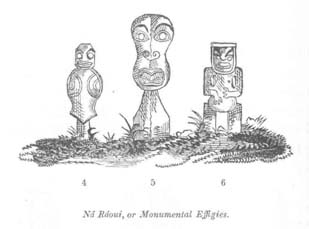
who steals the body (tupapaku ) of a rich man is entitled to a large portion of his property. In times of war, the greatest insult, causing unappeasable hatred and determination for revenge, is by either party ravaging the cemetery of the antagonist. But on a party conquering, after indulging themselves in all the lust of cannibalism, superstition triumphs over their animosity and revolting barbarism, and they erect monumental effigies
[Image of page 116]
(raoui ) to denote the place where an enemy, remembered as having been a former friend, or, perhaps, a relative, had been slain and devoured. When any valiant chiefs have fallen in battle, they are interred in the cemetery, with all the honours these people can bestow. A number of muskets, leaden balls, cartridge paper, and charges of gunpowder, are buried with each person. This is also termed arming for a sacred fight, (tawa moa ,) it being accounted among native superstitions an indispensable requisite for a chief to be provided with arms and ammunition to fight his way to the world of spirits. At such, burials most heart-rending barbarities prevailed, slaves being deliberately murdered to serve the spirit (wairua ) of the warrior in the next world. In honour of such men the festival of the Haihunga was established, the anniver-
[Image of page 117]
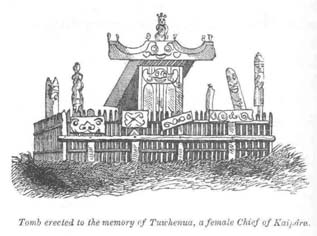
sary being religiously attended to. 9 Some of the tombs are erected, considering the scanty resources of the people, on a large scale.
The preceding Raouis or native effigies in honour of the dead were sketched at various places.
1. From a cemetery at Taohara, on the west side of the river Kaipara, where a battle was fought in 1826, between the inhabitants and the allied tribes of the north, under E'Ongi and Muriwai, in which the former people were entirely scattered and nearly exterminated, and the country has ever since lay desolated.
2. From a Wai tapu on the banks of Waima, a river estuating in Hokianga.
3. On the banks of Mahurangi, river Thames.
[Image of page 118]
4, 5 & 6. From a burial place at Tokomaru misnamed by Cook, Tegado.
The following was erected to the memory of Tuwhenua, an invincible Amazon, who formerly flourished on the banks of the Wairoa (long waters) at Kaipara, and dedicated to her prowess by her tribe, previously to their extinction.