[Chapter XVIII]
[Image of page 191]
CHAPTER XVIII.
SOILS IN NEW ZEALAND.--THEIR VARIETY.--MOUNTAINS.--GEOLOGICAL STRUCTURE.--PLAINS.--PREPARATIONS FOR FARMING.--PLANTING.-- INUNDATIONS.--DRAINING.-- ARTIFICIAL IRRIGATION.--SEASONS.-- FARMS VISITED BY THE WRITER.--INCURSIONS OF THE PIGS.--SINGULAR PREVENTIVE TO THE SOUTHWARD.--EARLY IMPLEMENTS OF AGRICULTURE.--THE MATERIALS EMPLOYED.--EXTRAORDINARY VALUE ATTACHED TO IRON.--VOLUNTARY SLAVERY.--REMARKABLE COMPACTS.-- OPERATIONS OF FISHING.--METHODS EMPLOYED.--NETS.--THEIR VARIETY AND EXTENT.--EISHING BASKETS.--LINES AND HOOKS.-- FISHING PARTIES.--SPEARS.--NIGHT FISHING.--BAITING.--EEL CATCHING.--FEARS OF THE FISHERMEN.--METHOD OF BUILDING FISHING VILLAGES.--VARIETY OF FISH AROUND NEW ZEALAND ENUMERATED.-- SHOAL BANKS.
THE soils of the country are as various as a variety in hill, mountain, dale, valley, and lowland, can form; including an extreme difference in the climate of a league only of extent in latitude. Mountains of enormous elevation, some towering to the height of 14,000 feet upwards, attract clouds from a great distance; their sides covered with exuberant vegetation, and impervious to the rays of the sun, are at times flooded with perennial streams, that nourish the lower lands to a vast distance, supplying both irrigation and soil, of which the upper regions become denuded. The geological structure of the country is various, so much so, that it would be almost vain to attempt a general description.
[Image of page 192]
The deepest and richest soil is found in the valleys at the foot of the mountains. This soil is a perfectly black mould, a compost formed from, debris of vegetable matter. A series of plains cover a large portion of the country, covered with a very thin layer of mould over a hard, stiff, argillaceous earth, from which the interminable fern-root is with difficulty extracted even by the plough, the roots lying deep, and three several seasons are probably required to work the land previously to entirely rooting up this indigenous edible. The worst soil, is a stiff argil of a deep red colour; this kind of land is found on the plains and hills. The mould in such places is scarcely three inches deep, principally obtained from, burnt vegetation; the nether parts contain, it is supposed, the oxide of iron. The native method of preparing land is by burning; the soil is afterwards dug up in clods by spades and hoes, and left exposed for the weeds and new grass (which soon spring up after burning) to decay; the farmer then waits for some heavy rain, which saturating the clods, renders them easier to crumble, which done, the soil is levelled with much care, and the seeds planted. Potatoes are put into the ground either whole or separated according to the eyes; Indian corn is put into small holes, about two feet apart, and kumeras, melons, &c., which are creeping plants, are planted in a similar method to cucumbers in Europe, in raised mounds, so as to allow the vine
[Image of page 193]
to extend itself. In low situations near the sides of rivers, inundations on a minor scale take place during the rainy season, and but few farmers trouble themselves in preserving their plantations by embankments, as land favourable for planting is easily procurable for the purposes of native families. Draining, for the same reason, is rarely resorted to, except in a favourite locality, and artificial irrigation is as carelessly attended to; yet the crops seldom fail, and the bounty of nature is displayed by the year being divided into two agricultural seasons, rainy and temperate, causing a division in husbandry, whereby two distinct crops are raised. At the various farms we have visited each of them presented an appearance supposed only to be found in highly-civilized countries
The soils chosen are generally of the richest quality, and after being made use of for one season are allowed to lie fallow for a long period. The plants which were well weeded flourished with extraordinary vigour: the potatoes, kumeras, melons, kai pakeha , or sweet yam, were planted in small mounds, laid out with great regularity. Between the raised earth, the broad leaf of the tarro appeared. In other parts were planted Indian corn and some minor vegetables, such as cabbages, turnips, greens, shallots, garlick, and beet-root; at night, the fires and smoke from land being cleared were discernible for some miles. Plantations are generally enclosed with railings to prevent the in-
[Image of page 194]
gress of pigs, dogs, &c., either of whom are sad destroyers of the kumera and soft Indian corn. 1 To the northward of the river Thames, the clime is so extremely favourable, that in many places, crops of various legumes, including potatoes, may be produced at any period of the year.
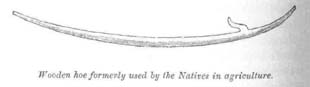
The implements of the native farmer previously to the arrival of Europeans, were extremely simple and rude; wood was made use of in the absence of iron, and stone, in such cases where the hard woods could not be made use of from their extreme toughness; a dark-gray and black-coloured granite, termed onewoa by the natives was made use of in Its stead, or the green talc, poeanamu and pieces of led jasper chipped off adroitly, resembling in shape our common gun-flints. Since iron has been introduced in the shape of the serviceable hoe, spade, rake, pick, &c., they have been eagerly
[Image of page 195]
adopted by the natives, and their former implements have wholly gone into disuse. Anecdotes indicative of the native predilection in favour of iron might be adduced almost innumerable; the recipients voluntarily entering into a slavery pro tem , to work off the debt occasioned by their purchasing such articles; 2 and we were informed by one man, that he had actually offered his head (which was elaborately tattooed) to a European vender, celebrated as a purchaser of such commodities, if allowed but the use of a large axe for a year, that he had taken a great fancy to.
Next to the occupation of farming, the operations of fishing form at once an amusement profitable and serviceable. The methods employed are pro-
[Image of page 196]
bably the same as followed by their earliest ancestors, and resemble those of the Polynesian islanders. In certain rivers and estuaries of the sea, a line of stakes bar the entrance a few feet in height, sufficiently low for the fish to pass over at flood-tide, yet high enough to prevent their return to their native ocean on the turn and consequent decrease of the tide.
Fishing nets of various kinds are made use of, of excellent quality, and have not the rude stamp that characterizes the form and substance of the generality of their instruments. Some of the seines are of enormous extent, and are made by each family in a village working a certain portion of raw flax, which is quickly ripped with the finger-nails into strips, the boon or useless gummy matter at the lateral parts being discarded. These narrow strips are tied up in bundles and left to dry on poles in the air. Flax nets thus made, are remarkably tough, and resist decay for a long time. After being made use of, they are carefully folded up (some of them are above 2000 feet in length) and placed on a wata or small scaffold. While in pro-
gress of manufacture, the workmen are placed under a strict tapu , probably an invention thus introduced
[Image of page 197]
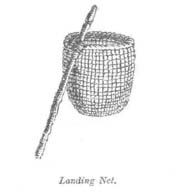
by a wise observer, to attach this fickle people to the attainment of one object at once, which they would be doubtless disinclined to follow without some such stimulant. Land-nets are also in frequent use, one of them is in the form of a bag suspended from a hoop and fixed to a pole; this net is found to be extremely serviceable in fishing for the kohuda or
[Image of page 198]
cray-fish that congregate among the rocks in certain places very numerously; they are sought after by the feet of the fisher, who places his net near to the fish, and with a dexterous jerk tumbles the scaly prize into it.
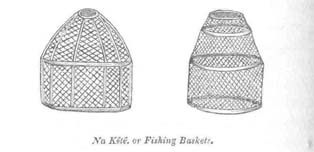
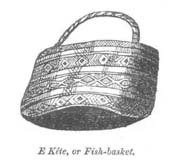
Fishing baskets made from a variety of liands or creepers, that almost form vegetable nets in the dense forests, formed of large capacity below, and narrowing to a small compass at the mouth, are also made use of to entrap the finny tribes, from which escape is impossible. Fishing lines (hehaho } are
[Image of page 199]
twisted from scraped flax, the manufacturer rolling it between the palms of his hands and on his thighs, frequently applying his saliva to assist his operation; they are much stronger than similar articles made from hemp, bearing a far heavier strain, that gives these crude lines a manifold superiority.
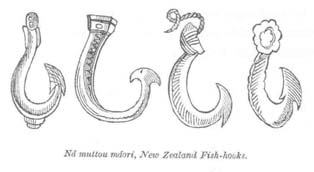
Fish-hooks are made from bones of the human body, shell and wood, but are so extremely clumsy, that whenever steel hooks are procurable, the former are generally bartered away to less fortunate neighbours; as no article is repudiated, however it may have fallen into disrepute in the estimation of its owner, without an equivalent being obtained in exchange. Fishing consumes much of the time of
these people, who undertake the art in large parties, the entire inhabitants of several villages joining forces to engage in this piscatory warfare; for this purpose, they repair to the sea-girt shores, or to the sides of the numerous bays that imbricate the coast and harbours of this favoured country. Fishing
[Image of page 200]
for young sharks is confined to the southward, principally on the east coast, and especially in the Frith of Thames, (lat: 36 degrees 25' S., long: 175 degrees 25' E.) Fish-spears are made use of for spearing flounders and similar fish, that are attracted by flames 3 at night on the river's brink, and fall to the share of the indefatigable fisherman; the only drawback to success in these undertakings is caused by the ceaseless oratory (or rather jabbering) of the people engaged in them, who give timely warning of the vicinage of human kin to the tenants of the waters, and thus fright the fish from their propriety and the natives from otherwise assured success. Shrimps, which are principally made use of as bait, are obtained by scooping a quantity of salt water on the shores of a bay into a basket; they are so numerous, that a number are thus taken, and found on the water draining from the basket. Eels are also
[Image of page 201]
found in vast numbers in the extensive mud-banks that line the rivers in the country; the places in which they secrete themselves are easily discovered by a small hole which lessens in size from the ooziness of the mud; into these the natives thrust their bare arms and are generally successful in obtaining their prey. They are quickly killed by the thumb-nail being pressed into the back of the head. Travellers by night often fall in with parties of fishermen who spear flounders; their torches are visible far distant; when successful, the fish are hung up in bunches on the branches of trees to dry in the wind and sun. A fishing-party on a large scale, induces a series of preparations that cause much bustle and activity in a village: where the place proposed as the scene of operation is far distant, the intrepid fishers make for a convenient shore every night, these people being mortally fearful of their own shadows after night-fall. As soon as the canoes touch the ground, the men instantly leap out and clear a piece of ground by tearing up the bushes and fern, while several engage themselves in searching for brakes and sticks, which are thrust in the ground as framing for huts. The fern and brush is employed in thatching, especially the kaikatoa (a philadelphus ) that renders them water and air-tight. The females (who invariably attend parties of peace or war) secure the provisions, anchor and take care of the canoes, or
[Image of page 202]
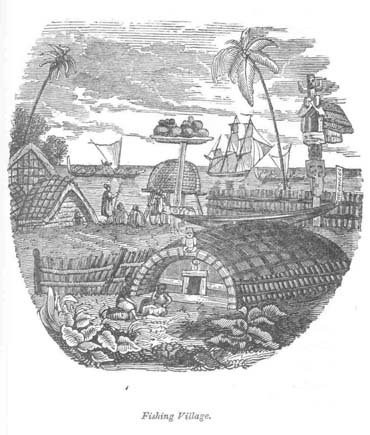
prepare with decayed wood a fire for cooking and heating the oven; if bad weather is predicted, rollers of wood are gathered to facilitate the hauling of canoes on shore. The coasts, rivers, creeks, &c., of New Zealand abound in fish of infinite variety, and equal in taste and flavour with those of Europe; 4 large shoals of various species visit, at certain seasons, the coasts, especially the east side, of which the natives take advantage to procure an abundant supply for the winter season, by drying
[Image of page 203]
them in the wind, sun and smoke. Deep sandbanks within a short distance of the shore, are extremely favourable for the congregating of shoals of mullet, cod, mackerel, a bastard salmon, and shark. Beating the waters with rods, is another method employed to force fish into nets. 5 It is not uncommon for the fishermen to present a torch at the mouth of the holes in the mud-banks, where numberless eels of large size and excellent flavour conceal themselves; the fish, attracted by the sudden glare, starts forward to discover the cause, when the patient native hastily clenches the prize, and kills it in the usual manner.