CHAPTER VIII
[Image of page 75]
CHAPTER VIII.
METHOD OF PURCHASING LANDS. ----DELIBERATIONS OF THE CHIEFS. ----DETAILS RELATIVE TO A PURCHASE. ----ORATORY OF THE HEAD OF A TRIBE, STICKLING FOR THE RIGHTS OF HIS PEOPLE. ----INTERPOSITIONS OF THE FEMALE PROPRIETORS. ----INVALID TITLES TO LAND. ----A SERIES OF CLAIMS THAT ENABLES A NATIVE OF ANY GRADE TO LAY CLAIM TO A PORTION OF THE PURCHASE-MONEY. ----HIGH PRICES OF LAND IN AUSTRALIA. ----LAWS ON MARRIAGE AND AFFIANCING. ----THEIR DERIVATION. ----TRIAL BY ORDEAL AND PUNISHMENTS. ----NATIVE INTERDICTS, AND CRUELTIES INTRODUCED BY SEMI-CIVILIZATION.
THE increase of British colonization in New Zealand during the last two years, has exceeded in number the quantity of Europeans previously established there. Families from the UNITED KINGDOM, SOUTH AND WESTERN AUSTRALIA, NEW SOUTH WALES AND VAN DIEMEN'S LAND, FRANCE, THE UNITED STATES, and INDIA, have hastened to become early colonists in the noble territory. Nor need they fear to amend their circumstances. The long-continued droughts that afflict for consecutive years that insular continent, (if we may use the term,) AUSTRALIA, point out NEW ZEALAND as the future granary of the country. But future colonists would do well, previously to leaving this country, to look with the most careful eye on the locale they may choose for the scene of their future ex-
[Image of page 76]
ertions. It must be remembered that the longitude of the land scarcely averages above one hundred miles, and that its length lies in LATITUDE, rendering every degree, nay, every mile, a marked difference in the climate. Consequently, the grain produced in thirty-five degrees, the latitude of the BAY OF ISLANDS, where the land becomes wholly free from the sand-hills of the north, is ready for shipment full a fortnight before that grown at WANGARI, about fifty miles further south. The RIVER THAMES is full a month later than the first-named BAY; and PORT NICHOLSON, in COOK'S STRAITS, in 42 deg 22 min S., open to the heavy and sweeping gales that blow with fury during, at least, a third part of the year, is full two months later in its produce. Nor is this all, the rains to the Southward, set in with a force and continuance unknown in the North. Cook, who was at anchor forty-two days at Dusky Bay, in the Island of VICTORIA, experienced but seven fair days, and for an account of the sweeping tempests that ravage the coast (to the South) we refer the reader to Cook and his companion Vancouver, who discovered the Chatham Islands. The climate to the Northward, is as bland and delightful as the South parts of the country are to the contrary.
Land once purchased by a European, agreeably to the native laws, is tapued to him, that is, it cannot revert again to the owners or their posterity, without repurchase. The chief of a tribe is al-
[Image of page 77]
lowed to have the responsibility of the sale, but he does not assent to the payment, if any of his dependants, yet proprietors of the soil, should be averse to his share.
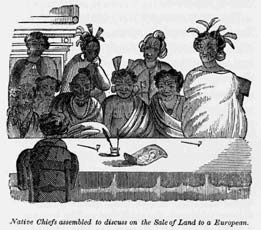
The chiefs, accompanied by a motley group of followers, retainers, and part-proprietors, assemble at the house of the European, to discuss the subject. The principal chief generally perches himself on a chair, covered with his blanket, and rarely joins in the conversation; but the venerable seniors give way to a flood of eloquence, that the price may be enhanced. A sketch of the land is generally made by one of the company, which lies on the table, as a reference for the
[Image of page 78]
boundary. The above sketch was hastily taken while a party of natives were assembled in full conclave in our parlour, to discuss the value of an estate in the Bay of Islands, which we subsequently purchased.
The purchase-money, or goods offered by a European for land, is rarely accepted at the first offer. The natives cautiously retire to their village, the subject is canvassed in all its bearings, the wants of one chief require a certain supply of a desired article, not stated in the proposed payment, another changes his promised portion with that of a third person, and after the debate, occupying continual attention for two or three days, and even weeks, the natives again call on the European; the chief spokesman states what his people and himself require: if the intended purchaser hesitates at giving the additions named in the new proposal, the chief desires him to recollect the advantages that will accrue to him. On purchasing a small estate on the river Waitangi, the chief Kamura, bad us remember that the land descended to the children of the purchaser, ending with the ejaculation "ha! tini rawa" which when long aspirated, as in this instance, signifies for ever more, "Remember," he added, "this land has been received by us from our forefathers, and do not think that a trivial payment will satisfy us. Look at the stream before you (which the flood-tide was entering, into a number of small creeks and inlets), it
[Image of page 79]
enters into numberless inlets, refreshing the mangroves in its vicinity, 1 now remember in a similar manner must my people be refreshed by the payment you shall give them. Can you compare the articles you offer, or even those we demand, which must eventually perish, with the broad land before you, which can never decrease, but will survive beyond the lives of your latest posterity ? What will become of your blankets? they must rot and be as nothing. Your muskets will become sick. (mati or dead), your tomahawks will become worn to the handle, or lost; is it not so! speak white man, and say that my words and your heart agree." Another chief, named Arripiro, also confirmed the sentiments of his liege, adding, "What comparison can you make between the money of the white man (na pakaha), and the lands of the natives! (na tan-gata maori). Your money, like the hard water (haupapa or snow) on the mountains of the South, will dissolve, in the purchase of such articles as we may require; your moni kora (gold money) will be exchanged for blankets (na prankiti) and muskets, (na poo); your moni torra (dollar or silver money), will be smoked away in tobacco, (tupakka) or
[Image of page 80]
wasted in powder; is not also iron brittle? then be a generous man, (tangata hoa) and make your payment a good one for us." This stickler to the rights of man had not ceased his harangue, when apprehensive of its probable prolixity, two of the lady proprietresses addressed us in a similar strain directed to the same object. "I have no garment to make myself respectable of a Sunday," said Kohora, the ladie love (wife we must add) of Reti, a chief also interested in the purchase, Rungi-apiti, sister to the chief, also added in her shrill voice a confirmation of the plaintive fact, and that the payment should comprise an article of a similar nature for herself. The argument was concluded by Kamura, who spoke for his tribe. "This tree," he observed, pointing to one of the numerous peach-trees that fronted our residence at Parramatta, "look at it, should a single branch fall, does not another supply its place; if you die, the land you purchase will yet belong to your children, but what will fall to my children" (na tamariki naku) pointing to his tribe, "when your payments have ceased to be serviceable?" The payment was then arranged, and the several articles taken from the store, and laid in the centre of the circle which the chiefs, females, and tribe, had made. Kamura, as head proprietor, distributed to each chief such articles as he knew they required, and in quantity according to the interest they personally possessed in the property, reserving a very minor portion to himself.
[Image of page 81]
The title-deed was then read, describing with minute care, the several boundary-lines, which on being named, was assentingly nodded to by the chiefs most interested in the part described. The deed was then presented to Kamura, in presence of several native chiefs, as witnesses on the part of the late owners, and some Europeans performing a similar service on our part. Kamura then drew his moko or representation of a portion of the tattooing on his face, as his signature, which was followed by the other recipients of the purchase doing the same. Congratulations passed on both sides, the chief, Kamura, declaring that we had become incorporated in his tribe, as an actual possessor of territory in the same district as themselves. The slaves were also well pleased, as a moiety of the articles also fell to their share. On the title deed being signed, as also by the European witnesses, the meeting separated, the natives taking to their canoes, well pleased with the transaction of the day. Gifts of land from the natives to Europeans are not valid, nor are the promises of a chief to a European who obtains land in consequence of his cohabiting with the daughter or female relative to the chief. Such titles have been insisted on, after the European has left the country; in the mean time, the lands have been regularly purchased by another resident in the legal manner; the titular claim of the former is consequently out of the question, leaving no doubt as to the rightful owner.
[Image of page 82]
Among the circumstances that entitle a native to become a claimant of land, unpurchased by a European, the following may be mentioned:
For having practised fishing for a length of time on the shores of a place, and sleeping there for the night.
For having been in the habit of cutting bulrushes (raupo) in the marshes (if any) for covering houses,
For having experienced a serious accident on the place, such as making an incision in the arm or leg in cutting fire-wood.
For planting and reaping while the land was uncultivated, without let or hinderance, while in the native possession.
For a relative having been buried on the place. For having fought in an engagement on the territory.
For dancing a war-dance on the land previous to, during, and after a battle, and even from circumstances yet more trivial.
The lands of the New Zealanders in the northern parts of the North Island are not to be purchased for mere trifles; similar property will be found fully as expensive as in England. The competition of numerous colonists has greatly raised the price, from 100 to 1000 per cent, to what the same lands might have been purchased within a few years back. 2
[Image of page 83]
The rapid increase that has taken place in the price of land in the several colonies of Australia for many years past, has exceeded any former parallel in this, or any other country. That very extensive (not to say immense) profits may be realized, by the purchase of land in a new country, and the improvement and erection of buildings upon it, is acknowledged by every person connected with the subject; that the advantages and inducements for an outlay of capital on purchases of certain portions of land, leaves at an immeasurable distance any other kind of commercial enterprise, returning within a short period a handsome fortune for the speculator. There is in fact no investment that affords so assured a profit, as all land, even far from the vicinity of a capital or township, acquires an augmenting value, daily increasing in a ratio with, the number, wealth, and respectability of its inhabitants. The following facts, which can be
[Image of page 84]
multiplied a thousand fold, and can be well attested by a number of gentlemen resident in this country, will best elucidate the above observations.
"In July, 1818, Governor Macquarie purchased from an individual a piece of land containing about ten acres, which is now the site of the Carter's barracks and buildings; the meadow in front, the corn, hay, and part of the cattle-market for which was paid twenty head of cattle, at that period sold for [pounds]200. This described land is now worth at least from [pounds]40,000 to [pounds]50,000, was called by the said governor 'a paddock of ground in the vicinity of Sydney." Sydney Monitor, Aug. 1838. But the progress of building occasioned by the annual increase of inhabitants has rendered the above place, that twenty years previously was only in the "vicinity," to be now termed as in the heart of the metropolis.
In the Sydney Gazette for July 1838, we find, "that the minimum value placed by the Colonial Government on land, skirting Sydney, is [pounds]1000 per acre, and said to be considerably under the real value, which is shown on sales by auction taking place."
About twelve years back, a piece of rocky land, distant by water four miles from Sydney, was sold by the proprietor at that time, for less than [pounds]5 in barter, this land is now valued at [pounds]4000. Some sections in the lately-colonized territory of Port Philip, near Bass's Straits, were purchased in 1836 by a gentleman lately returned to England; he
[Image of page 85]
gave [pounds]24 for each section, and the market price in 1838 for the said sections was [pounds]800 each, at which price they were readily purchased. The rocky acclivities in Darling Harbour, that were regarded in 1828 as being some distance from Sydney, on which an enormous outlay was required for mining, carriage-roads, and footpaths, and could probably have been bought up at within [pounds]5 per acre, has in several parts netted between [pounds]20 and [pounds]30 per foot, and within ten years has changed its appearance from an almost inaccessible waste, to a succession of wharfs and quays crowded with shipping, skirted by a number of well-built streets.
If such is the value of land in the vicinage of towns, in our southern colonies, land within the capital has a yet higher value. In this respect, the price is regulated by its locality, whereas quality is the principal requisite in the country.
In Sydney the value of land ranges from [pounds]300 to [pounds]5000 per acre, and even upwards; but water-frontage in the cove cannot be estimated by the acre. Campbell's wharf, in the cove, has been estimated at [pounds]100,000.
An allotment of land at the corner of George and King Streets, called Moore's Corner, then occupied as a small garden by a respectable solicitor of that name, actually netted, in 1833, [pounds]50 per foot; and by the Sydney Monitor of 26th August, 1839, (the latest Sydney paper in England at the present date) that an auctioneer had just sold several allotments
[Image of page 86]
at the Surrey hills in that metropolis, which netted [pounds]57, [pounds]34, [pounds]25, and [pounds]24 per FOOT. Nor are such enormous prices confined to Sydney; land at Van Diemen's Land and its capitals of Hobart Town and Launceston, have progressed at an equally surprising rate. Thus, town acres formerly valued and sold at [pounds]5 each, have within twenty years been sold from [pounds]10 to nearly [pounds]60 per foot.
A series of allotments in Melbourne, Port Philip, were sold about two years since by the Colonial Government, the prices obtained ranged from [pounds]7 to [pounds]95, since which period, some of the first priced allotments have realized [pounds]1000 to the enterprising owners.
South Australia has exhibited similar results in favour of the speculator in land. 3 These examples have already resulted in New Zealand, the salubrity of the climate, general fertility of the country, are the best assured guarantees of an unexampled increase of the land in certain situations. The preference in Colonial lands in a speculative
[Image of page 87]
view is invariably given towards boundary lands fronting the water, shipping, &c., for the subsequent erection of wharfs, warehouses, bonded stores, &c.
The laws respecting marriages have been explained in the proper place; a man cannot make a wife of his grandmother; we state this fact from the senile tastes often displayed by the chiefs for marrying with old ladies, but the matrimonial hook is often baited with a number of broad acres, slaves, canoes, &c. Unlawful intercourse between brothers and sisters, nephews and aunts, are strictly forbidden by national usages, as are crimes of nameless offences and public indecencies as practised formerly in the South Sea Islands. Affiancing children of either sex is attended to, when the betrothed parties arrive at years of puberty (we do not add discretion), the girl is forced to consent, however abhorrent to her feelings, but no such constraint attaches to the male. Such contracts are made in every native family, when the children are scarcely able to walk without support, and such conjunctions are appointed before the birth either of the bride or bridegroom.
The foregoing may be termed the principal laws of this people, the Levitical ordinances being comprehended in the extensive expression of Tapu. They are derived from the previous traditional actions of their forefathers, whose will became the law of the land, and as it is open alike to all the grandees, few of them, who have the sole power of the
[Image of page 88]
country in their hands, are willing to deviate from their observance.
There are no prisons for the reception of malefactors, which has doubtless caused (cannibalism apart) so many murders to be committed on the instant of provocation.
Trial by ordeal, there is none, 4 capital punishments are performed by the musket and tomahawk. Spearing was formerly practised, but has got into disuse. It must be an insatiate revenge that will induce the native to put a delinquent to death, by tedious and long-studied torments. To any person guilty of a breach of the Levitical canons, the tapu is enforced against him, and this Catholic interdict prevents him from feeding himself for some days, weeks, and even months. The native Guildhall is held in the open air, in favourite places of the villages, such as beneath a far-spreading tree, or in bad weather, beneath a large verandah.
There are no appeals to a superior court, and the simple proceedings may be accounted a modern
[Image of page 89]
transcript of the customs in this respect of the natives, contemporary with the patriarchs. 5