CHAPTER VI. TE POKIHA'S GREAT NET.
[Image of page 19]
CHAPTER VI.
TE POKIHA'S GREAT NET.
THE TALE OF THE RECORD HAUL OF FISH.
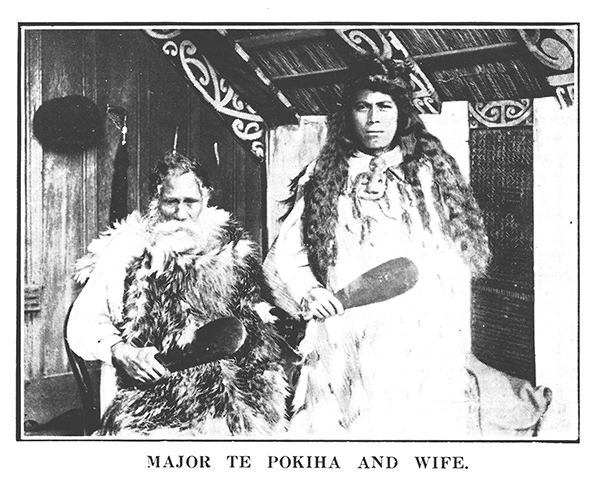
Te Pokiha, the fine old chief of Maketu, excelled all Bay of Plenty chiefs in the magnitude of his undertakings. His last effort was the weaving of a great net, which created such a stir on the East Coast that he was content to rest on his laurels, and it was never again used. During the winter months of 1885 several hundred of the Ngatipikiao living at Maketu were busily engaged in weaving a huge net, which Te Pokiha determined should outrival the famous historic one made by his remote ancestor, Taramainuku, the fame of which is enshrined in story, song and proverb by the Maori people. Tradition states of Tara's net that he fastened it to two huge posts, which are now represented by lofty pinnacles of rock against which the waves dash in vain.
About Christmas, Te Pokiha's net neared completion. Smooth, oval pebbles were obtained from Motiti (Flat Island), each weighing a pound. These stones were enclosed in woven pouches of seasoned flax, of which also the net was composed. The stones were strongly bound to the lower rope, the kahararo; the upper rope, the kaharunga, also was made of closely plaited leaves of whanake (the cordyline, or cabbage tree). These weights were tied about one foot apart, and must have aggregated at least two tons. On Boxing Day the net was taken in sections to Otumakoro flat, below Maketu pa, and the setting up, or toronga, was carried out with solemn ritual, performed by the wise old men of the tribe. Those taking part in the final stages were tapu (sacred); they carefully abstained from food till midnight. The net was tightly drawn to several rows of stout posts, and on being measured by Captain Turner, Mr. Butt, and myself in the presence of a number of Europeans, was found to be ninety-five chains long.
It was then discovered that there were no canoes at Maketu large enough to carry the net, and a stalwart crew was dis-
[Image of page 20]
patched to Matata, returning next day with a fine waka-taua, or war canoe. The beautifully carved topsides (rauawa) having been removed, the canoe was placed parallel to another of equal size about twelve feet apart, and a stout platform of smooth planks nailed across. On this double canoe stage the huge net was piled.
On New Year's Day of 1886, the weather being favourable, the crew of thirty stalwarts rowed the double canoe over the bar, then along the coast westerly some distance. The director of ceremonies, a grand old fisherman, Tohe te Whanarere, climbed to the top of the 96-foot telegraph wire tower and directed its movements. The whole sea as far as the eye could reach was covered with reddish brown patches, each an acre or more in extent, and denoting a solid shoal of fish from surface to near the bottom; all passing slowly eastward round Okurei, or Town Point. Naturally the crew and the large assembly wished to encircle the biggest shoal, but they were warned by the wary old fisherman to wait for his signal. So shoal after shoal went by, making for the mouth of the Motu River, the most famous place in the Dominion for kahawai, till at last an insignificant little brown patch approached, when, much to the disgust of the onlookers, the old man shouted "Haukotai mai!" ("Surround it!").
The canoe dashed in front, six men rapidly paying out the net. Steering north, then west, finally they brought the canoe to shore, with a considerable portion of the net unexpended, about a quarter of a mile on the north side of the Maketu River. The spectators, numbering quite a thousand, essayed to draw the net ashore, but finding it too heavy, the canoe was relieved of the balance of the net and sent out to the poito, a carved human figure holding a fish and representing Tangaroa, the Polynesian Neptune, which floated at the centre, here about thirty feet deep, made of very small meshes.
Te Whanarere having descended from his lofty look-out, now took charge, and, divesting himself of his clothing, rubbed his body with red ochre (kokowai, horu, or takou) mixed with fish oil, and plunged into the sea. The water seemed a seething mass of denizens of the deep; quite a number of large sharks, countless sting-ray and other fish were plainly visible. In answer to our warning he shouted back, "Ko-Tangaroa-puka-nohi nui e kimi putanga ana" ("Neptune, the many-eyed, is seeking an outlet"), meaning the fish were too concerned at their novel position to molest anyone. He swam out to the crew, ordering them to lift the konae clear of the bottom. This
[Image of page 21]
they did twice, until the fish perceptibly lessened. Still the net came but slowly, and the top rope (the kaharunga) parted. Then the spare ends of the net were passed round outside, making three thicknesses, and the incoming tide brought it about half-way up the beach. When the ebb threatened to carry it hack, stout posts were driven in at high water, to which
the net was fastened. Then there was a long wait. All this time no one was allowed to partake of food. At last the vast mass of fish was left clear of the water, and amid tremendous excitement the work of carrying the spoil above high water mark commenced.
Te Pokiha marked out thirty-seven places, placing a man at each to keep tally. When 500 fish had been laid on each spot he ordered 250 more, then another like number, till each mound contained 1,000, for presentation to the various sections of the Arawa tribe who were present, and a like number to Captains Turner, Simpson, the writer, the missionary, the postmaster, and the hotelkeeper. When this was done all the big sharks and sting-ray remained on the beach, for those
[Image of page 22]
who cared to take them. The fish caught consisted mainly of kahawai, schnapper, trevalley, gurnard, moki, tarakihi, parore, kingfish, tutahuna, kapeta, pepeke, mangopare, mangotara (several kinds of smaller shark), the latter a small blue shark, much prized for its fine oil, also about twenty "takiari," which attains a length of 12 to 14 feet, and has been known to attack swimming horses, cattle, dogs, and human beings. There were also uncounted numbers of smaller fish, such as koheriheri, or koheru (horse mackerel), kutorotoro (sand fish), and some new species.
Quite a variety of flotsam and jetsam was also brought in, including three medium-sized anchors, one of which was of ancient date with wooden stock, iron bound, a mass of barnacles. Probably these had all belonged to coastal trading craft, of which the Arawa tribe owned about twenty in the early Sixties.
As soon as the counting was completed, every vehicle on wheels and every sledge, boat, and canoe were used to carry away the spoil; but darkness found the task unfinished, to be followed the next and successive days by the inhabitants in cleaning, salting, smoking, and drying fish. So the odour ascending heavenward was not exactly that of Araby the blest; indeed for weeks afterwards a resident of Maketu could be recognised by his ancient and fish-like smell.
Certain sceptical persons aver that there is only one true fishing story, namely, that mentioned in the New Testament, about the two disciples who went a-fishing, and who, after "toiling all night, caught nothing." In like manner, I had my doubts about the miraculous draught made by Zebedee and company on the shores of Lake Genaseret, but after witnessing Te Pokiha's haul made at Maketu on New Year's Day, 1886, I willingly accept the Biblical story.
Captain Cook and Sidney Parkinson, Sir Joseph Banks, draughtsmen, mention seeing the Maoris using floating nets over a mile in length, catching mackerel (tawatawa) some distance off Cape Brett, but this fish is rarely seen nowadays.
Having resided in the Bay of Plenty off and on since 1864, and watched the countless shoals of fish which cover the sea from Mercury Bay to Cape Runaway in the spring for months, I perpetually wonder why our fish supply should be so precariously uncertain and expensive.