TREASURER IN STAFFORD'S GOVERNMENT
[Image of page 246]
TREASURER IN STAFFORD'S GOVERNMENT
[Sunday,] 8 June 1856. The last week has been one rather of suspended action--the sort of thing which takes place after a decisive battle when the business is to originate new plans of strategies. We were sworn in in due course on Monday [2 June]; 1 and on Tuesday [3 June] Stafford came down to the House with a short statement of what we meant to do. 2 The only distinctive feature of this new phase of Government is, that we are now going to propound our plans for adjusting the public burthens. That is the vexed question of the Colony; has been so ever since the Constitution Act; and if not settled will involve us in eternal discord and confusion. As it is, things are in a lamentable mess. The degree of incompetency in the management of the financial affairs of the Colony since the Constitution Act (and for aught I know before) passes belief. Not a single provision of the Constitution Act has
[Image of page 247]
been observed. Not the slightest order or method in the department of Finance. There is not a single intelligible Account. All that we know is, that we have immediate liabilities coming upon us in the course of the next year, and not a sixpence to meet them with; and but for the forethought of the House of Representatives itself last year which at my suggestion originated a vote of credit to the Government of £30,000, the Colony would at this moment be bankrupt; 3 unable to fulfil its engagements even for Native Land purchases actually made, upon breach whereof in all human probability we should have lost all control over the Natives, and Heaven knows where the consequences would have stopped. Who is to blame for all this? (I have but one answer to make. Look at the evils of the Colony from whatever side you will, one man is mainly responsible--Sir George Grey. If neglect of opportunities be a sin, it lies heavy on his head. If it were a great wrong to leave chaos behind him when it was his duty to put things in order before he left, he is the heaviest wrong-doer that New Zealand has suffered under. I do not like to enlarge on this theme. It looks like prejudice against the man; but I feel indignant at the successful Charlatan who has quietly slipped his head out of a noose, which threatens to strangle his successor. The new Governor feels all this, and so far as he can with delicacy speak of his predecessor, sympathizes and agrees in all which I have ever said about him. I gave him the other day my long letter to the Duke of Newcastle to read. 4 He told me that without agreeing to every thing, the main points of it were prophetically true. In all which I there said about Sir Geo. Grey's Native Policy he expressed his entire concurrence. Indeed the nearer the view one has of these matters, the more absolute is my conviction that under Sir George Grey nothing has been done towards mending their condition or improving their relations with the Settlers.)
The last week has been in great part occupied in sifting those horrible old Land Claims. 5 Think of that! Here in the year 1856, we are actually called on to contrive a scheme for adjusting questions which Sir George Grey was sent out to settle in 1845. Eleven years of do-nothingness. I have been half bewildered the whole of the week past, in moving from a Committee on Land Claims to a Committee
[Image of page 248]
THE JOURNAL-JUNE 1856
on Finance, 6 the whole matter of occupation being the masses of confusion which Sir George Grey has left behind him.
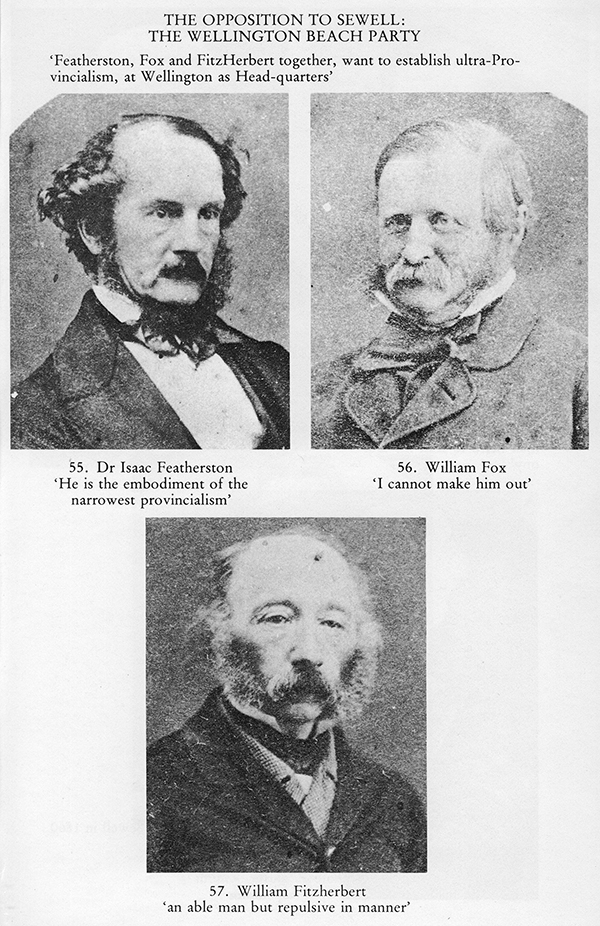
In the House there has been nothing doing beyond a little skirmishing. I had a long talk the other afternoon with FitzHerbert after the House had adjourned about the position of the Wellington party. He complained sorely of their being excluded from all share in the Government; recurred to old times when they alone were fighting the battle of Constitutional Government--referred to past services, their anxiety for friendly co-operation--the indignity cast on their Province, and on themselves, men of acknowledged ability. In all which I could not but confess a great deal of sympathy, and earnest and sincere regret that things should be so. But what is to be done? I pleaded against him their own impracticable wilfulness. Why did they fling down the gauntlet against the whole colony? Oh, he says, Hustings Politics are one thing--Party Politics in the House another. I do not subscribe to that doctrine. Still I confess to a yearning for the re-establishment of friendly relations with Wellington. I have a personal regard for Featherston; Fox (I like well enough socially. Beyond that I know little of him. But he) is unexceptionable in point of ability and character, in every thing but his political doctrines.
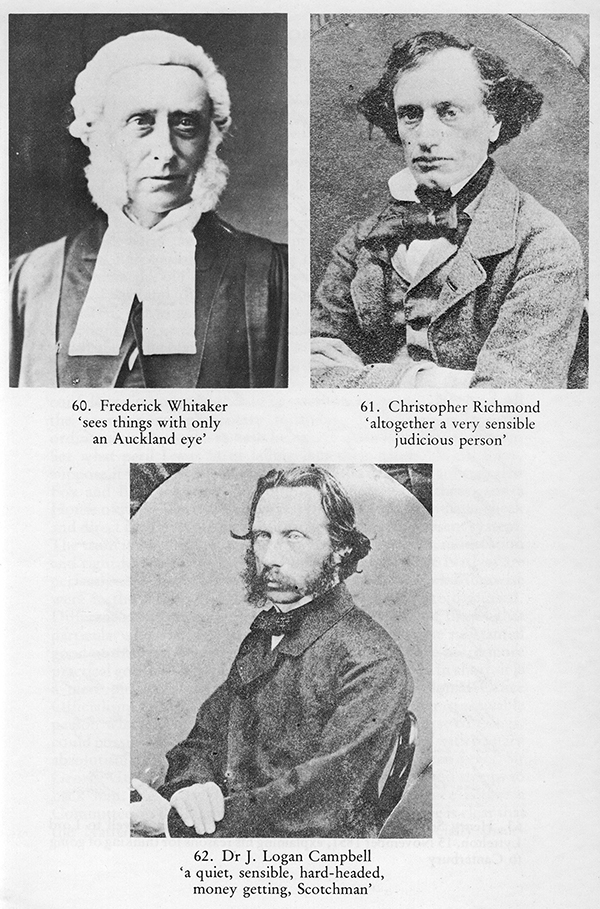
A good part of the week has been taken up in Cabinet work, arranging amongst ourselves details of Finance. We very nearly came to a split yesterday about that wretched Resolution, which Wakefield got the House pledged to in the first Session; for exempting Auckland from the New Zealand Company's Debt. I was almost the only man in the House who protested against that Resolution. 7 I knew it would embarrass us when we came to adjust the burthens, and so it has. It nearly upset the Government yesterday [Saturday, 7 June]. Whitaker, who sees things only with an Auckland eye, insists not merely on relieving Auckland for the future, but repaying all it has contributed towards that debt. That amounts to £45,000. But who is to pay? Say I, the Colony at large, in its totality; Auckland being one Member of the common Partnership. The Resolution is binding on the Colony as a whole, and is like an agreement between a Partnership firm to exonerate a particular Partner from a particular liability--No, says Whitaker. In that case we shall have to bear our partnership share in a new form. You--the other Provinces must take it exclusively on yourselves. But, say I, how can we ask Wellington and New Plymouth to take
[Image of page 249]
part of this burthen, whilst we are asking them as we are, to take the cost of buying their own Native Lands on themselves? But if we exclude Wellington and New Plymouth, how can we throw such a heavy burthen on Nelson, Canterbury, and Otago? And what justice is there in making them repay fourths of Land fund which Auckland has contributed to the Company? Whitaker was obstinate, and it ended at last in our agreeing slightly to increase the sum to be paid by the Middle Island. We now propose to give up to Nelson, Canterbury and Otago their respective Lands and Land-funds, they paying £200,000 in equal shares; relying on an Imperial guarantee for a loan to get rid of the Company's debt. Then the Northern Island to pay for its own Native Lands. The success of the whole scheme turns on our getting the Imperial guarantee for a Loan of half a million. Think of that as a burthen for a young Colony to stagger under; and all the result of past misgovernment. I note this for people at home. I want them to understand that it is vitally essential that we should obtain the Imperial guarantee for a loan of £500,000--we cannot afford to borrow at a Colonial rate of interest.
[Sunday,] 22 June 1856. The last fortnight has been spent in Finance. Last Tuesday week [10 June], I brought down my Resolutions, and moved the House into Committee to consider them. 8 As might be expected they have caused a good deal of commotion. They involve the broad principle of separating all the public burthens, and for ever relieving the Middle Island from the charge of Native Land purchases. She will have to buy the release at a high price--payment of the Company's debt. But any thing is better than that insatiable gulph into which our Land fund has hitherto been thrown. Wellington kicks violently against the proposal. It is in fact from her that we mainly seek to protect ourselves. She is a cormorant, a vulture, a shark, a beast, bird, or fish of prey of the most voracious kind. She has swallowed upwards of £40,000 of Middle Island Land fund. Things of course could not continue at that rate, but Wellington resists the effort to choke her off.
After I had made my Financial Statement the Debate was adjourned till Friday [13 June]. Meantime to get the Estimates ready; but Friday came, and we were not prepared with them. So the Debate was further adjourned till Tuesday [17 June]. Tuesday came--the Estimates were in Members' hands, but they wanted a little more time. So we adjourned the Debate again till Thursday [19th]. 9 The time was not lost. It gave people full time to digest our
[Image of page 250]
THE JOURNAL-JUNE 1856
scheme, make calculations &c. and if, as seems likely, we carry our measures, the long delay and opportunity for consideration will be a fact favorable to their final acceptance.
On Thursday [19 June] the Debate was resumed. Featherston moved an Amendment, which if carried, would have turned us out. He was not forcible, and his figures and facts were preposterously erroneous. But he said all that could be mustered against our proposal, which was in fact, that the Constitution Act had made the Middle Island liable, and therefore she ought to pay. 10 A long and rather tedious Debate followed; adjourned first from Thursday to Friday [20th]--and then after a most wearisome effusion (of drivel) from FitzHerbert for 2 hours, 11 we adjourned till yesterday, when we divided--Government getting a majority of 14--24 to 10. 12 That is decisive of our Ministerial position. Still we have to get the Resolutions through Committee; but we shall do so I think. Besides this, nothing special has occurred.
[Sunday, ] 29 June [1856]. (Elizabeth reminds me that it is Radley Gaudy (q Gawd-day?). Success to Radley, and a great many loves to Harry and all the rest. 13 Oh how I wish I were with them.) Here we are in what would be January in England, with weather as mild as April or May. Barring the rains, certainly the Winter climate of this part of the world is a wonderful contrast for the better with the Snow, fogs, and intense cold of England. Cold we never feel; chilliness now and then. Geraniums are in flower. A night frost happens now and then as an accident, and Ice is sometimes heard of as a rarity.
The Denny is in from Sydney. News from England to the 27th of March. Peace just on the point of completion. Thank God for that--And Jonathan's blustering fit seems to be passing away. 14 Peace would be of incalculable service to this part of the world. 15 It
[Image of page 251]
would bring us Steam communication again, the greatest of all our desiderata. No letters from England. We expect them by the Zingari, which is now over-due from the South. There is a report of a gold-field at Nelson, a real one, diggings where people are making £20 a week. 16 People are on the qui vive here, and if the report should be confirmed on the arrival of the Zingari, there will be a large emigration from this place. No greater calamity could happen I think than a Gold field. If a large one it would completely upset the whole order of Society; derange trade; put pastoral capital in imminent jeopardy, produce an enormous rise in prices, and drain the labour market. Eventually it might produce some compensating advantage by forcing population. A small gold field would be simply injurious. It would disturb all the ordinary employments of labour in its neighbourhood, but without attracting more from a distance. We are beginning to be anxious for news from Nelson. The Overland Mail from Wellington and New Plymouth brought no intelligence but gossip and rumour. Native affairs at New Plymouth continue in the same unquiet state. In truth the whole Native question is more complicated and hazardous than it ever was: Native confederacies are forming, friendly and unfriendly. American Whalers, and disaffected people of bad character are about doing mischief 17 --and what is worst the character of the Natives themselves is deteriorating. The Religious bodies are losing their hold upon them as must needs be, so soon as the Savage begins to emerge from his state of child-like ignorance, into one of semicivilised worldliness. We forget entirely the means by which providence works. She civilises men, and keeps them so by secondary influences. Religion does its part, but only a part. What is wanted is the cooperative agency of those secondary influences. I brought in a Bill last week, and passed it through the House which I believe will have a salutary effect--must do so if properly worked. Those Native Reserves, the first idea of which was originated by Wakefield and the New Zealand Company, have been left in a state of utter neglect, only now and then Sir George Grey jobbed away the land, as sops to the different Religious orders, bribing them into alliance with him but exasperating the Colonists. But for the Natives themselves scarcely anything has been done. Money out of the public Chest has been expended (squandered I may say) in a thousand ways comparatively profitless; but except a few Schools here and there established by the Religious bodies, and a few
[Image of page 252]
THE JOURNAL-JUNE 1856
Hospitals, things too insignificant to be worth notice, as means of solid amelioration of the Native race, it has been almost a case of absolutefar niente [idleness]. People in England will not believe it. The nonsense which I see written in Reviews on this subject is perfectly sickening. But to these Native Reserves--my Bill has passed through the lower House, and will no doubt go through the Legislative Council. 18 It enables the Government to place all reserved lands under the management of local commissions, with whom Native Chiefs themselves may be associated. These Commissioners to have full power of management (even of sale, with the Governor's written authority, for I will never consent to a law of Mortmain in the Colony). Out of Funds thus produced provision may be made for Schools, Clergy &c. in which the Natives themselves will have a voice through their Chiefs. But the most important of all is the power of giving them lands in severalty; so taking the first step to lift them out of their present merely animal state of communism, into the position of civilised communities, starting from the 'Family' as the social unit. 19 If we had done nothing else this Session, that alone would in my opinion have been worth all the trouble and expense of it.
About our Ministerial Finance. We have carried our whole scheme successfully through the House, in the shape of Resolutions 20 and that by decisive majorities; 10 at least out of a House of 35. (2 Members are absent). We had battles over again with Wellington, and one thing gave us a little momentary embarrassment. I was arguing [on Wednesday, 25 June] against Fox's proposal to take an Acreage payment from the land, on the ground that he did not mean it to be final, and that after he had borrowed £2,000,000 for Native Land purchases this year, he would come back next year or the year after for more. Such was the whole gist of his argument before, and Featherston's cry has been from first to last, 'Do not let go the hold on the Middle Island for more if we want it for Native Land purchases.' I thought I was perfectly safe in pressing them hard upon this weak point of their case, its non-finality, knowing as I did that it would work on their Otago supporters. I got them as I thought into a corner, when to my surprise there came murmurs from the corner where they sat,
[Image of page 253]
indicating that they were ready to swallow finality, as they had swallowed every thing else. It took me by surprise. I knew that Featherston would not agree to this; nor Ludlam, nor in fact any of the Northern Men. So I pressed them a little harder, and was indulging in a little banter, when to my amazement Fox came forward with a distinct proposal to exonerate the Land fund in perpetuity from all contribution for Native Land purchases and to make them a Provincial charge, in consideration of a perpetual payment of 2s 6d an Acre. I was fairly taken aback. A challenge thrown down merely for debating effect, was taken up, and turned into a serious question. I drew back of course, but it was necessary to treat the matter gravely. So we adjourned the Debate, and took counsel. Of course the idea was inadmissible. It would have been far too good for the Middle Island. Middle Island Members wisely saw that, and avoided the trap, which I suspect was merely set for us to throw things into confusion.
Next day, Thursday [26 June], we came to a vote on this new scheme, proposed by Fox in the shape of a Resolution--negatived it--and went on with our own, which as I have said we carried by large majorities. 21 Featherston threatens Parliamentary opposition, but this is brutum fulmen ['ineffectual thunderclap'--Pliny, Natural History, ii. 113]. Four provinces are we may say unanimous for it--Auckland, New Plymouth, Nelson, and Canterbury. Wellington is divided against itself--Bell is with us; and Otago merely confederates with Wellington to turn us out. In reality Otago thinks it 'too good to be true'. I am satisfied myself that it is the wisest and best way of getting out of the mess. Still we are embarrassed with practical difficulties. Having resolved what to do comes the question 'How to do it?' The Constitution Act ties us up. We cannot legislate ourselves against the provisions of the Constitution Act. Besides all depends on the Imperial guarantee, and a loan of £500,000 at 4 pr. cent. So we have resolved to leave the scheme where it is in the shape of Resolutions, which we shall get the Legislative Council to endorse--and send them home to England to be effectuated by Parliament. That will be a good, many ways. It will save us a great deal of laborious and profitless work in hammering out Acts of the Assembly which can only be imperfect, and may embarrass the making of a perfect Act of Parliament in England. We shall move additional Resolutions on Tuesday [1 July] embodying these latter ideas, and then we shall practically have surmounted the difficulties of the Session [see Appendix II]. The Estimates and a Land Claims Bill are all which I care about.
[Monday,] 7 July 1856. The Zingari is come and gone. Sunday
[Image of page 254]
THE JOURNAL-JUNE 1856
(yesterday) week [29 June], on coming out of Church the intelligence was announced, rather to our relief, for she was after her proper time, and there has been a good deal of bad weather. I walked off after Service with the Governor, talking to him about Government House, and his own Salary and expenses, very delicate subjects, about which he says every thing which a gentleman, and a right minded man should say. I fear that we shall be obliged to stint him in salary, and for the present behave shabbily in the matter of house-room. The Province of Auckland last year did a crafty, but unwise thing. Seeing that the Seat of Government was being agitated, and wanting naturally to secure it, she thought to trip up the heels of competing Provinces (Wellington in particular) by building a new Government House. The Colony looked on, surprised at such liberality or extravagance, whichever you like to call it, but grumbling a little at what they considered a rather impertinent assumption, as if the seat of Government had been absolutely fixed. But no one dreamed of Auckland sending in the Bill for the Colony to pay. When we arrived we found Government House far advanced, a large pretentious building, with a Palladian front, greatly disproportioned to the extent of land round it, and above all, a sham, a wooden building affecting to look like stone; ill-contrived in its internal arrangements, of indefinite cost to keep in repair, altogether a thing to be ashamed of and disgusted at. 22 Still it was almost in readiness to receive the Governor. Now heretofore we have been in the habit of allowing the Governor £400 a year for a Residence, and we (I rather) thought this allowance might cease as he was going into his own House. But lo, and behold--Auckland presents her Bill. Please to pay £10,000. We demur; we neither like the House nor the price. 23 [.Sunday,] 13 July 1856. Auckland looks sulky but is obliged to submit. But meantime as to the Governor himself. He is living now in a hired house. 24 Is he to move into the new House? That we cannot say any thing about. He must settle that with the Provincial authorities of Auckland. He is satisfied to do what is thought best. So there the matter rests.
[Image of page 255]
I was explaining all this to him in the course of our walk through the Government Domain, when a passer by informed us that FitzGerald was come, and was at our House. I hurried home, found Mr and Mrs FitzGerald, and sundry people--Bell and Ludlam &c. &c. FitzGerald himself very poorly. He was better when he left Canterbury, but had had a return of the attacks on the voyage, from which he had scarcely recovered. We at once made them stay with us and here they are. We are only too glad to do any thing to make him more comfortable, for in truth he is very far from well. Since he has been with us he has had several attacks, one very bad. He would go to the House, and meddle with business, so of course he got excited and upset. He is better again now, but the Doctors say there is organic affection of the heart, and that he must not undertake business of any kind for a year at least. This puts an end to my notion of his succeeding me, which is a disappointment.
Since I last wrote (I am now writing on Sunday, 13 July) we have had nothing specially worth note. The Governor's Ball at New Government House, last Thursday week [3 July] the only notable event of the social world. The rooms are handsome and were well lighted, the Music good, and the people as far as I could judge, well-dressed. The supper solid and plentiful. The Governor and Mrs Browne had an upset coming down, and she did not make her appearance. He only for a short time.
In politics there is a sort of reactionary stagnation. The Zingari after being kept in Manukau several days by strong westerly gales, which make the bar impassable, is at last gone Southward, carrying away some of our most turbulent elements. The Denny has carried away others to Sydney. Our House is now reduced to about 25; barely enough to do business, but we are working on with it. Every day brings up questions of deep importance to the Colony, but of no interest to any one else. Native management, its cost--Steam communication--Land scrip--Land claims--Questions between General and Provincial Governments as to undertaking various departments. Through all these the Government gets on well enough, commanding sufficient majorities on all important questions. But the Session is drawing to a close, and I have written to Stafford to remind him that I must leave this, not later than October. But who is to take my place? That is the difficulty of difficulties, and I know not how to get over it. I have told the Governor of my plans, he laments, and has dismal apprehensions of the future. He is horribly afraid of falling into the hands of Fox and his party. Indeed I can see that nothing but the most delicate management will prevent a rupture between the Governor and his Responsible advisers. We are constantly treading on each others' toes about Native affairs, and
[Image of page 256]
THE JOURNAL-JULY 1856
the inclination of my mind is that it will be best to place them altogether under the direction of Responsible Government. 25
[Sunday, ] 27 July 1856. I have been careless about Journal for the last 3 weeks. They have been full of business, but nothing specially worth noting. The question about management of Native Affairs becomes more and more urgent; and my mind is almost settled upon the conclusion that it will be impossible to detach it from the ordinary rule, and place it under an exceptional System. To do so would be to establish an Imperium in Imperio; most mischievous if practicable, but impracticable; and to attempt which would involve collision between the Governor and the Colony. This, like all other questions of like kind, turns ultimately on that of Finance. Who is to pay? We go down to the House with proposals for voting large sums for Native expenses--Hospitals, Schools, Pensions, Magistracies &c. &c. The House of Representatives asks what control is there over the Departments, or the expenditure of money? We answer--none. Then every Member gets up to find fault with this or that item; in answer to which little can be said, for little is known, and nothing can be promised. It may be that sullenly and reluctantly they vote the money this year, upon the urgent importunity of Government but with threats of stopping it next year; and doubtless stopped it will be, unless the House can exercise its ordinary control over it. Then how is the System to work in itself? The Governor says 'I am responsible; I must appoint and remove my Officers without reference to my advisers. I must spend what I think necessary. I must give Pensions to Chiefs as I see occasion; must entertain them when they come to town; must &c. &c. &c.; in short must have the power of unlimited expenditure, otherwise how can I answer for the safety of the Colony?' But where is the money to come from? 'Well, he says, I do not know. You, the House, must vote the money.' That they will not do. 'Then I must send home, and tell the Home Government that I cannot get on. They must either rid me of responsibility, and enable me to hand over the whole affair to Responsible Government, or give me money and find me Troops to establish a separate sovereignty over the Natives. But then, says he, I cannot recommend the transfer of power over Native affairs to Responsible Government.' Why not? 'Because it is liable to change. I have no confidence in its falling into the right hands. Humanity to the Natives, and Exeter Hall 26 forbid it. The Imperial Government
[Inserted unpaginated illustration]
[Inserted unpaginated illustration]
[Inserted unpaginated illustration]
[Inserted unpaginated illustration]
[Image of page 257]
will not trust the question of peace or war to such doubtful hands.' Alas, Alas! Here is the root of the old evil again. Distrust of the Colonists, and want of faith in our new Institutions. It makes me angry to hear people talk in this way. The Governor is really a very well-intentioned honest man but he is Military, is a mere apprentice in the art of Government, and has no great power of mind. He is surrounded by men tainted with Military notions, and with the spirit of old Officialism. They look with dislike and alarm on the new regime. Just at present they are wondering that the savage monster Responsible Government which has for years past filled them with alarm and rage, should prove so tame and tractable. The truth is, Responsible Government does its work a thousand fold better than the old concern, and with no sensible damage to any body. Here and there a superfluous or incompetent Officer is displaced, but in general things go on as heretofore only in right directions, and with greatly increased energy.
But about the Natives. Is it safe to trust them to the management of the new Executive? 'Oh yes, says the Governor, that would be all very well, but I am not sure that you will stay in Office. I have great confidence in you, and should be only too happy &c. &c. &c.' All the common complimentary formulas. 'But' (then follow the ordinary common-places) says he, 'there is Mr Fox and Mr Brown. See what peril I was in of falling into their hands.' Well, I say, suppose it had been so; where would be the danger. I am sure that Fox and Brown with public opinion standing over them, and a House of Representatives to correct them, punish, stimulate, check and direct them, would be infinitely better than the present system. The truth is there is a great deal of practical good sense, moderation and right feeling in the House of Representatives. The Natives are perfectly safe in their hands. I wish people who think otherwise were in the House to hear how Native questions are discussed. Different individuals have crochets of their own about this or that particular question; but all are directed to one end, the substantial good of the Natives themselves. Then I am sure I have heard more practical good sense talked in the House than out of it. In short, it is a mere piece of Exeter Hall cant, mixed with Colonial Office Officialism, to say that Mr Fox or Brown, or any other conceivable person who may get into Office in the common course of things, could possibly mismanage worse than Sir George Grey with plenary absolutism. Try the two Systems by their fruits. For ten years, Sir George Grey has had unlimited power, with money and troops to back him. Yesterday [26 July] we examined evidence before a Committee on the Native Offenders' Bill. The evidence is clear that the Natives are becoming morally deteriorated, socially disor-
[Image of page 258]
THE JOURNAL-JULY-AUGUST 1856
ganised, and as a necessary incident politically disaffected. The authority of the Chiefs has been destroyed; nothing has been substituted in its place. A younger race is rising up in a state of absolute lawlessness. Christianity has lost its hold on them. 27 One point which is turned to as affording hope for the future is equally lamentable and instructive. The race is disappearing fast. Such is the result of old Colonial Office Government.
Now for the other side. Responsible Government has been in existence some three months. In that time we have taken the first real step which has yet been taken to elevate and save the Native by enabling him to obtain an individual title to Land; the first beginning towards planting the family, and raising him out of his present miserable state of tribal barbarism. I described it in my letter to the Duke of Newcastle three years ago as a state of debasing socialistic communism. It is so. Here in the heart of Auckland is maintained (in great part at the expense of Government) a so-called Hostelry for the Natives, an organized institution adapted to the Native ideas of communism. 28 We are asked to vote money for the same thing at Wellington. We revolt at it. The people of Wellington protest against it as a horror and a nuisance. They turn to us, and ask if we will make ourselves responsible for the expenditure of public money, voted for such objects as these. This we decline.
[Sunday,] 10 August 1856. The Session is drawing to a close, and as is always the case, business accumulates as we approach the end. I have been at work for the last fortnight constantly till midnight, sometimes till two or three in the morning. Now I must make a short summary not having time for any lengthy disquisitions though there are plenty of fruitful topics.
We have passed a new Tariff Bill, which was greatly needed. The old Customs Tariff was a thing of intolerable minutia; an invention of Sir George Grey, which has been found exceedingly vexatious to merchants, without an equivalent in Revenue. We have followed the example of the Australian Colonies, (I should add the advice of all the Mercantile Men of the Colony, who are unanimous as to the desirableness of the change) and have simplified the Tariff, laying on a slightly increased duty on a few principal articles, Spirits in particular, and classing all general Imports under a Tonnage duty chargeable by measurement. The latter is strongly recommended by the Governor who says it has been tried with complete success at St Helena. We passed our Bill through the House of Representatives by a sudden stroke. The object of course was, to do it by surprise, so
[Image of page 259]
as not to give Merchants the opportunity of taking unfair advantage. We arranged a week or so before, to get a call of the House on a certain day towards the close of the Session for the purpose of generally suspending the Standing Orders. We did not of course specify any particular measure we had in view, but put it on the ground of expedition's sake to get through business. So on Tuesday [5 August] the call took place. The House was full. Standing Orders were suspended so that we could push a Bill through all its stages. We waited till 3 o'clock at which hour the Custom House was closed and then introduced our Bill for altering the Tariff. People were taken by surprise. There was the usual declamation from Fox, but the measure itself was so desirable and every body was obliged to admit the propriety of the course taken, that we passed it with scarcely any opposition, and forthwith by Resolution declared that the change should take place instantaneously. 29 So that next morning the new Tariff came into operation. There is a double gain in this. Both the removal of the old vexatious Tariff and a considerable increase of Revenue, which will give us at least 15 or £20,000 a year more.
Besides this we have passed Bills for settling the old question about Land Claims, and Land Scrip-questions full of difficulty and entanglement, but for which I hope and believe we have at length found a solution. 30 If these measures be successful they will almost complete the work which was to be done. On the whole, we may reasonably look back on the work of the Session with satisfaction. Such is the general feeling.
But now comes the old question again. What to do? Will Stafford remain? I have written and told him again and again my own ultimatum. He ought to stay. It will be a plain dereliction of duty on his part if he does not. Now and then he seems to yield, and then again shrinks back into his Nelson shell. FitzGerald cannot take it. Richmond and Whitaker will not go on without Stafford or me. I must go, and then if Stafford refuses there is no alternative left but to throw the Government up. This would be a lamentable break-down of Responsible Government, and that, after what at present appears to be, and is, a signal success.
[Sunday,] 17 August [1856]. The Session is over. Our work is done. The House was prorogued yesterday [16 August] amid torrents of rain, and storms of wind, which thinned the usual attendance on such ceremonies. At 3 o'clock the Governor came
[Image of page 260]
THE JOURNAL-AUGUST 1856
down, without band, or guard of honour, and with no other trappings of vice-royalty than a great coat and umbrella. Slipped into his fine clothes in the Speaker's room, walked into the Legislative Council, with us, his Ministers, in attendance--summoned the faithful Commons who came down with the Speaker at their head, and appropriation Bill in hand, made their obeisance and took their seats. Stafford handed the Governor his speech, which we (Ministers) prepared for him, and which he repeated like a good boy, made his bow and departed. We to our own Chamber where the Speech was again read, and the Assembly dissipated. 31 Actum est illicet--The Curtain is down, the lights are out, the doors are closed, and so the performance ends for this year.
During the remainder of the day there were the usual hurryings to and fro of people about to take a sudden departure. Paying of bills, and of visits; parting words, letters to be written, and a thousand things to be said and done. With us, Official dispatches to be written to all the Officers of Government in the Provinces, announcing the various changes consequent on the Session. In short, a general wind up--a very disagreeable operation if to be performed in a storm of wind and rain; but there was no help for it. The Steamer lay at Onehunga ready to start the next morning; the wind was fair, though the weather was foul. The Captain would start punctually at day-break. Carriages were in request to carry off parties to Onehunga, there to sleep the night in order to be ready for the morning. A few remained behind intending to be off before day-light, Mr and Mrs FitzGerald amongst the number. This morning we were all astir before five o'clock. We got them some breakfast and at 6 their vehicle appeared and they departed.
Auckland this morning looked deserted, one missed the old faces at Church. After all the excitement there is an oppressive feeling of stagnation. With me it mixes itself up with the pleasing consciousness that the work is done, and that the days of my mission here, at all events for the present, are drawing to a close. Stafford consents to take my place in the Government. This was accomplished not without a struggle, and at one time we feared it would end in his refusal, and a consequent breakdown of the Government or the necessity of my remaining. But after much hanging back he was compelled to give way. He goes to Nelson for a month or two, then to return here and assume Office; I in the mean-time to hold it for him, and then go back to England, there to transact for the Colony the important part of the work which has to be done there. I have resigned my seat for Christchurch. This I did just before the close of the Session and there was a little fun. Fox and
[Image of page 261]
I are very good friends, and he made a bantering attack on me and the Government for this new coup d'etat. 32 It was all nonsense, for I had told him myself of my plans. We parted very good friends. Indeed the Session has ended with infinitely less of personality than could possibly have been expected. Nobody has quarrelled with any body else.
The measures which have occupied these latter days of the Session were some of the most important. We passed sundry measures for redressing Sir George Grey's various sins of omission and commission. We attempted to pass a Bill to give the Governor power to place disturbed Native districts under a kind of interdict; a salutary measure but which the House refuses to pass so long as Native Affairs remain under their present system of administration. 33 We had sundry fights about Native expenditure, the House turning sulky and restive at being asked to vote money of which they had no means of controlling the expenditure. They pass Resolutions condemning the present system and praying that Native affairs may be placed under Responsible Government. 34 So say we; but for the present we are held to the terms of relation settled with the Governor, pending the reference home.
We had a skirmish about building a new Government House, concerning which Richmond and I disagree with Stafford. But the House has voted the money, to the extent at least of £8000 and so I suppose it will be done. 35 Lastly we have had a renewal of the fight as to the place of Meeting of the Assembly. That question has gone through a variety of phases. In the early part of the Session there was a fight between Auckland and the South, and Resolutions were carried declaring that Auckland should be the Seat of Government, but that the next Meeting of the Assembly should be held in a more central part of the Colony, meaning to leave it to the Governor to fix either Wellington or Nelson. The Legislative Council passes a Resolution just the other way, declaring in favor of Auckland. The Governor is perplexed. He asks us, his Ministers, to advise him. We tell him we cannot, we are divided in opinion. He must decide for himself. Time goes on; the Legislative Council send him a message, asking for an answer. The Governor gets fidgety; sends a message down to the House of Representatives asking them to vote the
[Image of page 262]
THE JOURNAL-AUGUST 1856
necessary expenditure. The House will not do it, but leaves the matter to rest on the old Resolution. The Governor summons an Executive Council, including Col. Wynyard and asks all our opinions. We give them--they are three to three. The Governor decides in favor of holding the next Session at Auckland. 36
[Thursday,] 21 August [1856]. I do not know what interrupted me, but so it was. Now to end about the next place of meeting of the Assembly. The Governor decided in favor of Auckland for the next sitting--after that, alternate Sessions to be at Auckland and Wellington. He sent this ultimatum down by message to both Houses. It raised a storm of course amongst Southern Members, Wellington in particular. There was loud talk, and threats of not coming up. But I doubt that when the times comes. For my own part I think it would have been best to hold it at Wellington as an experiment. But nevertheless I think with promises of alternate Sessions, the South may be contented. The only actual resignation was Ludlam's. He is gone to Sydney, and left his resignation with Bell, dependent upon the next meeting being held again in Auckland. This was the last scene of the Session. Just as it drew towards three o'clock (the time fixed for the prorogation) I handed in my resignation to the Speaker, and so ceased to be Member for Christchurch. 37
Since the Zingari left I have begun Office work; putting the accounts of the Colony in train for being kept more intelligently than heretofore. Principally time has been occupied in controversy with the Governor about the management of Native affairs. This is one of the most difficult questions of Government. I have noted the terms on which the Governor surrendered to Responsible Government; viz. that in a modified way he should keep control over Native affairs. Well, but when we come to put the Machine in motion we find difficulties--the Native Land purchaser and Native Secretary set up a little Ministry of their own. 38 They have the Governor's private ear, and possess him with the notion that it is essential for the peace of the Colony to keep up a little separate empire of their own. They refuse allegiance to Responsible Government, only they are constantly reminded of the disagreeable fact of its existence by the money difficulty. How to get this or that expense covered. We hold the purse strings. The Governor gets restive and sore at finding himself pulled up by the reins of finance. Every thing threatens a final split and catastrophe. We all of us agree
[Image of page 263]
that the system of a separate empire will not do, and if we are to be Responsible Ministers we mean to have a word to say to Native Affairs, as well as the rest. The House expects it of us, and if things go wrong will fall foul of us, and rightly too. On Monday [18 August] I held solemn talk with the Governor, and pointed out the mischiefs impending. We were friendly enough, but I made no impression.
[Tuesday,] 26 August [1856], Our relations with the Governor touching Native affairs are improving. It has come about thus. The old saying is true--when things come to the worst they mend. So with us. We had reached a point when one step farther would have made a split between us and the Governor. He was stout about not surrendering Native Affairs to our management. We were equally resolved not to go on with an Imperium in Imperio; a back stairs influence guiding or misguiding him upon this the most important branch of Government. Monday, Tuesday and Wednesday [18-20 August] last week were spent in controversies with the Governor; ending in a resolve that we would bring the matter to an ultimatum. We did not mean to throw up the Government at once, but to state our views and appeal to the Home Government, with the determination if the Home Government sided with the Governor to throw up Responsible Government as an impracticable thing--which it would have been. We plainly told the Governor that this would be the issue if he pressed his extreme views. On Thursday [21 August] Whitaker and I had a kind of last interview on the subject, intending to bring to the Governor's mind the views and intentions with which we both of us undertook the Government in the first instance. We pointed out to him the reasonableness of our side of the question, and the unreasonableness of his. Also we went into the practical working of our plan of conducting Native Affairs shewing him, that whilst we secured for Responsible Ministers a full knowledge of every thing, we did not mean to take from him his individual right of deciding questions. He gradually moderated his tone, listened, and at last assented; in short, gave in--told us to put our views in writing, which we did; and it has ended in his giving in his absolute adhesion to us.
But now comes a new difficulty. How it will end I know not. The factotum Mr Maclean, kicks and rebels. He does not like being put into harness, and so there threatens new danger. But the Governor seems to hold stoutly to our side of the question; and I suppose it will end in Maclean giving in. 39
Amongst Native questions none is more difficult than the Education question. The Religious bodies share amongst them the
[Image of page 264]
THE JOURNAL-AUGUST 1856
£7000 a year devoted to Native purposes from the Civil list. It is our business not merely to see that the money is properly spent by them; but we have ourselves to discharge our own responsibilities on that score. How to educate the Natives, and whether it be any how practicable? Those are problems to solve. We have put ourselves into communication with the heads of the Religious bodies. Yesterday [25 August] we had an interview with Mr Buddle, the head of the Wesleyans, 40 and made an appointment to go to-day over to the Three Kings the Wesleyan Institution about four miles from Auckland. 41 Started this morning on foot; Whitaker, Richmond and I. The day very fine and agreeable, a nice day for walking. Passed Mount Eden. Two miles beyond it, at the foot of three volcanic Hills, in the midst of a nice piece of rich pasture, lies the Wesleyan Establishment, consisting of three distinct buildings, bald, meagre and wooden, with some pretensions to architectural design but of a spurious kind. Mr Buddle (who resides at Onehunga) had ridden over to meet us, and Mr Read the Master, 42 with his wife were in attendance. We talked over the concerns of the Schools generally, the state of their Endowments, which one of these days will become valuable but which they hold without means of improving, except to a very limited extent. (I see a law of Mortmain in the distance, unless these Endowments are managed upon a system of Improving Tenures. Land must not be locked up in dead hand.) Still, their Endowment Fund is growing, and in time will relieve the Civil List of its present charge.
We partook of hospitality in the shape of tea and bread and butter, with cakes ad libitum and then went forth to inspect the School. The Pupils were assembled in a good sized room, about 80 in number, about half Maories and the rest half castes, with three Europeans--Orphans. The children seemed intelligent, clean and well-behaved. The teaching very good and effective. There are several Adults amongst the Scholars. As far as I could judge, as an Institution in itself, it was well-managed and successful; but as a means to an end there seemed a general confession of its inadequacy. These Children fed, clothed, taught, and reared up in habits of
[Image of page 265]
civilisation to a certain time of life, go back again into their own savage world. What becomes of them there? We asked this question. It was of course difficult to answer, for it involved the individual history of each pupil. But the general answer was unsatisfactory. They make good ploughmen, very tolerable handicraftsmen, understand the management of cattle, but as a general rule they sink back socially and morally to the level of their native Pa. In some instances their knowledge becomes a power, ill-directed, and therefore mischievous and dangerous. Such is the judgment of a competent witness. It is fair to add that talking to Archdeacon Abraham on this subject, he denies that the case is so, and points to instances to the contrary in Schools connected with the Church of England. In fact I suppose the experiment has not yet been fully tried, and in this as in other things we must 'cast our bread upon the waters'. But it is our duty as far as we can to see that means answer the end; and that the true end. Merely to take a few hundred children away from their homes, to provide for them for a certain number of years, and then cast them back into the defilements of their Tribes, is, I will not say an evil, nor altogether a waste, for some good may come even of that, but it is not the true end of a large and wise policy. We have to educate the Maori race (if we can) and with that view we must carry instruction into their own districts. Mr Read, the Wesleyan, holds that doctrine. Between him and Mr Buddle there is a controversy on that point. The former has the best of the argument and it seems to me plain that he is right. But where is the teaching power? Where the personnel, and where the material? We want money, and men, aye and women too, and to teach not merely reading and writing, but useful arts which will be a kind of bribe and incentive to the Maori to subject himself to civilisation. Here we stop, and ask the question whether the present School Institutions are serving as nurseries and training Schools, the real desideratum. Institutions for teaching Masters and Mistresses. The system is defective here, though perhaps it is unfair to judge it in its infancy. Here and there a Master has been sent out, but the instances are rare, and their success not certain. The Maori as Mr Read says is a good Preacher but a Bad Teacher. He wants perseverance and solidity. The schools have been established now three or four years. Some have thriven, some have failed. The Wesleyan Schools at the 3 Kings are a good specimen. Mr Read admitted, with a liberality highly creditable, that Mr Maunsell's 43 and Mr Ashwell's 44 (Church of England) Schools on the Waikato were the most successful. The
[Image of page 266]
THE JOURNAL-AUGUST 1856
Grey and Bell Institution at New Plymouth (Wesleyan) 45 is a failure. So is St John's College (Church of England) 46 and so is the School at Wanganui. 47 At Otaki, under Archdeacon Hadfield, things are rather declining. 48 Upon the whole the Schools do not present a bright aspect. They want (as it seems to me) a more definite aim--better organization, larger means, and a supply of English Teachers.
Sunday, 31 August 1856. On Thursday [28 August], one of those lovely days which New Zealand alone can furnish, Elizabeth and I bethought ourselves that we would take a holiday and go to St John's College to pay the Abrahams a visit, a long standing debt. Dr Campbell lent us his dog-cart, Kirkwood his man drove us. I think I have before described the College and the road to it. 49 It is a charming drive, the road good till within about a mile of the College. The country wants wood, and reminds me a good deal of Ireland, but improvements are rapidly growing. Land is being enclosed, good houses are springing up, every thing in fact betokens a prosperous and advancing Settlement. The scenery is extremely beautiful. Leaving Auckland, we mount a steep hill and get upon high table land studded with extinct volcanoes, like so many pyramids averaging from 3 to 500 feet in height. There on one side stretches away the estuary of the Waitemata with islands, and promontories, and peninsulas, breaking it into all kinds of varieties of aspect. Out in the distance on the horizon rises a dim outline of the great Barrier Island, a mountainous Island about 40 miles from Auckland--and
[Image of page 267]
Eastward from North to South stretches a range of Mountains along the Coromandel Coast. On the other side you look across to Manukau Harbour, the Manukau Heads just shew themselves with a glimpse of Sea beyond. Across the Manukau lies the Waikato Country. To the North are Mountains covered with the Kauri Pine, but with no distinguishable features. It would make a charming panorama.
About a mile from the College we met Archdeacon Abraham on horseback coming into Town. He turned back and escorted us to the College. I talked to him about the Schools. He made me angry, and impressed me strongly with the mischievous feeling which pervades him and his class as regards Responsible Government. I take for granted that the Bishop is of the same mind, and I fear that it augurs unfavorably for my plan of mutual cooperation. The language which (according to the Archdeacon himself) is used to the Maories is positively dangerous and inflammatory. Speaking of the Schools and their usefulness, says the Archdeacon 'I have spoken to the Maories, and told them that the General Assembly was going to take away their Money, the Money which the Queen had given them &c. &c.' Thinks I to myself, if that be the language used, no wonder we get into difficulties with the Maories. I did not enter into hot controversy with the Archdeacon, as I was tempted to do, my object being to conciliate, and if possible to get the Religious bodies into harmonious working with the Government. I ventured to remonstrate and told him the General Assembly had no intention of doing any thing to the detriment of the Schools; on the contrary, the Government had placed the School-fund out of reach by placing the whole grant on the Civil list; rather improving the Security than otherwise. Also that all which the Colony required was to see that the results were equal to the outlay. Also I pointed out that a certain jealousy and irritability on the score of these School grants was not a very unreasonable or unnatural feeling, looking to the fact that the whole £7000 a year intended by Parliament to cover all contingent expenses for the Maories, was absorbed in this one object by Sir George Grey, and that, with no clear evidence before the Colony of the value given in return. This School and that were notoriously failures; admitted to be so; and it was not to be wondered at that remarks should be made. To all this the Archdeacon replied--vaguely and unsatisfactorily. I told him we should be glad to have a talk with him about the School system and how to make it as effective as possible. He said that he could not say any thing about matters; every thing rested with the Bishop, and the Bishop was away: (traversing the Pacific in search of extra work).
Then we went in, and dined in the College Hall, a very College
[Image of page 268]
THE JOURNAL-SEPTEMBER 1856
like apartment with a high table, and transepts, and open roof and buttery. Every thing looked like a College, at least outside, but it was deserted and dreary. I do not know what the Bishop means to do with it. At present its means for good appear wasted. 50
We returned by way of Panmure, making a slight circuit in order to see a little more of the country. Panmure is one of Lord Grey's Pensioner villages, and a neat little place enough it seemed to me, laid out in acres of land with cottages planted in gardens, filled with peach trees in blossom; too regular and methodical to be picturesque, but neat and apparently thriving. Our drive was over what is called a Scoria road, half rock and half quagmire. We had a stout horse that pulled us through lustily, or we might have been left in the lurch. Reached Auckland in safety, after a very enjoyable drive.
[Sunday,] 14 September [1856], I have literally nothing to fill up my Journal with unless I were to recount all the drudgeries of my Office work. Elizabeth and I have dined twice at Government House, with the Governor and Mrs Browne alone, and we have had a good deal of talk about Native affairs, which have settled down into a satisfactory or at least a quiet state. McClean accedes to the new Regime. 51 Now we are moving Offices. The old Offices were wretched affairs; little better than wooden booths. We are turning the Assembly buildings into Offices, till the Assembly turns us out again at its next meeting. What then to do I know not. The permanent solution of the difficulty will be to build a new Government House and give up the present so called building for Offices and Assembly Room. So we are laying out plans for building in the Government Domain 52 and laying out the Domain itself; a charming piece of ground but sadly neglected; and which ought to be a park for the Town.
[Image of page 269]
About Native Affairs. Things are better with the Natives themselves. At New Plymouth, there seems to be a break up of the hostile confederacy, and one of the most dangerous of the confederated Southern Tribes has returned home. 53 At Coromandel the stolen powder has been partly delivered up, the whole is in course of delivery, and we have seized two vessels belonging to the offenders. The delinquent tribe has met with no sympathy from the Natives generally. 54 As to the management of Native Affairs, we are talking amongst ourselves (I mean we Ministers) of making an effort, if we can, to apply in a profitable way for the permanent good of the Natives, those larger sums which we are about to borrow for purchasing their lands, at least a great part. If this can be done, I perceive a glimpse of hope for them and a prospect of gain to the Colony in the accession of a useful body of Native Colonists; Settlers improving their own land. But whether this, or any thing be practicable I know not. There is a sad want of men to do work of the kind. None but the Missionary power; and that looks askance at us, and I fear will decline suspiciously to cooperate with us. So that I am not sanguine of the result. This I am sure of. After raising £200,000 and straining itself to the uttermost to provide money for the purchase of Native lands, the Colony will violently rebel against any future plans of improvement for them involving outlay. So I tell McClean, and the people engaged in Native affairs that a great responsibility rests with them and us now to devise if we can some plan for effectually bettering their condition. Of the past I shall say nothing--it would seem to be harping on an old theme, of which I never think without disgust. The future will rest with ourselves. [Sunday,] 21 September [1856]. (Robert's birthday. Many happy returns of the day to him. Same to me last Sunday. I suppose that has not been forgotten.) The Zingari is come, and gone again. The Bishop has returned from his Pacific wanderings. 55 The Zingari brought with it nothing of interest except a sort of indirect formal completion of our Ministerial arrangements, by Stafford's resignation of his Superintendency. Monro is coming forward in Stafford's place, with Travers as an antagonist. (Monro is beyond comparison the best man, and I take for granted will succeed.) 56 Richmond is
[Image of page 270]
THE JOURNAL-SEPTEMBER-OCTOBER 1856
gone to New Plymouth to settle his affairs there, and will return per next Steamer. Meantime I am left here with Whitaker and Campbell; but the whole office work falls on me, occupying my whole time.
My Lord the Bishop came in on Saturday (yesterday) week [13 September]. [Three pages of the MS are crossed out here.] (He brought back with him a cargo of small savages. Also young Harper and Mr Pattison. 57 The latter I have not seen. The former (young Harper) is a remarkably nice looking fellow; if he is a sample of the family it omens well for the addition to Canterbury society. 58
(About Mr Harper's appointment. I forgot in my letter to Lord Lyttelton to answer his question how it came to pass that the Canterbury folk specially named Mr Harper. The answer is simple. It was my Lord the Bishop's doing. When he was last at Canterbury all things were at Sea. Nobody could answer for any one. But the Bishop said, 'I know if you ask Mr Harper he will accept, and I recommend him.' At the Lyttelton Meeting I was present, and when the subject was brought under discussion, the Bishop wanted us to originate the nomination. I said 'No'. 'We know nothing of individuals. We are contented to take upon trust your recommendation, but let it be so distinctly understood.' So it was, and so it stands recorded. 59 For my own part I doubt the policy of transplanting a Tree with so many branches. Also I am sure that £600 a year is an absurdly inadequate income for a Bishop with 14 children, who must not plough, or sow himself. The fear is, lest the res angusta domi ['poor or humble home'--Juvenal, Satires, iii, 165] should drive his family into Colonial employments, which have not an elevating tendency--thus lessening his influence.
{[Sunday,] 5 October 1856. So the Steam question is settled, at least one important step. The contract is taken for the Service from England to Melbourne via Point de Galle, to begin in January, but at what time in January, beginning, middle, or end? 60 This does not seem to be clear. Now we are all in perplexity what to do. The Denny is not yet in but is expected daily. Shall we be off in her,
[Image of page 271]
taking our passage home per Ship, via Cape Horn?--or shall we wait for the Mail Steamer? Go per Ship, says Economy. Wait for the Steamer, says Inclination. Think of the extra expense says Economy. You will have to stay here six weeks at least, living on your own means, (for so soon as Stafford returns you must vacate your paid Office) and then you will pay at least a third more for the passage per Steamer than per sailing Ship. Ah, but says Inclination, think of the cold and the storms of Cape Horn; the three months at least of that dismal life on board Ship, without a single object of relief; the chances of being stuck fast in the Channel nobody can tell how long. After all, says Inclination, you will not get to England a week sooner. How absurd to be wasting time on the Sea--which you might spend so much more profitably here. In aid of this comes the Governor 'Dear me, I am very sorry that you must go. Cannot you stay? Think how important it is that you should see Stafford, and that you should convey to him your knowlege about matters, Native matters in particular; Otherwise he will have to learn them all for himself.' There is truth in that, and if the question were merely about the Governor, I think I should be disposed to stay, believing as I do, that there would be good done by staying. But my Colleagues seem indifferent on the subject, that is Whitaker and Campbell. Richmond and Stafford are away. I am not quite certain which way it will end. There is to be a Meeting at Melbourne of Representatives of the different Colonies about the Branch Steam Service from Melbourne to New Zealand &c. It is, I think very important that someone should be there from New Zealand; and I have it in my mind to do that service for the Colony, though it will involve a small additional expense. 61
{Sunday, 19 October 1856. The question to go or not to go, is settled at all events thus far, that we depart hence by the William Denny on Tuesday [21 October], for Sydney. What to do when we get there will depend on circumstances; but the impression on my mind is, that we shall take Steam and go via the Red Sea. Inclination and I think reason point that way. I must stop some time, it may be a few days--it may be a week, it may be longer, to make arrangements about the Steam Service for New Zealand. Incidentally I shall try to see something about New South Wales Government. There are many hints to be got no doubt. Also I shall be glad to see the working of Responsible Government in other Colonies as well as New Zealand. Steam will carry us home quicker than sailing Ship. The extra information to be gained by a short stay in Sydney and Melbourne will I think be worth the extra expense.
(So now I have to write my farewell to New Zealand and shut up
[Image of page 272]
THE JOURNAL-OCTOBER 1856
this chapter of my history. We shall leave it without regret, but not without interest. There are few people whom we leave behind who will either care to think of us, or we of them.)
Sydney. [Wednesday,] 29 October 1856
I ought to open a new chapter. The curtain has dropped on New Zealand. We are homeward bound, and thus far on our way.
The last passages of my stay at Auckland were not worth recording in Journal, though very instructive, and illustrative of the state of things political. That Native question is a great ugly difficulty surrounding the Government on all sides. There the Colony is, and there it must be, and be maintained at all risks, and all cost; but for years to come, that Native question will be a trouble. What are we to say to a Government with 50,000 subjects over whom it exercises and can exercise not the slightest practical control? We talk of their civilisation, and respect for British law, and so forth. It is a delusion, and a sham. We profess to govern them, and are only able to do so just so long and so far as they choose to let us. Sometimes they appeal to us for Government, but it is generally the cry of the weak against the strong. We are not strong enough to interfere, so we let things take their course--laissez faire--trusting that Providence will set things right one of these days. For the last week of my stay in Auckland we were troubled with such a case. Years ago, when Hongi 62 made his fierce descent all through the Northern Island, driving all the weaker tribes before him, Pikai [Paikea], 63 a small Northern Chief with his tribe, took refuge with Tyrarua [Tirarau], 64 another more powerful Chief, and was received and sheltered by him. The fate of the weaker party was the common one in such cases. Protection became virtually conquest; and the state of wardship, one of bondage. Tyrarua, with the consent of Pikai took possession of the latter's country, and located himself upon it, and there for years continued, still keeping Pikai and his people in a state of vassalage, and it is said, every now and then thinning them down when they seemed likely to become
[Image of page 273]
over-populous and dangerous. 65 Tyrarua and Pikai both became friends of the Europeans and embraced Christianity after their fashion. Under these improved influences Pikai and his people lifted up their heads again, and began to assume an almost independent position. But Tyrarua maintained his Lordship over the lands, treating them as his by right of conquest, and it is alleged (though this point is disputed) by right of Cession also. Tyrarua, holding by this Title sells a portion of the country to the Government. 66 Pikai refuses to recognise the sale, denies Tyrarua's title, and appeals to the Government. 67 Pikai has influential alliances with the Waikatos, a fierce and warlike Tribe, who can muster perhaps 5 or 6000 fighting men, just on the borders of Auckland. Tyrarua is a close connection and ally of the Northern Chiefs who are still mightier. The cause is taken up on either side by the respective allies, and failing a settlement of the question in dispute, a bloody war is likely to ensue, which will involve the greater part of the Natives of the Northern portion of the Colony, and lead to Heaven knows what consequences. Pikai appeals to us to act as Arbitrators; but Tyrarua refuses to admit arbitration. On the other hand he is willing to give up a large territory to Pikai, but Pikai will not submit to any diminution of his claims. Both are obstinate, and all attempts at conciliation fail. Here is a predicament for the Government. 68 To interfere at all we must do so with a high hand--in invitos [compulsorily]--and whatever we profess to do, we must carry out. To do less than this would be worse than to do nothing. But are we prepared boldly to administer what we may satisfy ourselves to be justice? No--we are powerless. We have but a few Troops, barely enough to defend the Town of Auckland, and we cannot venture to provoke the wrath of either of the discontented litigants. I saw no help for it but to buy if possible the claim of one, or other, if possible
[Image of page 274]
THE JOURNAL-OCTOBER 1856
of both, to the disputed territory; and so to extinguish the quarrel. But the practicability of this seemed to be doubtful. Such a state of weakness and imbecility in a so-called Government is worse than discreditable, it is dangerous. To betray weakness is sure to breed contempt, and lead to quarrel. 69 We (the Government) are doing what we can to mend our case by placing ourselves in a more defensible position. We have commenced organising the Militia--are looking to our arms. I am going to buy Minie Rifles for the Colony. The Governor projects what appears to be a good plan of inexpensive outwork to protect the Town of Auckland. Added to this we are going really to begin what Sir George Grey talked about--Roads into the interior. These measures, coupled with others for bettering the condition of the Natives, buying their Lands, laying out reserves for them, and so forth, will probably in time set things right. But meantime the Colony is, and must for a long time to come, be in a ticklish state; and at any moment the whole combustible mass may be thrown into a state of explosion. A thousand accidents impossible to be foreseen or guarded against may produce this result. In all this there is a mixture of hope and fear and this is the sentiment with which I leave the Colony. There is a dark cloud in the sky, but there is blue sunshine beneath.
I took my farewell of Office on Tuesday morning [21 October]. We held an Executive Council. I resigned the Treasurership and was sworn in as an unofficial Member of the Executive Council. 70
The last days were occupied in getting together the material for my Mission--settling accounts--dispatching remnants of Office business; and so forth. I cannot reckon paying visits amongst my performances, I left all that to Elizabeth and there was nobody in Auckland I cared for, or who cared for me, except perhaps Dr Campbell, for whom I have a real kindness. The Governor was friendly and expressed regret at our separation, and in truth I can well understand that his change may not be for the better. Stafford is dreadfully deficient in tact, and I am apprehensive of differences between him and the Governor.
Then there was the nailing down of boxes, soldering of Tin cases, and so forth. The House all in confusion with everything spread abroad, till bit by bit it was gathered up and got into place, and at length about 4 o'clock on Tuesday (last Tuesday week the 21st)
[Image of page 275]
ranged all outside our gate ready for shipment in the Denny, which lay getting up her Steam, ready as we supposed for a start. The Custom House Boat carried me alongside with a full boat load of our luggage. All the old work over again. Boxes and cases, and trunks down to the Hold--Carpet-bags and Portmanteaus dragged into the little closet called our Cabin, stuffing it up, so as to make entry difficult, and motion impracticable. Oh, those Cabins! Not that we had any thing to complain of in particular. We were as well off as we could reasonably expect. But then, take it in the best form a cabin is a den, and an abominable one. Two wooden trays set against the wall with mattresses spare in proportions, and hard of substance--pillows which are to real proper pillows what dough is to a well made loaf. A most scanty allowance of sheets and blankets, so scanty indeed that they were evidently constructed on the principle of Man being a mere superficies, length and breadth without depth. But we had somewhat provided against these accustomed accidents of sea travel. We had our own big pillows, and lots of rugs and coverings of all kinds--so we nobly bade defiance to the discomfort of the Ship. But I am rambling on--I should have said that after seeing our valuables safe on board I returned for Elizabeth. The Custom house boat was again returning with the Mail bags, and we and the Post went off together, about 5 o'clock. We were to have started punctually, but behold two vessels lay alongside, shipping off Cargo, wheat and potatoes (on which by the bye there will be a terrible loss; flour and potatoes are down in the Sydney Market, and I am afraid the Auckland Merchants will burn their fingers; they cannot reckon agricultural produce for a certain export.) It was clear that if our Ship had to take on board all this Cargo, we could not start by five o'clock. We hung about on deck fretting and fuming, a drizzle came on which eventually settled into rain. The wind came up gusty betokening a troubled night. The day went down and it was very dark, too dark to take the vessel out of Harbour; so it was determined that she should not be off till daylight. We went below, beguiling the weary hours as best we could. Luckily we had very few companions. An Auckland Merchant going on business to his correspondents at Melbourne. A Homeopathic Doctor migrating to a more profitable field. An ancient Spinster, Sister of my old antagonist and late subordinate Dr Knight, 71 on a visit to friends at Sydney, with two or three other harmless individuals, made up the total of our party in the Saloon. To bed--I cannot say to sleep. About daybreak we slipped away; the morning dark, wet and dreary. I did not get on deck till we were fairly away from Auckland, running up under the shore of the East
[Image of page 276]
THE JOURNAL-OCTOBER 1856
Coast, towards the North Cape, a strong Westerly wind blowing off the land, so that we felt very little Sea. We passed Islands innumerable, and headlands of Harbours of which that part of the Coast is full. Towards evening we were off the Bay of Islands, marked by rocks which reminded me of the Needles [IoW], detached fragments running off into the Sea--a singular gateway in one of them through which the waves roared dismally. The evening closed in, we turned into our berths, and by morning we were round the North Cape, tumbling along against a heavy head sea, and a wind barely enabling us to keep our course. I looked out from the Cabin window, and saw the three Kings--Island rocks, about 50 miles to the westward of the North Cape, to which we were quite close, and this was my last of New Zealand.