Early Days 1859
Page 24
[Most of page 24 omitted as it remains in copyright]
May 2d 1859 Shipleys lodging, Nelson
[To Eliza]
Reports of approaching steamers warn one to get ready one's 24
[Image of page 25]
postbag my dear Eliza, & I will not be cheated again of my letter to you. I made myself quite easy about [Edmund] in his long absence [at General Synod], thinking he would be taken care of to a certain extent by the Bishop & Mrs Selwyn, & that at any rate he would enjoy being with them. He returned pretty well.
I always thought, whilst I could not help rejoicing in anything that prolonged our stay in England, that though it was easy on an outside view of the case to think that there could not be any urgent need of a Bp in this thinly peopled district, yet if one were on the spot one might judge very differently, & now I see how greatly they have long been wanting a head on the spot in all ecclesiastical & religious matters. The Bp of N. Z. could not of course exercise effectual superintendence at this distance. The good Archdeacon [Paul], though an excellent man of the oldfashioned dry orthodox school, does not originate, & the clergy themselves are not of the stamp to do the work unaided & undirected. Unluckily too the people here generally have little love for the Bp of N. Z. for they cannot forgive him his protection of the natives, so the influence he might have had was lost.
Edmund & I have only had 10 days together since I landed here 6 weeks ago. He came back on Monday in Passion week, was duly installed on Thursday in Easter week, & the following day set out on horseback to sleep at a village 8 miles off & ride 26 more the next day to reach another village (Motueka) wh I believe is scarcely 20 across the Bay. I hope he will come back the day after tomorrow by the little steamer. [Mr Pritt] is acting as the Archdeacon's curate at present & Edmund is almost bound to keep him with or near himself for a year before sending him out to any distant post, for it was the hope of being with Edmund for a time & working actually under his eye that induced him to come here rather than elsewhere. So we share one sitting room with him at present & I might say one bedroom, for the houses in Nelson are eminently sociable, having such thin partitions in the upper floors that they might almost as well have none. If Mr. Pritt happens to cough in the night, one wd think he was sitting at my bedside. I shall indeed rejoice when we get into the house I have partly described in my circu-
[Image of page 26]
lar letter. I have no doubt that the strange & straggling plan on wh it is built has arisen from the difficulty of making walls soundproof, as a substitute for wh (an awkward one you may imagine) they make as many rooms as possible detached, or semi-detached, 2 of the bedrooms are islands, & one (wh will be mine) a peninsula. But I have filled more than 4 sheets.
The Archdeacon's family are very pleasant kind people & thoroughly ladylike and gentlemanlike respectively. They were among early Canterbury settlers and had a very rough life for some time which seems to have overcome the English habits & notions of tidiness & comfort to an unfortunate extent. Mrs. Paul [wife of the the Archdeacon of Waimea] is a kind amiable easy woman, who was too old to transplant successfully, & who thinks everything may be left to take care of itself, so that she is neither just the person for a clergyman's wife nor for the Colonies - but she is excellent for a neighbour, and friend, in the popular sense of the latter word.
Mr. and Mrs. Henry Sewell are daily expected here. I trust that if they settle here she will be one of the anti-muddle party in domestic matters. I have the greatest respect for the self sacrifice of people who are obliged by the devotedness of their lives, like the Bp and Mrs. Selwyn, to renounce ordinary comfort refinement & regularity -- but if the renunciation is made with no such object it only degrades people from the rank of gentry, & destroys self respect & proper distinctions, & so in that point of view I shall try to make our house & household as like that of a parsonage at home as possible.
Edmund's sermon the day of his Installation was advertized in the Nelson paper to 'preach on behalf of the fund for enclosing & planting' the Church precinct, so that I am afraid some of the congregation expecting hints on landscape gardening must have been disappointed to hear a discourse on the pastoral office & its responsibilities.
P.S. May 5 8 p. m.
Edmund is just returned from Motueka. Edmund has been introduced to a good many natives at Motueka, and had his relations to them, & to 'Selwyn' duly explained, and they are quite satisfied to have a Bishop of their own at Wakatu
[Image of page 27]
(Nelson). They tried very hard to say Hobhouse but after vain efforts one remarked 'truly the name is a hidden name' & gave it up.
Edmund exhorted them through the interpreting clergyman to imitate the white men in their industry etc. not in their vices, (having heard that they were beginning to drink) to which they replied with a form of assent universally adopted amongst them 'all right'! He has brought me the pleasing news that I am to have a school for Maori girls. I can only shrug up my shoulders for I confess I never felt any vocation for black children however glad I may be when other people have it.
i June 1859
[To Eliza]
Today at length has brought us my dear Eliza a feast of news that will last us some days before it is thoroughly digested and very thankful we are for it. 1 [The news of a cousin's death] is the first thing that has made me feel my long ignorance of what is happening to those I love, for it was more than a month after his death that I was reading Maria's letters... full of his praises in unconsciousness of all that had been! It does indeed make me feel that we ought to be in constant preparation for all changes and losses that must reach one here as it were suddenly.
June 3
At length my dearest Harriet, [Edmund] is now re-established after 3 months on shore, & he has regained his lost flesh, indeed I never saw him looking better, but my internal machinery is still in great disorder, though not so much so as whilst I was at Sydney. I have submitted to swallow grey powder or blue pill at least a dozen times in the last few weeks. The cause I do not make out - indeed how can I when the Doctor at Sydney after long investigation assured me my liver was enlarged & the Doctor here, a cleverer man I think, declares that my liver is not at all enlarged but my spleen is! In spite of this complicated malady I feel on the whole very well, & am grown quite strong again. The other day at Motueka, I was able to begin the day by a solitary run up the Valley at 7 o'clock, to walk 3 or 4 miles in
[Image of page 28]
the course of it, & ride down to the steamer between 10 & 11 at night.
There is a great mixture in the feelings with which I see how very much Edmund is wanted here, & how exactly it is the sphere for him. If it had appeared that it would not do for him, perhaps there might have been a faint hope of his moving elsewhere, & wherever it had been it must have been nearer home, but this of course I never expected though a vision of it might sometimes cross my mind.
The clerical body here stand in great need of a head, & the funds & lands appropriated to the Church & Church objects are in great need of a man of business to look after them, & society at large is in need of a gentleman & an educated man of higher tone than itself. The Colonial clergy are not the flower of the clerical body, as you may suppose. I am afraid like other settlers a good many have come because they could not get on at home. They are just the people who want reminding of their responsibilities by the example of a man with Edmund's zeal, & who want the encouragement of sympathy & superintendence. There is generally a great deal of good feeling towards Edmund, & willingness to carry out his suggestions but one always feels that things cannot go on smoothly for ever. When one comes to a place where everyone is so poor that there are really no luxuries & few comforts, where nothing is done for shew & there are no artificial habits, but everyone seems to be working hard for their maintenance, it is wonderful how all the paint & varnish seems to drop off life, & everything appears in its naked simplicity. It strikes one that one has thrown away so much time & thought & money on things that are only made needful by everyone else having them, or doing them, & that have no value in themselves. One feels as if one here got completely out of the reach of the pomps & vanities of the world, & though one knows that the world is really rooted in one's own heart yet it does seem as if one was set more & more free to give oneself to the service of God & the good of others, & I pray that it may be so, & that the presence of God, & no lower sources of comfort may be one's stay.
How very often did I on my way out here, & in Australia, think of what you say of the rapidity with wh. you see other
[Image of page 29]
people striking up close acquaintance with each other, & the slowness with wh. you progress yourself, for I used often to try as I thought to make myself very agreeable to my fellow passengers & to the people who kindly received & entertained me in Sydney, but I never got beyond a certain point, whereas I used to find that the most frivolous & idle woman on board who was a proverb for her neglect of her husband & child, was taken into the confidence of most of the ladies & had all their concerns imparted to her!
Nelson, July 6, 1859
My dearest Lou,
I would that we could see each other face to face to talk of all that has been since you wrote to me on Feb 18. How strange it seemed to get by the very same mail (for the Feb. and March letters came together) letters shewing side by side your projects, & the events that took the place of their fulfilment! It is this that makes one feel the distance, not to know what is filling the hearts of those whom one cares for, until so long after, & I felt when [I read] the sad news [of a cousin's death] a chill in thinking of the letters I had been writing in ignorance of it - it seems to one for a moment like want of sympathy or rather shews how one's sympathies are shut out from each other by these many many miles that at such times seem to become a wall of iron.
... I hope you will fulfil your intention of sometimes sending something like a journal with minute details. It is just what one wants to bridge over the distance. Believe dearest Lou that you have a most affectionate cousin on the wrong side of the globe.
Nelson, 5 August 1859
[To Eliza]
We are at the close of our third week of settling in our new abode, and my head which never is capable of a long stress of little bustles and perpetual calls, is beginning to be thoroughly worn out with trying to do things with no means of doing them. This bustle would all have been saved if we had got possession in the early part of last month, but now the Synodsmen are menacing me from all quarters, and though we
[Image of page 30]
cannot house, we must feed them, and I must have my time at leisure for Edmund, for which reason I have been making a violent struggle to get things and people into their places. This laudable purpose of mine has not been assisted by our cooking matron, Mrs Langley, from Wellington turning out too delicate to cook, so that after having her in her bed for 2 or 3 days I am obliged to provide other working power, and put her on a sort of half pay retirement. However I do not anticipate either cooking, washing or sweeping myself at present, though I did spend some interesting mornings in the kitchen last week, advancing experimentally in 'social science'.
Nelson, Monday Aug. 22, 1859
[Circular letter to the Hobhouse family]
Up to this time I have been very [thronged], the meeting of the Synod having occurred (according to my misgivings) before we had the house fitted with half the necessaries or conveniences of domestic concerns, and before that tedious operation of getting things into their places was accomplished, bef. alas! we had our 3rd maid servant. (Our complement when we do get the 3rd will be more properly described as 2 1/2, the little lassie of 15 not reckoning for more than a fraction.)
But today the business of the Synod is finished, & I have little to do beyond arranging & cataloging my lending library for young and old, & our portfolio of prints and photographs (wh are a source of great enjoyment to our visitors) in order to feel perfectly at ease and banish all thoughts of unpacking and rummaging from my mind.
One of the clergymen at the Synod who has been our guest came out here with a sort of vague notion of combining miss[ionar]y & farming work, but, poor man, he soon found that to earn his maintenance by the latter left little time for the former, & so Ed. found him somewhere up the country living in a tent killing & cooking his own meat, & he has just dragged him out of the Slough of Despond by getting him an appointment in a gentleman's station (that is a great sheep farm) where he will be tutor to his sons, schoolmaster to his labourers and minister to the scattered population.
They have been sitting for a fortnight and Edmund's head
[Image of page 31]
has held out wonderfully; for being President in a Board composed of people who mostly know nothing of business is a great strain on the attention.
It was no wonder if there were some irregularities at first starting, seeing the materials of which the assembly is composed. A retired Captain of small traders, all bristling and bushy, a prosperous footman turned farmer, a broken down lawyer, 1 or 2 old military men, a good honest yeoman who when he dines with us drinks to our health in a tumbler of beer, and so on. And it is a great thing to have got them to take interest in Ch matters & give up time to them, and to carry on their discussions in a Christian tone.
Saturday, Sept 3
It has taken just 6 weeks to settle us in our house decently & greatly have I grudged the time - with no available servant but one. We have had, to be sure, our invaluable schoolmaster Mr. Philpotts, whose turn for carpentering and every other domestic occupation is, fortunately for us, stronger than his desire to study classics & mathematics. He has in reality been our mainstay, with his broad shoulders, good sense & good temper and did more than anyone could have done for us who had not been trained in the vicissitudes of Colonial life.
There have been a succession of struggles each concluded by an era of comparative peace, a landing place on the stair but not the uppermost. First, for instance, there was the struggle to get mattrasses, blankets and sheets unpacked & aired, chairs to sit on & tables to sit at. This being accomplished we felt we had made good our footing (or rather our sitting) & could work more at leisure. Then began the unpacking of china, (for we had not thought of any more cups or plates than sufficed to save us from eating off the bare table & drinking out of our shoes). The putting up of blinds and curtains, the fitting of chair & sofa covers, & when this was done it seemed as if all the worst was over, but in truth it was to come. For then the books poured out & had to be arranged. Then there was the whole stock of bed and table linen to look over, then the stationery, then our clothes (the object being to divide what is for present use from our stores for the future, and pack these away) & all
[Image of page 32]
the endless operations of putting on a caster there & a ledge here, a press in one place & shelves in another. I would impress on every one coming out to bring stores of everything with them, but to have a selection for present use packed independently so as not to have the trouble of unpacking and repacking.
It is the only house in which there is a room large enough to serve as a Chapel, & it is situated just where (on account of the distance from Ch & dark evenings) a place of worship is wanted. Many people with young childn & no servant have not been at Church for a year or more. So our good carpenter schoolmaster is busy making benches & a harmonium has been lent to us & we hope tomorrow to begin a Sunday afternoon service for the inhabitants of 'The Wood' as all this side of the river is called.
Our domestic forces of the masculine gender consist of the schoolmaster bef. named & a second d[itt]o, an old parochial protege of Ed's who came out with the Bishop of N. Z. 5 years ago and has been living among the natives at a miss[ionar]y station for 2 or 3 years (Hiram Harris by name). The schoolmaster No. 2 milks our cows, chops wood etc. etc. & does some gardening, tho' that department is chiefly under a late officer of Indian merch service, who has at present nothing better to do than to dig and who works at 6/- pr. diem and comes in occasionally to dine or drink tea with us & is a very well bred & obliging if not a very lively guest.
I was anxious all my friends should know that neither Edmund nor I have to sow, reap, grind, knead & bake everything we eat nor wash our clothes.
On Tuesday I had my first earthquake. The shock was so slight that I should hardly have observed it but for the creaking of the wooden house. Mr Tudor was sitting in the room & did not even look up, till I asked whether it was an earthquake, upon which he nodded a cheerful assent. It was preceded by a beautiful red aurora, and we had auroras but not earthquakes again. Auroras are not common here. They are much brighter than what I have seen at home.
We are in great excitement about a German savant Dr. Hochstetter, who is here just now & is going to tell us like Danstersnivel what treasures lie hid underground. He has
[Image of page 33]
already announced both gold & coal in great abundance. I assure you this is a stirring place constantly supplied with stirring novelties.
About two months since, the Judge came here [and] everyone was asking with the utmost empressment whether we had 'seen the Judge'. Then came Klaver's Dancing Dogs and Monkeys - & then Dr. Hochstetter - followed by Auroras and Earthquakes. And about the same time laying the Foundation Stone of the Government Buildings. 2
[P. S.] I have forgotten amongst our excitements to mention Sports - 12th Aug.: Poisoning Rats and Mice with strychnine & dripping.
1st Sept: Hunting after Pig congregated to the number of 8 under our house.
2nd Sept: Catching Peacocks wh were not very wisely domiciled in this small garden by our Landlord with such results wh might be imagined.
And here Sept. 5 must abruptly conclude.
A 'large house'! that shews the contracting effect of Colonial life on the mind. I never lived in a large house in all my life, but I never was established in so small a one before. But people here talk of it as large & seem to have persuaded Edmund to adopt their language.
Then again I wish to observe that 'Mary' [Hobhouse] does not 'bear a frequent hand in the cooking' though for a week she did do half of it. I was not at all sorry of the emergency which induced me to take vigorously to the kitchen, that I might know how cooking was conducted here, but having installed Deborah as cook, I need do no more now than one would have to do with any indifferent cook at home, inspect and advise, which probably appears to Edmund in the same light as my former active operations. And I ask myself why do people cook & sweep here when charwomen & servants are to be had, as long as they have a penny to pay them with? We are still looking out for a housemaid. I have spent more time during the last 6 weeks in superintending household work than I shall ever have to do again as long as Deborah remains, & am thankful
[Image of page 34]
the crisis is over.
Meanwhile I am grievously behind in public news, & am startled by something unexpected in every paper I take up. As soon as this mail is gone I shall take a methodical & consecutive pull at the newspapers. In return for your accounts of European wars I send you a paper giving an account of the last great event in this Town & Edmund's part in it.
The part of it that is of real interest is that with the non-religious system of government here, there should have been any public recognition of religion, & but for the existence of a Bishop here I do not suppose there would have been. Of one thing I am sure that having a Bishop here puts religion generally & the English Church in particular, in a more influential position than it ever has been in before. But fancy Edmund's sensations in listening to the audacious and mendacious puff of local self-government, uttered by the poor dear Superintendent, himself the best paid of the 'hired functionaries'.
Monday, Sept 12 1859
[Addressed to no one individual - presumably a circular letter to the family]
Edmund is just returned from one of his Monday holiday walks, (which today has included a ride) to the Maori Pah at Wakapuaka. He has a domestic interpreter now -- our schoolmaster No. 2, Hiram Harris by name, who milks the cows, plays or blows the harmonium by turns with schoolmaster No. 1 & accompanies Edmund in his expeditions to the natives. I daresay you remember that we thought we should have little or nothing to do with natives & that it was not worthwhile to learn their language. We can easily understand how it was that people gave that impression to Ed. and maintain now that there are not eno' in this Island to be worth considering, for it is the fashion here to ignore their claims, spiritual & temporal, & to excuse all carelessness about them by bringing forward the undoubted fact that in spite of all that is done to improve their condition they are rapidly diminishing. The Colonists simply think them a bore, especially as a great deal of good land is scrupulously reserved for them by Governmt, and the Bp of N. Z.'s
[Image of page 35]
devotion to them, which necessarily often clashed with his duties to his white flock, was a source of great irritation.
Having much more to do than any human being could accomplish, and having his heart more with the brown than with the white popn the claims of the latter were often passed by; and this vexed people, who were above the general cause of grievance, viz. a hankering after the natives' land. One way or another, the natives tho' they are tolerated are not the fashion with the Colonists generally. But, there they are, in greater numbers & requiring more to be done for them than we had any idea of, - & Ed wishes, of course, occasionally to visit all their settlements himself. Today he has been at one of their snuggest retreats, which can only be reached through a swampy forest at Wakapuaka, about 14 miles along the coast westward from this. Hearing of his intended visit they had been diligently clearing about a mile of the worst of the road & sent horses to meet him. They were extremely delighted with a set of scripture Prints he took to shew them, expressing their pleasure and admiration in their usual manner by a long drawn out ee... e... e. They did not at all like shewing him their schlhouse, which is a miserable shed, much dilapidated, but they have been greatly pleased by his promising them Hiram's help for a month in erecting a new one & setting it going. At this Pah the number of y[oun]g people and childn is very small, and the few childn that there are are all girls contrary to the usual rule, for the number of women is less than that of men.
I cannot yet see my way to having the girls in our house to train. Whenever we are able to take them I should wish to receive only those who belong to families which are so far civilized & decent in their mode of life as to allow the girls the possibility of keeping up the habits they have learnt. It seems to be a mere waste of time & labour to teach children order, industry, & cleanliness, & then to send them back to live in a dirty cowshed where they soon resume their taste for squatting on the ground, and doing nothing.
Motueka or rather Wakarewa 3 miles from M. Sept. 22.
This house is a wretched edifice which has hitherto been known
[Image of page 36]
by the pompous epithet of 'The College of Motueka' in spite of never having had Principal or pupil & Ed has determined that it shall be designated Wakarewa School. As houses go in this immediate neighbourhood (Motueka being many degrees behind Nelson in luxuries and refinements) this one is elegantly finished especially since Edmund has given the sitting room a chimney piece so constructed as to take the place of a newspaper pinned to the bare bricks to serve as a blower. The rooms are tidily plaistered (tho' neither papered nor painted) & the doors all have excellent locks instead of latches or buttons. Whatever the house is... it has the one great merit in my eyes of being perfectly empty, & so when in the beginning of this week Ed announced he was coming here on business about the Trust Land I begged to come with him. We thought that there was 'the girl' who acted as servant to be had along with the key of the house. (Here I was obliged to break off to drain the potatoes, or rather control them with a fork whilst Edmund handled the black pot of too heavy a calibre for my powers, a practical comment on the absence of the girl aforesaid) - but when we landed from the steamer we were met with the pleasing intelligence that the girl was away from home & there was nothing to eat at the 'College'. As to the latter I was prepared with a basket of baked meats for a 3 days' pic-nic, and as to the 1st I made up my mind to the worst; comforting myself with the knowledge that our schoolmasters are great proficients in 'social science' and could carry off the prize in most examtns for 'common-things'. I journeyed reclining on our bags at the bottom of a cart, patience being the principal qualification for travelling in an ox cart. Mr. Tudor who was the clergyman of Motueka and occupant of this house [is] a ruddy blue-eyed Welchman of sanguine complexion and temperament, a great favourite among the natives and a very active parish minister in his own unmethodical way - without ever seeming to think it was a sacrifice to walk miles in the dark, when it was wet overhead and underfoot, to hold services at the extremes of the parish. He will now be Chaplain to the natives who are so scattered over the Diocese that it is impossible for a minister to be stationed among those of any one spot - and Mr. T. will make our house his own headquarters.
[Image of page 37]
As soon as I arrived here I dived into Mr. Tudor's stores & had the satisfaction of finding that not only were there sheets and tableclothes, but brooms, kettles & saucepans in a tolerably sound and healthy condition and my Colonial experience led me already to feel much more anxiety about the means of cooking and charing than about the materials for food. Besides we could look calmly thro' a long vista of cold veal & bacon, & the point was to be able to boil potatoes & make tea. Next morning I was spared all unusual activity by Hiram H. who took on himself the office of housemaid.
To my great joy before breakfast was over a little maiden of 12 or 13 in a sun bonnet, younger sister to our frustrated hope, presented herself to offer her services for an hour or 2 daily which was all I wanted. I saw more of Colonial life yesterday in its naked simplicity than I have yet seen, excepting the glimpse I had of it when I was here before. This house stands on a great expanse of fen & shingle stretching to the sea with here & there a patch of unburnt forest left & many a blackened stem sticking up where all the rest is gone.
Behind are the hills shutting in some cultivable valleys wherein people of the upper middle-class have perched their houses. Of course the poor womenkind seldom leave them, but on this occasion there was a great gathering of people, who did not see each other.
Friday evening, Sept. 23
Our stay here realises the idea of bush life as a perpetual pic-nic. No sooner was it known that we were bivouacing here, than kind considerate people began pouring in supplies. [One] Lady bestowed on us a magnificent supply of home made bread and butter. Another Lady brought a basket of apples (on horseback). Yesty morning just as we were going to breakfast 2 children a girl of 11 and a boy of 9 arrived, having ferried themselves across the river in a rickety canoe, to bring us a supply of all sorts of comestibles including rashers of bacon ready cut, & today I had further contributions of tea, wine & eggs, so that we are nearly as well off as the Officers bef. Sebastopol with their Fortnum and Mason supplies.
There are two remarkable families of widely differing charac-
[Image of page 38]
teristics who as they form an important part of the aristocracy of Mot[ue]ka I must describe more at length. The one is the family of Dr. AB..... the other a Mr. and Mrs. XY... who own the children last named of the rickety canoe. I do not think they would be prominent people but for the restless activity which carries Mr. XY always into the thick of everything that is going on and unfortunately in so doing carries him away from the farm that he ought to be cultivating and the children he ought to be educating. He really has a strong sense of duty and makes himself of use to his neighbours in their moral and spiritual interests by his watchfulness over public affairs but when a man with 7 childn to feed off a bare hillside and no one but himself and his boys to put a spade into the ground it seems doubtful whether he ought to spend his time & wear out his shoes by attending every Board Committee & meeting within 30 miles. He has been one of our most constant visitors at Nelson which he reaches usually not by boat but by a 30 mile walk, occupying 1 1/2 day. His old eveng coat, short-waisted and half buttoned, in which, as his fullest costume Mr. XY usually arrives at our door, is one of his most prominent characteristics, together with a lean face and large moustaches, a black stock and cotton gloves full of holes.
Tuesday morning
I began my description on Friday since when I have had an opportunity of visiting the XY in their own Chateau.
Round the house there is no sign of farm or garden except a patch of flowers & shrubs, & what was my amazement when he shewed me the present scene of his labours, a place where he is beginning to hoe up the tangled roots of the burnt scrub, to try experiments with difft sorts of grapes with a view of feeding sheep. The fact of his being unable to afford to plow and sow this land of which not a foot is level is, I suppose, too practical & near home to have attracted his attention. His poor wife endures it from the highest principle and XY is so attached to her and so attentive (whilst he does everything that is possible to secure discomfort & wretchedness) that she does not seem at all unhappy. But, the 'Provocations of Mme. P.' were nothing to hers, for she has to endure all the privations with the cer-
[Image of page 39]
tainty her husband will never find the 'White Enamel'. The poor little girl of 11 is just what a Colonial child whose parents are bad managers is sure to be, thin & overworked with a face like 25 & a head full of housework instead of a child's interests, so she will grow up stunted both in mind & body.
But I must give you a briefer view of the AB family who form the strongest possible contrast to their unlucky neighbours. AB was a medical man & is a person of great practical sense as well as of considerable talent and cultivation. His wife is a clever active well educated woman, who has never known illness and if she sits up all night is just as fresh next morning! I need not say they are just the people to colonise. They were amongst the original settlers here, came and lived in the fern in a tent with a heap of little childn & thought it very pleasant! As the children began to grow up, they somehow managed to educate them and at the same time to turn the boys into farmers & employ the girls in household work. They are poor, by the surest test here, viz. that they have no sheep, which is both proof & cause of poverty. Even with 5 pairs of strong arms to cultivate their land, they tell me the young men would be quite disheartened as to their ultimate prospects but for the hope of being soon able to buy sheep. But still they live in comparative comfort. Their house is of a good size & solid structure & they have an abundance of all the necessaries of life. If not quite come up to one's own views of comfort to sleep on a straw mattrass that makes one's bones ache, nor to smell the yellow soap on the wash stand as one lies in bed, nor to use coarse unmangled towels, all which are concomitants of a visit to their house but the general air of cleanliness, management and prosperity outweighs these things.
One of the little girls about 10 years old has been my companion here since Edmund went away, & I cannot but marvel at her perfect good breeding & at her being like any gentleman's child except that she can boil potatoes & wash her socks, pelts the cattle that seem inclined to dispute the road with one instead of running away. The habit of going about alone is what gives the children this enviable fearlessness.
AB is now Government Inspector of Schools of the District of N[elson], and Editor of the respectable N[elson] paper,
[Image of page 40]
which 2 occupations occasion him to have head quarters in Nelson whilst his sons manage the farm. He is one of the leading people in politics & public affairs, but he and all educated men are set aside at present, our Superintendent being a cabinet maker, who naturally does not wish for the advice or assistance of those who know better than himself.
Motueka is called a Village, but there is no street in it and no 2 houses adjoining each other. In the thickly peopled part the houses stand each in its own garden, perhaps 3 on 1 acre, but most have from 1 acre to 5 or 6 around them. The site of Motueka like that of Nelson is a strip of flat land hemmed in between the hills and the sea, probably left by the retreat of the latter (but I am anticipating Dr. Hochstetter) but the plain here is 6 or 7 miles in length and from 3 to 4 in breadth, whereas there cannot at Nelson be more than 2 square miles of flat ground. I suppose this would have been the site of the principal Town only that there is no harbour whatever and large ships can't get near the shore. The whole plain here, as well as at N[elson] having been surveyed & allotted in a businesslike manner, is traversed across & across by perfectly straight wide roads at right angles to each other which is to me a very tiresome and unpleasing feature. However, at present the roads are grassy & the fences light so that the lines do not catch your eye. There is not a hedge in the place, except here and there a bit of furze hedge but furze grows so rampant here & propagates so fast that farmers are afraid of it. When the Greenwoods arrived here 14 years ago the whole plain was a dense forest wh has been gradually cleared till only patches of it are left. Unluckily, the trees on the outside of these patches, missing the protection of their comrades sicken and die, and the undergrowth of evergreen shrubs gets gradually cut away on the skirts of the forest by those who go into it for wood, so that the beauty of them is greatly impaired. Few European trees have been planted round the cottages except peaches & weeping willows, the former greatly preponderating so that now you see a roof surrounded by a blush of deep rose colour, with just a patch of tender green here & there instead of the general green being patched with fruit blossoms as in England. It is very singular & pretty. The Maoris have found out the merit of peaches & their pah
[Image of page 41]
here rises from a thicket of brilliant pink, or I would say is buried in it.
Saty evening Motueka still. I have been kept from day to day by the faithlessness of the steamer.
Nelson Nov. 4. I was kept at Motueka till too late for the Oct mail & alas! have added nothing since.
Nelson, Nov 24 1859
[Addressed to no one individual - presumably a circular letter to the family]
The rivers are the chief cause of anxiety. Of course they are treacherous after floods & the fords are so narrow in some that if you diverge ever so little from the proper crossing your horse must swim. The early Colonists tell me of the days when there was no way of crossing the rivers but by driving in a bullock & holding on by his tail as he swam across, the current being too strong for a man. If however the bullock took a fancy to explore the river instead of going across at once the poor attache ran great risk of dropping off from numbness or cramp (the waters being very cold).
The perils however are fast diminishing as roadmaking saves the crossing & recrossing of the same stream, and where you used to cross the same river 25 times you now only cross 5 times.
I was in anything but solitude during Edmund's absence as he left me in charge, as usual, of clergymen & schoolmasters. A schoolmaster on the lookout for a school was amongst the miscellaneous deposits of the steamer & like a similar visitor a few months past thankful to be lodged & shewed his gratitude by working diligently in the garden when he was not waiting on Inspectors & Managers. The garden has been cultivated by such a body of learned men that the fruit ought to be flavoured with Grammar & Arithmetic if not with Latin & Greek. But whatever it may gain in this respect I fear it has not, on the whole, thriven the better for the intermittent character of the labor bestowed on it nor for the contradictory recommendations of the difft. authorities who in my ignorance I have consulted.
Our predecessors did not like the trouble of attending to a garden & tho[ugh]t it easier to buy what they wanted so they let it go to ruin & become a wilderness inhabited by sheep. I
[Image of page 42]
trust I shall never again have to clear a garden or clean up the precincts of a house after an Australian millionaire. We have only just burnt the last old shoe & carted off the last wheelbarrow of rubbish collected about the doors. Bones turn up every time the lawn is mown & sardine boxes & pickle bottles turn up under every bush.
[Edmund] always comes back [from expeditions] looking much better for the exercise and open air. His well tanned hands after his Wairau expedition made me think with more amusement than ever of the unlucky turn taken by the wit of a Wellington Paper writer who in making satirical description of the members of the Synod there in March represented Edmund as a Clerical Dandy with 'hair duly curled and white hands duly ringed'. I have no doubt his ringlets were unusually long as they had not been cut since he left me at Sydney, and he had, it must be owned, a signet ring given him just before he came away by Bp. of Salisbury but I would have thought his work-a-day hands would have secured him of any suspicion of an attempt to decorate them.
2 days after Edmund's departure we had a Sunday School tea party at which we mustered 60 children and 6 teachers. There was great encouragement in the sight but 60 sounds a very small number and so it is. I should think 1/2 the population must be Scotch Presbyterians who of course have their School and the scattered nature of the Town is a drawback to little children coming. At any rate they are now in good order, improving (though not excelling) in manners and really learning. It is a painful reflection when one sits down to teach them for an hour on a Sunday morning and another hour on Sunday afternoon, that this is all the religious instruction that the majority of them get at all.
But I am surprised at the respectful manner of the majority of the grown-up people. Sometimes their courtesy takes an offhand shape. One day, as I was walking with a companion on the Waimea Road with a large bag in my hand, a man who was jogging along on the shaft of his cart, with his pipe in his mouth looked very hard at us & jerked his head. I stared, & the same mysterious signal was repeated. So, at last, seeing how dull we were, he made the exertion of taking his pipe out of his
[Image of page 43]
mouth & asking whether we were going along the road, with a significant glance at the vacant cart wh then suggested to us that [he] was offering a ride. I quite regretted we should lose so good a chance.
There has been an unpleasant new feature in Nelson society this week. 2 respectable householders, earning each £2. 10. 0. per week were found cutting up a neighbour's sheep. They were rather the worse for drink when they did it as appeared by their stoutly maintaining when they were told to produce the head that "it had no head and never had a head", - but I am afraid the idea of such a feat would hardly have occurred to them if nothing in their previous habits had led to it.
Generally speaking the prisoners in the jail are a very good sort of people - sailors who have run away from their ships & people who have made little mistakes of var[ious] kinds, & indeed the present jail & its system wd be ill adapted for criminals of a worse kind. It is built on one of the pleasantest sites in the Town & the prisoners are out at work on some kind of pub[lic] improvement all day, only watched by a man with a gun & another man to tell the man with the gun when to fire. In former days the discipline was still milder for the prisoners used to ask leave to go out in the even[ing] in the Town which the jailer prudently was wont to grant as he had no means of enforcing a refusal. At Wellington, where a prisoner not long ago died of apoplexy it came out at the inquest that his fellow prisoners used to warn him that if he 'lived so high & took no exercise' he would certainly suffer by it. And it is reported though I can't say with what truth, that, at Otago the prisoners declared they would not stay if their Sunday plum pudding was stopped. I am sure that with the frequent steamers will come adventurers of various sorts, who will gradually oblige people to lock their doors and look after their property. A regular could not well be managed because escape is impossible, but there would be no difficulty now, as formerly in speedily disposing of stolen goods.
People tell one of the time, & that only 3 years ago, when they thought an answer from Home within a year was all they could expect and when it took as long to get anything from Auckland as from Home!
[Image of page 44]
I find many of the inconveniences I anticipated here have been quite abolished by this change in the state of things and I have no doubt that in 2 years more the shops will be so regularly supplied that they will never be 'out of' bellows, mops or mousetraps.
Nelson, Nov 1859
My dear Fanny, [Mrs Henry Hobhouse]
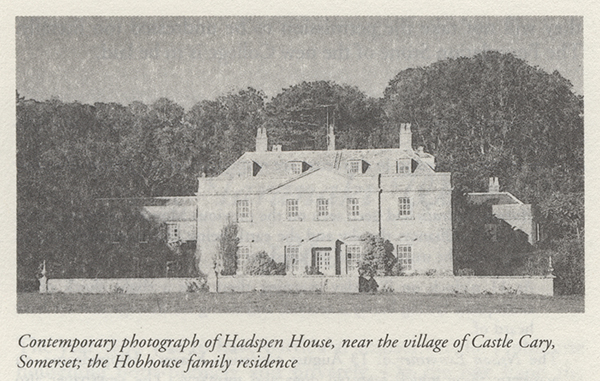
I sit down with a picture of Hadspen hanging opposite me. Hadspen always comes before my imagination in its brightest colours in autumn, which was the season in which I first made its acquaintance and last visited it.
Edmund is still absent on a long pilgrimage begun a month ago which was to take him the whole length of his own diocese, and land him in the Canterbury province.
In his absence this episcopal hotel and boarding-house contains besides myself 2 clergymen, (Mr. Pritt his chaplain being one, and Mr. Tudor, a circulating, Maori-speaking deacon another), an aspirant for a schoolmaster's post who is improving his education under Mr. Pritt, and doing instead of teaching, 'common things' as they would be called in educational works, for us. And lastly a very deserving but not very brilliant person, a Mr. Jennens [sic] of respectable family, whose advancement in life seems barred by various accidents and deficiencies and who has crept under Edmund's wing for the next few weeks until he can see his way more clearly for future employment.
I must say when I sit down to pour out tea for them I feel very much as if I kept a school or an Inn, but I rejoice at having every room in the house full because then occasional visitors of a sort that have to be entertained and looked after, and of whom I dread an incursion in the midst of other occupations are at once put out of the question. There is one consideration however that always stops my inclination to grumble at the destruction of all domestic privacy in this mode of life, and that is that it is broken up by those to whom a temporary home is a great comfort, or else by some unfortunate overworked women to whom a few days' holiday is a treat.
[Image of page 45]
3 December
[To the Hobhouse family]
Our good schoolmaster (No. 1) Mr Philpotts continues to be the stay of the family, milks the cows, feeds the pigs and the calf, makes wheelbarrows, rolling pins and benches, teaches the boys singing, rings our early bell to rouse the family in the morning and when Edmund is away pumps water and chops wood.
I must go and call on the wife of the Captain of a Queen's ship just come in and I am afraid I ought to take her some strawberries if she is in a dismal lodging. I should not grudge it if she would come and pick them herself, but who is to gather the fruit is and will be a difficulty. Edmund has just demolished in 5 minutes the result of some 25 minutes of my labour in strawberry picking.
The Governor 3 being here is of course a prodigious event in our annals. The good Cabinet Maker who is kind enough to 'superintend' our public affairs does not go out in the line of 'receiving' or 'representing' so on these occasions the Governor does the best he can for himself. He is to have on Monday an undressed Levee at Freemason's Hall which in plain terms means an unwashed Levee. The Maoris will muster strong. We hope
[Image of page 46]
they will not take the permission to be undressed too literally. The Foundation Stone of the new College is to be laid.
[Endnotes on the rest of page 46]