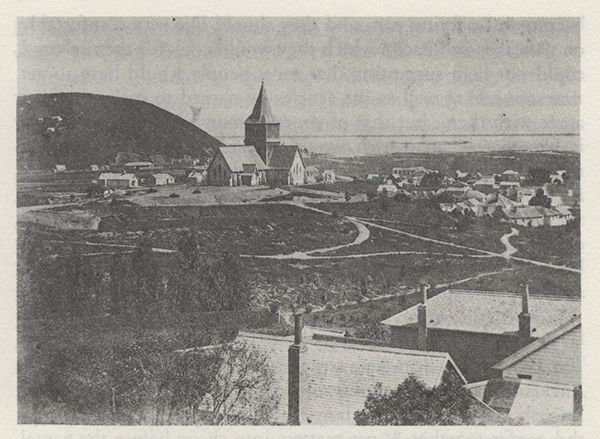
General Synod Meets in Nelson, 1862
Page 82
[Most of page 82 omitted as it remains in copyright]
29 January
[To her cousin Augusta]
I am expecting another grandchild which I hope may prove the last, in May, but I do not dread its arrival as much as I did the
[Image of page 83]
former ones having suffered so much less & I shall be very glad if my poor little Wakky gets a nice companion, as the position of an only child is always unsatisfactory.
At this moment the Bishop of N. Z. is staying with us, in anticipation of a General Synod, and one of my first conversations with him threw light at once on the calculation of necessary income for a Colonial Bishop, which I mentioned to you last year. He was regretting that he had not advised his Auckland Clergy to bring their tents which they could have pitched in our garden, and so been saved the expense of lodgings, which poor things they can ill afford. Now I, having but 2 active girls and 1 delicate housekeeper as my whole staff (I don't reckon the nurse, whom I never dream of asking to do anything unconnected with the baby) trembled as I saw in my imagination an encamped host of clergy besides our own house full to the brim, to be cooked for and washed up for, so I enquired how, if people lodged in tents, they were to be fed? Oh, he said, nothing could be simpler; if he and Bishop Patteson had a tent they should get some tea and sugar, a sack of flour, a piece of
[Image of page 84]
bacon, and a frying pan, and they should live very comfortably on pancakes and bacon which they would cook for themselves. I could not help suggesting that most people would have to get new stomachs as well as the articles he named to make this diet agree with them, but that of course a man whose own stomach is like that of an ostrich would not admit. There is another thing which he overlooks, that others do not share his wonderful capacity of working under the most disadvantageous circumstances, and that to most people a certain amount of space, quiet, regularity, and convenience, all most expensive articles here, are as necessary for the despatch of business as food and air are to their health.
[Her Synod record begins on 10 February.]
The Primate has been here a month already having arrived from Auckland on that Saturday of frightful whirl in wh the last English mail went out on Jany 11. It was expedient that the Bps shd confer together & get matters into shape before the actual meeting of Synod. The following Saturday brought the Bp of Chch & the Bp of Wellington was expected a few days later, but to the great disapp[ointmen]t of the Prelates the steamer came in without him. So they fell to work without him, & have been sitting daily in conclave in that useful building which has been successively coach-house, bed-room, Infant-school and Diocesan Library. (A green-gage tree wh grows over it they say has been a great resource during their discussions; the Bp of N.Z. declaring that until he saw the Bp of Chch shake the tree he always contented himself with what he found on the ground.)
You may be sure that in our chronic scarcity of clergy for Sunday Services, the opportunity of this increase in their number is not overlooked. The poor Primate had hardly set foot in the house (looking jaded enough to inspire pity in the heart of any one but a parish clergyman) when Edmund & Mr. Turton were laying their heads together to see what cd be got out of him the very next day. Of course he went into harness directly but I admired the wisdom of the Bp of Chch who when he arrived the following Saty from Otago a good deal tired with his exertions there, replied to Edmund's enquiries the moment
[Image of page 85]
he had swallowed his dinner as to what he would do? 'that he would rest and steadily declined any duty the following day.
Yesterday (Sunday 9) the whole Wellington forces arrived. The steamer was not due till today, but fortunately I had turned Wakky out of his nursery & sent him & his suite to Maria that we might be ready for the Abrahams & just as we were preparing to go to bed they made their appearance, Mrs. Abraham & Charley as well as the Bishop having walked from the Port, a distance of between 2 and 3 miles. You may imagine therefore how much stronger she is than she was 2 or 3 years ago. They brought with them Archdeacon Hadfield... but they had to leave the poor man lying on a mattrass on the floor at a little Inn at the Port, for the night, as he was too ill & weak from the effects of sea sickness to attempt to walk, & it was too late to wait for a vehicle to be summoned from the Town - so he only appeared today.
There is a great panic lest after all there should not be enough laymen to make a quorum, & consequently no acts can be formally passed. Not a single man from the Canterbury settlement either lay or clerical, but the Bishop! As the Bp says, the clergy there are all farmers -- & this is harvest time. [Selwyn] frequently regrets that he did not advise them to bring tents. I own I have two conflicting feelings as I see in my mind's eye an encamped host of clergy frying their pancakes & throwing out their slops in our garden. I cannot but admire the way in wh those who have been out long enough to have gone through the privations of early times take everything just as it comes and are satisfied with bare necessaries. At the same time I am not quite easy at the impossibility of finding out whether one's guests are really comfortable & have their wants supplied, or whether they are contentedly practising self denial.
Wednesday, Feb 12
Yesterday brought fr Auckland or at least by the steamer from the North, Bp Patteson, the Bishop of Waiapu, 3 Auckland Clergy & Archdeacon Govett from Taranaki, so that Bishops, Archdeacons, & Priests abound, but laity do not. So therefore though Synod has opened formally today, it is not Synod, there not being a quorum of each order. They hope however that in
[Image of page 86]
consequence of the Primate's urgent letters the needful number will be here in a week, & in the meanwhile they have resolved to go on as a Conference discussing matters, & preparing them for a formal ratification at the last.
This day began with Service & Communion at the Church at 9, before adjourning to the Provincial Hall (the Town Hall in fact) in the new government buildings, wh has been politely granted for the use of the Synod. I hear that at the Service there were not half a dozen people besides the members of Synod, and there were only about a dozen or twenty ladies present to hear the address. Immediately after the Address the names of Members duly elected were first read over by the Bp of each Diocese, and then read out as a roll-call to be answered by those present. The poor Bp of Chch having read out his list of absentees once, sat down, but the Primate cruelly called upon him to summon them all by name again, though knowing perfectly there was not one there.
They all came rushing back for dinner about 3, & have settled to meet for General Synodical Conference at 4 daily, but the whole day will be taken up in Comm[itt]ees, for those at least who have capacity enough to work in them.
[This separate letter appears to be part of a letter, copied in Eliza's handwriting, probably for circulation among the family. It adds some amusing glimpses of the social side of the General Synod. It evidently refers to the gathering mentioned in Mary's journal of the Synod dated 21 February.]
I really must relate to you how yesterday evening your largest Paraffin Lamp shed light upon 6 Bishops & some 35 or 40 other persons as they aired themselves by turns in the vine wreathed verandah turned for the occasion into another room.
I never before embarked on so spirited an undertaking as the hospitalities of yesterday - but the real gratification afforded to the good people of Nelson & our country neighbours by the gathering & by the opportunity of seeing the Bishops assembled here for the General Synod repaid one for the trouble.
We have all the Bishops in our house except Bp Patteson, besides the Archdeacon of Wellington and the Bp of W[ellington]'s wife and child.
[Image of page 87]
|
|
Note
|
|
| 6 Bishops were
|
|
|
| 1841
|
New Zealand
|
Selwyn (Primate)
|
| [1856]
|
Christchurch
|
Harper
|
| 1858
|
Wellington
|
Abraham
|
| 1858
|
Nelson
|
Hobhouse
|
| 1859
|
Williams
|
Waiapu
|
| 1860 [sic: 1861]
|
Patteson
|
Melanesia
|
You will wonder how they are stowed away!!
It is necessary to have simplified one's ideas of the preparation required for guests, especially in the kitchen department before one could with a small house already full and a staff of 3 maid servants, undertake a great luncheon party & another in the evening. But with regard to our inmates, as they have all gone through Bishop Selwyn's bacon & frying pan period - except indeed the good Bishop of Chch - one felt that to them roast beef and apple pie must bear the stamp of an advanced - tho' not I trust a pampered - civilization.
Their daily claims being easily disposed of, one had to consider one's means of satisfying those of the persons invited to meet them - I have always remembered the signal success of our good friend Mr. Tudor's primitive dejeuner a la fourchette and I was encouraged to tread in his steps.
Having made my preliminary arrangements I was at first rather dismayed, when it came to getting the supplies. Not a fowl nor winged creature to be had for love or money! The last tongue & ham in the place were gone! so we had to shoot our own young hens & use up our last resources in the way of home cured tongues & hams & with the help of a proper cook to furnish forth pies & pastry we did very well. Then we secured the services of a man to wait who having arrived early made himself thoroughly master of the ground & proceeded throughout the day as if he had been one's butler for a year.
I feel myself inexpressibly grateful to him! for when our 30 daylight friends departed (after coffee in the verandah) I enjoyed an hour's repose of mind & body before the arrival of my candle light guests & this brings me round to the Paraffin Lamp (and several stable lanthorns which much to the admiration of
[Image of page 88]
the company illuminated the festoons of vine & hop in the verandah) & so (as the man used to say in shewing the Tower) you end as you begun.
Friday 22d
Besides a large party on Monday we entertained on Wedy. upwards of 50 people, those frm. the country at luncheon, & the rest in the evening, besides inmates & strange Clerks. But today it has become Synod formal & proper, the lay quorum having arrived.
[Mary's journal continues:]
Having got their quorum there will be a tremendous push to get through business in the next 2 or 3 days, especially as the Wellington people expect their steamer to carry them off on Sunday night (the day after tomorrow). Business can proceed after they are gone, but of course it is an object that they should be present at the more important discussions, especially as Adn Hadfield who is one of them is the only match for our meddlesome friend Mr. Bagshawe. Mr Bagshawe is at the bottom of this as of every other turbulent move, but makes large use of cats paws. He is as the Bishop of Wellington expresses it 'such a clever tumbler'.
The party in this house always comes back in the evening with their spirits apparently refreshed by their encounters in Synod, & it is most amusing to hear the Bp of Wton describing them. Unfortunately as the Synod sometimes does not break up till 8 o'clock, I am obliged to go to bed soon after their return & am tantalized by hearing them talking & laughing till 1/2 past 10 & sometimes later. I believe Mrs Abraham thoroughly enjoys the meeting of old friends, especially having the Primate in the house, & Bp Patteson constantly here (he is Mr. Turton's visitor) but her spirits never seem to rise. I wish much on her account as well as my own that Mrs. Selwyn cd hv been here for I suppose the life and exuberance of spirits wh she is said to have retained through everything would act more inspiritingly than anything else could on Mrs. Abraham. It is a happy thing that her husband's spirits are so unflagging. He is certainly the great source of life to the whole party, for one reason because I
[Image of page 89]
think he is the only person in it who is thoroughly at ease with the Primate, & thoroughly himself in his presence. It would be too much to say that we are all afraid of him, & yet it is certain that we all (excepting the Abrahams) talk more, & differently in his absence. One feels that it is so much better worth while to listen to him than to talk, & one also feels that his mind is too strongly pre-occupied with his own ceaseless flow of ideas to be in a condition fully to take in the drift of one's replies, & so one gradually utters little beyond monosyllables & short questions.
I often regret having the party so condensed. There seems such an embarras de richesses of people, each one of whom would have been at another time a prize in himself - one has not time to extract half the good of them.
All the Clergy from the other settlements are struck with the extent & heartiness of the congregational singing in Church, for which one is very thankful, especially as when we first came here it was so little the practice, that when one sang audibly people turned round, to see I suppose whether one of the choir had got out of his or her place. A lady with a strong clear soprano voice who is now one of Maria's chief assistants in her choir practices says frankly that she never sung in Church before thinking it unladylike, & when she first began she was very nervous about it, though she had frequently sung solos at the Harmonic concerts to an audience of half Nelson.
Tuesday, Feby. 25
Synod is actually over. But I must go back to the Friday on which I last made my notes. On that evening there was a missionary meeting of which the only fault was that there were too many speakers. The Primate's idea was to bring forward the speakers in chronological order, exhibiting the progress of the Church in N.Z. from its first missionary efforts, down to its latest offshoot the Melanesian work. Thus good old Bp. Williams as one of the early missionaries was to begin, others to follow, then the Primate was to come in himself, then the Bps. of Ch. Ch and Wellington as representatives of the later Colonial Ch. - but this was a part not 'understanded' of the vulgar, who as they said 'could not see what they had to do
[Image of page 90]
with the missions' - the idea of the oneness of the endowed Colonial Church & the missions to native races being rather too abstract a one for them.
Archdeacon Mansell [sic] an Irishman, & one of the old Church missionaries, was I believe the most diverting of the speakers - but the freshness of Bp Patteson's mission & the self-forgetting earnestness & simplicity with which he pleads for it made his speech one of the most acceptable.
Well, on Saturday we had the people's representative, the Superintendent, & his wife at luncheon to meet the Bps. But the Primate could not be dragged off the scene of action even for an hour, so that I had to send down food for him wh. Edmund insisted on his retiring to gulp down. I could not but admire the Superintendent, a cabinet maker by trade, who can never have associated with gentlemen till his elevation to office 5 years ago, for his combination of modesty & self-possession -and the absence of anything that cd be called vulgarity. We are fortunate, considering that the cry of the place is always to have a working-man, not to have some upstart demagogue in his place.
On Saturday too we had a great disappointment and failure. It had been suggested by someone & hailed by others, that all the Bps. should be photographed in a group, the photographers came two or three times to know if they wd consent & when they wd be ready but they could not be got to give any answer, & always went off upon every possible subject except what we wanted to pin them to. The Bp. of Wton too vowed that there was one photograph too many of him already, a frightful thing that had made him resolve never to be done again. So I resolved in despair to fix 8 o'clock in the morning, our usual breakfast hour, without consulting them, to have breakfast earlier, and then give the Bp. of Wton the choice of being taken with only his back visible. We breakfasted accordingly, they all consented & assembled in the verandah which was to be the background of the picture (Bp. Patteson had attended the muster) & by a provoking misunderstanding the artist never appeared, & they dispersed never again to re-assemble!
Archdn. Mansell [sic] had a service on Sunday in our Chapel for the Maories [sic] which gave them immense delight. The
[Image of page 91]
Bp. of Wton. who attended it did not listen with such unmixed feelings, though he was very much struck with the genius displayed in his oratory, for he said his acting amounted to the most perfect mimicry of Maori gesture & ranting & he was sometimes squatting on his heels Maori fashion, when he ought to have been kneeling or standing. The Adn. has a station on the Waikato, & when they came out of Chapel the Maories were heard saying to each other 'Can't Waikato do it?'
[Maunsell] and another Auckland clergyman 1 are representatives of the old school of Church Missionary watchdogs who sincerely believed it a part of their duty to worry Bishops. But that feeling happily has in a great degree worn off, and it has been remarked how much more cordially they have worked with the rest just now, than they would have done in former years.
I regret very much the want of opportunity to draw out from [the Bishop of Waiapu] the interesting histories of the early days of the Missions that he is able to give. He does not condense, nor give things in a few touches but likes to set to & tell a story full length, & this is just what time has lacked for. Archdn. Hadfield I shd like to know more of. At first sight he strikes one as a man of smaller calibre & slighter build than the rest, & as more quick-witted than wise. But when one sees more of him & finds how much capacity & cultivation he combines, how he has kept up his general studies in the midst of the roughest missionary life & how he dared to venture the first into the territories of one of the most savage & cruel of the old chiefs, being himself a fragile, excitable, nervous man & more addicted to books than to active life, one admires him more and more.
Thursday Feb 27
Much interest was shewn in the work of the Bishops & clergy by the attendance at the service they had yesterday before the final breaking up. As there was scarcely a person at the service on the opening of Synod, Edmund determined to have it in our Chapel in wh there are only seats for about 24 people, since the Sunday service there has been given up. Hearing however as the time approached that many people were dropping in, we got
[Image of page 92]
more benches and chairs, - & I suppose there must have been at least 40 people altogether.
I am glad to find that at the next [General Synod] a regular Committee will be formed before-hand for arranging the accommodation for clergy & laity from a distance. It appears to me (with all deference to the Primate) that the days when tents and frying-pans were appropriate accommodation for them, are now gone by.
I am sorry to say that in spite of the abatement of work this week Edmund's head does not appear at all to improve - and I am disappointed to see in comparing him with others, how much more he suffers from the same amount of work.
[With the end of the General Synod, Mary's journal ends and her normal correspondence is resumed. ]
24 March 1862
Though I neglect all my correspondents by turns I still find more time than I really can afford is consumed in letters. The fact is I perform the mechanical act of writing very slowly as compared with other people, I find it takes me on an average nearly 40 minutes for every sheet of note paper I cover, so when you get a letter of 6 sheets it represents 4 hours or a whole morning's work. Moreover at the end of it my head is often fit for nothing else for the rest of the day.
April 3
Had I known my dear Eliza that I should be taken ill [go into labour] today instead of May 3 according to my intentions I should not have spent so much scribble [in my last letter] on Wakky's wardrobe, neither would Edmund and Maria have been airing up the country 13 or 14 miles off, and on the wrong side of the river. Mr. Turton with his usual kindness has sent up to them & the satisfactory tidings has [sic] reached me that the river is not unpleasant in spite of pouring rain.
I trust please God good tidings may accompany or rather precede this dear Eliza, though the prematureness is always an additional anxiety. Should it please God I have a living baby to nurse I must be much more careful than I was about using my
[Image of page 93]
brains or encountering a bustle. Last time a mail day, though I thought I wrote very little, deprived my poor Wakky of a good deal of his sustenance.
April 30, 1862
Last Sunday being the 1st after Easter I was able to go to Ch[urch] with 2 little Sons & assist at Walter's baptism. Eddy was taken because everyone else was going - he behaved admirably as to loquacity, but unfortunately his propensity to climb led to a difference between him & his nurse which led to his ultimate expulsion.
The small creature who has now had 3 weeks and 3 days' experience of life has, I am thankful to say, thriven without interruption - & has seldom been awake except long enough to get his food - a great merit in every point of view.
Nelson, August 30, 1862
My dear Eliza
Doubtless at daybreak tomorrow he [Eddy] will begin exhorting 'Edden' to sing all his favourite songs - He certainly has an ear, for if I hum two or three bars of any song he can always suggest the right words - & the other day when he insisted on Maria playing without a book a march wh. I played often to him but wh. she does not know, & therefore picked out as best as she could, with a great many wrong notes, he listened attentively for a minute then called out 'funny'! & burst out laughing - But these anecdotes have no business in an epitome & can only be excused on the ground that he is yr. godson & today his birthday - As for little Walter (who continues to be an object of the tenderest adoration to Eddy) he is thriving so fast on baked flour & cows milk, & plenty of fresh air, that I daresay he will rival his brother as the prize baby of Nelson, by & bye.
I have not time to depict my own family circle for the last few weeks. I can only say that it has included a young lady whose turn of thought and mode of expression is what I should not even have imagined but for the help of Dickens and my slight acquaintance with him. I often wonder as I hear her speak, just as one does in reading Dickens, how she can have
[Image of page 94]
thought of such ingeniously vulgar things as she says. But so prolonged a visit from Mrs Quilp or Mrs. Gamp is rather wearisome and I am glad that it is drawing to a close - useful as the poor girl has been in a domestic capacity.
Vicissitudes of Colonial Life
Nelson, August 1862
'Well, Mrs. Stuart I am come to beg from you' addressed to a neat comfortable little woman working in her garden. 'Weel mem' replies Mrs. Stuart. 'Could you spare Kitty to come to us for a week? Elizabeth is gone home with the mumps, & Hill is not well & I want to send Ann 2 back with her Father who has to return today, & I don't know what we shall do if you can't let us have Kitty'.
'Oh yes mem. Kitty shall come if ye wish it, but I shall be glad to have her back again when ye can spare her, for she's very useful to me.'
This is the sort of conversation that takes the place of the condescending permission of the Squire's or Clergyman's wife in story books to the deserving girl to come into the kitchen or nursery, & the rapturous gratitude of the Mother upon receiving it. And this is actually the conversation I had one afternoon not long since when I had resolved to strain a point to send our pretty housemaid for some weeks out of the way of a whimsical lover with £400 a year who was bent on marrying her then and there after having recently jilted her & shewn himself to be a very unsatisfactory person. So the girl with the lover went home & the girl with the mumps went home, and the young lady who is visiting me & speaks worse English than both the girls put together, did a large share of their work very goodnaturedly, but it was not a comfortable state of things.
9 September
We have now as visitors in the house 2 of the roughest specimens of colonial growth that I have seen. This poor girl Miss Gibbs is one, a certain Horace Jennings is the other, and really it makes one sad to see what a gentleman's son can come to out here. The boy is 16, sharp & useful in all matters of common
[Image of page 95]
life, & well meaning, but as thorough a clown as ever walked by a plough. He does not know how to sit or how to eat or how to talk & seems not to have an interest or an idea beyond the things & people he has last seen in the street. There is not a sentence he utters that would not come as naturally from a common labourer, except that in accent & grammar he does shew some symptom of better descent, & in that respect he contrasts with Miss Gibbs.
You can hardly imagine what it is to be in constant intercourse for weeks with a person whose pronunciation is so extraordinary that you often are at a loss to understand what she says. The absence of hs is a mere trifle so is that of 'an', a form of the article with which she is quite unacquainted, but it is difficult to follow a number of words deprived of their final letters & all melted together except the last which is lengthened with a nasal sound as if to make up the time. I tried at first to cure her of saying 'I see 'im come 'ome long 'go. He 'ad fell down & hurt hisself dreadful' etc. but I found it was quite useless, for the superficial vulgarity is but an index of what is within. 'Mrs 'obhouse are you fond of conversation lollies?' was a question with wh she mystified me one day. I got an explanation but [it] is hardly worthwhile to forward it to you as you are not likely to be examined on the subject.
To illustrate Colonial life still further I went to the gate this morning & met 2 little girls, children of an M.D. with a very sick wife & large family just coming in with a bundle. 'Please Mrs. Hobhouse' said the elder, 'Mama will be very glad if you will take Alice for a few days for she thinks baby is dying' etc. (I had invited the child some weeks ago, I should say, or they would not have thought of sending her).
Staplegrove (Captain Blundell's),
Nelson Oct 9 1862
[To Eliza]
The Synod has on the whole been satisfactory, & has got through business in a more business-like way than previous ones. It might have been over much sooner & with much less storm but for the factious opposition of Mr. Bagshawe on
[Image of page 96]
almost every thing proposed. Edmund has stood the strain wonderfully well, but is very much jaded now, & it is well that he had to start immediately on a journey. It is so inconvenient for me to leave home at present, & such a vexation to me to start just before the mail, but I was anxious he should have someone to divert his thoughts from business. I shall not go beyond Motueka.
8 November 1862
My comfort has been greatly increased by the purchase of a butcher's pony, on wh I can ride about quite alone, so that what formerly I could not do without tiring myself for the day I can accomplish without fatigue & with much benefit from fresh air - & it is a special comfort by enabling me to get up to Maria in 10 minutes at any time of day I want to see her.