CHAPTER X: OLD NEW ZEALAND.
[Image of page 142]
CHAPTER X.
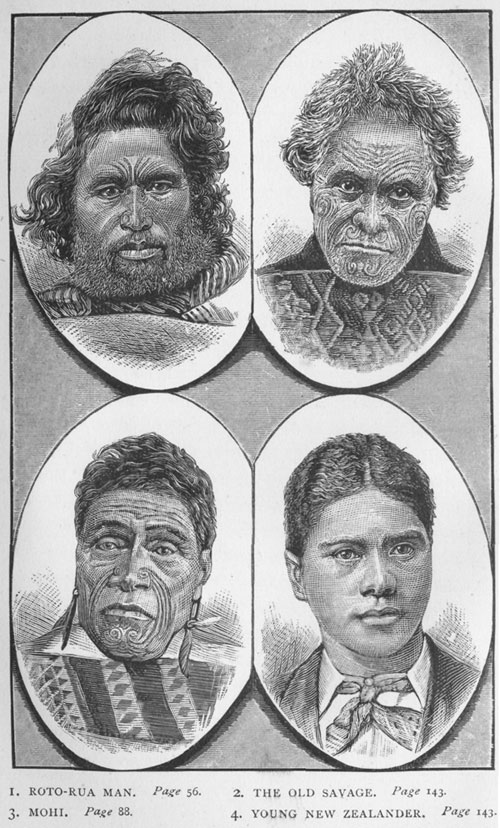
THE grand breed of chiefs, such as we knew in the first years of our residence in New Zealand, is fast passing away. Christianity and civilisation have both helped to break down their position. The head of each tribe was formerly from early infancy, treated with the utmost deference. He ruled over his mother and all his slaves with despotic power. He was fed with the best of food. Slaves cultivated the ground, and snared birds for him. He had his eel preserves, which no one dared intrude on on pain of death. When he grew older and was about to go out for the first time to war, he was put into a state of tapu by the priest, i. e., was consecrated, so that for a time he must not even feed himself. He might have an unlimited number of wives, and if he chose to put one of these to death, no one dared to interfere. The natural outcome of this training was that such a man became, if of a noble nature, dignified and commanding. St. Paul's words about the heathen of his time, who, having not the law, are a law unto themselves, often came to our
[Inserted illustration]
[Image of page 143]
minds as we became acquainted with this old breed of chiefs. Some so self-restrained, grave, and courteous; others cruel, ill-bred, sensual tyrants. One such we knew who was head of all the tribes in the upper part of the Thames. He had the look of a wild beast. His eyes were blood-shot, and glared with passion on the smallest provocation, and his high birth did not prevent his being a shameless beggar. To the praise of the New Zealanders be it recorded that the chiefs, as soon as they became Christians, set their slaves free. Those who had been taken in war, as a rule, thankfully returned home, leaving their old master to till the ground for himself. He thus lost the power of exercising large hospitality, and, as wars ceased, of winning fame. Now the young New Zealand chiefs go to English schools, work for settlers, and mix on equal terms with all the nobodies in their village. We had a friend named Kawau (Anglice, Cormorant), who lived a few miles off, and was a fine type of the old Maori chief. He was very tall and big. He was a warm admirer of the Bishop, and never failed to attend any festivities at St. John's College; but he could not make up his mind to accept Christian teaching and be baptised. He had several wives, and was unwilling to give up any of them. He had too a long-standing feud with the Waikato people, and was always ready to go to war with them. The bad conduct of two of his sons, who
[Image of page 144]
had been baptised some years before, was a great stumbling-block to him. But at last peace was made with his old enemies, and he fell ill; and on his recovery, after many months of suffering, he expressed great anxiety to become a catechumen. After much preparation, Kawau was baptised in the native chapel near his own pah. It was in the autumn time, calm and still, with a soft grey light over sea and sky and the distant hills. The chapel was approached through an open grassy glade in a wood, and stood, perched on a small promontory from which one commands a fine view of the harbour and the headlands around. The Bishop and some of the Clergy walked up the hill from the beach, followed by Kawau and a train of men and women. The noble old chief was dressed in a long dark blue military cloak, lined with red. There was a great discussion before the service as to what name the convert should have. The people finally decided on Abishai, son of Zeruiah, because he was a great warrior. The chapel was crowded. The old man distinctly and earnestly assented. When all was ended, the Bishop turned to the congregation and spoke strongly and solemnly to them, reminding them how their want of steadfastness in the Christian course hindered their heathen brethren, how vain it was to hope to win others to the Church of Christ when they were seen "now in, now out, obedient for a little while, then rebelling against all restraint."
[Image of page 145]
Then he turned to Kawau, took his hand, spoke a few words of affectionate welcome and of warning, and, placing his hands on the old man's head, gave him his blessing. Abishai continued a faithful Christian man, and received Holy Communion many years after from Bishop Selwyn's hands on the day that he finally left New Zealand.
We often received visits from another great chief who lived on the North Shore. He was between seventy and eighty when we first knew him, and was upright and very vigorous. We could make a fair guess at his age, because he remembered Captain Cook's coming to Hauraki in 1773. He used to tell us of his going down into the cabin and having biscuits given to him. His head just reached up to the edge of the table; so he must have been five or six years old. The settlers had a great respect for this old man. He was popularly called Hook-nose. He had fine features, and when he stood up with a dog-skin mat over his shoulder, and a spear in his hand, looked a born ruler. Curiously enough, he was able to throw light on an incident narrated in Cook's voyages. It is told there that one of the natives who came on board stole a piece of calico, and got with it into a canoe alongside. Captain Cook ordered his men to fire at the thief as he paddled away. The next day the same canoe came with a large party of natives. The man who had
[Image of page 146]
stolen the goods was not there, nor was he ever seen again. Cook supposed that he had been killed, and wondered that no grudge or ill-will was shown by the survivors. Hook-nose told us that he was in the canoe when the man was fired at. He died just as the party got to shore. His friends lifted the body out, and found the piece of calico underneath soaked with blood. A council was held, and it was decided that the deceased had paid the just utu 1 for his offence. So they buried the calico with the dead body, counted the whole affair settled, and felt free to continue friendly relations with the white people.
Councils used to be held on all important subjects by the elders of each tribe, and some men were noted for their powers of oratory. It was difficult for the most acute Maori student to follow one of the old men when he got warmed and excited in speech. In our days the Maoris delighted to hold committees on all subjects. The Judge was appealed to one day by a party of men who had met together to consider what Phoebe's work, Romans xvi. i, could be. Instead of "a servant of the Church," the then Maori version had "a minister." They were in great per-
[Image of page 147]
plexity. What could a woman do to be spoken of thus? She could not preach, for St. Paul forbade that in another Epistle; nor might she read in public. One man had made a happy suggestion: "Perhaps she rang the church bell!"