[Chapter XIV]
[Image of page 153]
CHAPTER XIV.
PRECAUTIONARY MEASURES.--CAPTIVE WOMEN.--AND LIVING SCAPEGOATS.--ARRANGEMRNT OF FAMILY COMFORTS.--EVILS OF POLYGAMY TO SOCIETY.--FRACAS AMONG SLAVES.--ADOPT THE MANNERS OF THEIR MISTRESSES.--HANDMAIDS AND CONCUBINES.--DISTINCTION WITHOUT A DIFFERENCE.--RESPECTIVE RANK TAKEN BY MISTRESSES IN A HOUSEHOLD.--FEMALE SUPREMACY.--ARDOUR OF FEMALE AFFECTION IN NEW ZEALAND.--SELF IMMOLATION OF WOMEN.--CONDUCT OF RELATIVES ON SUCH OCCASIONS.--ANECDOTE.--LYING IN STATE.--FAITHFULNESS TO EUROPEANS.--PRIDE AND OBSTINACY OF CHIEF FEMALES.--WIDOWS.--DIVORCE, ITS INSTITUTION AND CAUSES.--RECORDS ON THIS SUBJECT.--MEANS OF PROCURING SEPARATION BY MEN AND WOMEN.--RESULTS OF THE SYSTEMS.--CONDUCT OF WIDOWS ON THE DECEASE OF THEIR HUSBANDS.--LUCKY AND UNLUCKY DAYS FOR MARRIAGE.
THE same caution is not always required from the husband in taking an additional rib to himself. Women captured in battle are taken to wife by the captors, when the latter feel interested in so doing, otherwise they become slaves, literally hewers of wood and drawers of water. A woman raised from slavery to the embraces of her master, gains but little by the exchange of condition (if such it can be called,) as she becomes the scape-goat on which the free women and children of the house vent their spleen and ill-humours.
[Image of page 154]
The next care that engaged the attention of Wata after obtaining the consent of his wife, was to protect the new addition to his family comforts from being insulted on being inducted into her new and somewhat equivocal home. To effect this he was continually declaring of the outrage he had done his feelings; to soothe which the prima donna promised to receive her new relation.
In the sacred writings, the evils of polygamy are distinctly visible to the reader, between the mistresses and the handmaids. 1
[Image of page 155]
Nor are quarrels confined to the married women. As soon as a new wife makes her appearance with her slaves, the servants of the previous wives take umbrage, and aping the manners, and adopting the feelings of their respective mistresses (as is customary among more civilized folks) regard themselves superior to the new comers, in the same ratio, (but with more insolence) as the earlier wives contemn their successors. This is only avoided when a difference of sexes among the slaves induces a conjugal arrangement, which is the only way such an incongruous household can be managed. Among the women, the greatest possible animosity, jealousy, quarrelling and fighting, at times prevail.
On feasts being given, or when a fishing party is proposed, the first wife is accounted mistress of the ceremonies, and is looked up to with deference accordingly. At such periods, mutual good offices take place among the wives. The eldest is pleased and flattered with her supremacy; the juniors are delighted to get peace and quietness at the expense of a little self-infliction.
[Image of page 156]
The cruelty practised by the senior women, in the absence of the husband, is as vindictive as degrading to human nature. Should the hapless woman be in the way of becoming a mother, means are used to disappoint the husband from becoming a parent. If they prove unsuccessful, an attempt is made to make the husband believe the poor woman has been unfaithful to him during his absence.
The ardour of affection or rather devotion, that has been exhibited by the sex in New Zealand, has never been surpassed at any period or in any country.
Until within the last seven years, the native wife immolating herself at the death of her husband was a common occurrence that elicited no surprise. This suicide was effected by hanging, drowning, strangulation, and even starvation, rigorously abstaining from food, and so far from the relatives interfering to prevent the practice, it was customary for the family to form a rope of flax, and give it to the victim, who retired into the adjoining bush and put a period to her existence.
In India, when the heart of a devoted victim to the suttee of her dead husband misgave her, the poor wretch was dragged and thrown headlong into the flames; instances frequently occurring where the frantic sufferer has rushed from the blazing pile, enveloped in flames: but rarely self-immolation was forced on the benighted women in New
[Image of page 157]
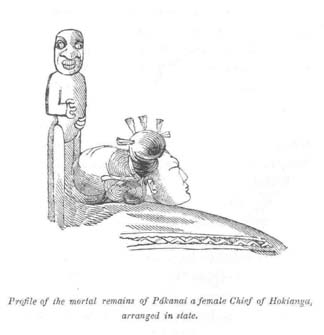
Zealand; yet it was solemnly inculcated as a paramount duty for the head wife, at least, to sacrifice herself, in order to accompany her husband on his road to the Reinga . A chief named Parenui , died while we travelled on the west coast of the Northern Island, on which three of his wives sacrificed themselves. To aid this family in their eternal route several slaves were murdered to assist their master in future existence. The females were laid in great state by the side of the husband; the slaves were immediately buried, as such sacrifices are not per-
[Image of page 158]
mitted to be devoured. Some melancholy occurrences often took place in consequence of the false intelligence hourly promulgated among the people. If a wife has heard that her husband had been killed while absent on a distant expedition, she has taken a cord and hung herself. When the news proves false, the messenger (generally a slave) is murdered for his conduct. Innumerable anecdotes could be adduced to illustrate the fact of immolation in New Zealand. The feeling of devotion that leads a woman to commit such a crime has often been transferred to their European partners, who have in general showed a good example to the native husband. Many a female has twisted her rope of flax, determined not to survive her lover, who has been prostrated on a bed of sickness. Many females, personally known to the writer, have departed in this manner from existence.
As the head wife generally committed suicide, but little commiseration was felt by the surviving women, who in some degree felt disinthralled from a life that had been made miserable to them in the extreme. The pride and obstinacy of chief women, are scarcely credible; many have committed suicide on their inclinations being thwarted, or their stubbornness resisted; hanging and drowning has generally been resorted to. The widow of a deceased chief rarely marries again; and yet more rarely below the rank held by her first husband. A slave
[Image of page 159]
wife is allowed to re-marry, but she remains a slave in the family.
Divorces, or putting away of wives, are not of unfrequent occurrence among this people. 2 This may arise from a variety of causes; as the decline of conjugal affection, barrenness of the wife, or introduction of new claimants to the titular honour. A husband has been induced to separate, from his children being ill-used by a step-mother, or the act of infanticide on the part of a mother.
Many other causes induce separation among the New Zealanders: extravagance in squandering pro-
[Image of page 160]
visions, idleness, too much coquetry, infusing suspicions of jealousy, and refusing to admit a sleeping partner in the conjugal firm. The method pursued to effect a divorce, if sought for by the lady, is simply seeking shelter among her parents and friends; and should the husband be desirous of breaking the connexion, he is satisfied as to the step taken by the wife; this is a divorce enabling both to marry; but should the husband regret her absence, he first employs persuasion, and should he disregard the power of her friends, employs threats; but if the woman should continue to remain obstinate, he tries to waylay her, or calling some friends to his assistance to enable him to effect by force, what he has found to be ineffectual by entreaty. In this the feelings of the wife are not consulted; she is often made to suffer severely in person. One party being anxious to force her away, the other to effect her detention. When both parties are willing to separate, the property of both is fairly divided, and they can marry when they please. 3 If they have
[Image of page 161]
children, much discussion arises, as to whom they belong; but if the father insists on claiming them, his right prevails. Divorcees have been known to kill their children, to obtain a separation. A female once divorced is freed from future insult from her late husband; should he, regardless of custom, continue to annoy her, he is liable to suffer severely for his conduct from her relations.
On a female becoming a widow, whether possessing affection or not for her husband, she utters the most frantic cries, throwing herself with marks of unconsolable agony on the inanimate remains, tearing her hair, excoriating her face, arms, breast, with her finger-nails or muscle-shells, until she absolutely becomes undistinguishable from blood and filth. The other women also, made widows by the same stroke, join in with similar howling and lamentations. Huddling together, they cover themselves within a garment, yell in chorus tones of distraction and sorrow, scorning any attempt towards being comforted. Should they re-marry at an after-period, a priest is consulted, to divine whether the future husband is likely to become the survivor or not. 4
[Image of page 162]
[Only a footnote on this page]