CHAPTER XX.
[Image of page 217]
CHAPTER XX.
MECHANICAL INVENTION IN CANOE BUILDING.----FORMATION OF THEM---- PROGRESS OF LABOUR.----DEFICIENCY OF IMPLEMENTS.----DESCRIPTION OF A FIRST-RATE.----EXTRANEOUS ORNAMENTS.----HEIROGLYPHIC PAINTING. --PADDLE.----INCITEMENTS USED FOR PROPELLING CANOES.----NATIVE CARPENTERS.----ROPE AND SAIL MAKERS.----PAINTERS.----CARVERS----CANOE NAVIGATION.----SUBSTITUTE FOR CANVAS.----THE TIARU.----THE MOKI.----CANOES OF RAUPO.----ANCHORS.----CELEBRATED PORTS FOR THE MANUFACTURE OF CANOES.----SYSTEM OF EXCHANGES.----ARTISTICAL TRIBES.----FAVOURITE DESIQNS AND DEMANDS.----CARVED BOXES.
THE mechanical invention of the New Zealanders is principally confined to the wakiro or art of carving; the canoes and house-boards evince this fact. Canoes are as various in name as length, breadth, and topsides can cause. The te wai is the least ornamented without being raised on the side, and generally formed from one undivided tree; they vary in length from six feet to sixty. The building, if we may so term it, of a large canoe, consumes some months ere brought to completion. Antecedent to the introduction of iron implements, a large tree was felled by fire being applied to the roots on the windward side, which required being continually fed by fuel, and being a work of time, the slow progress served to harden
[Image of page 218]
the wood, by drying the sap and rendering manual labour more difficult in the achievement. When felled, the same agency was made use of to hollow and widen the trunk; it was afterwards dressed with stone adzes or axes, most barbarous apologies for those invaluable implements of steel. Canoes are now obtained, by the intended builders laying the axe to the root, three or four persons engaging on the trunk of the tree at the same time. Fire is made use of to widen the body of the tree, and the dressing that follows proves that the natives are able workmen in wielding the axe and adze. Some canoes are fully eighty feet in length, upwards of six feet beam, four feet in depth; the bottom being worked to the sharpness of a wedge, the sides are consequently well projected. In order to support the topsides or shore-planks, the gunnels are two inches in thickness, and, towards the keel, three inches. The two side planks are also formed from one large tree, dubbed down with much care, and no little stock of patience; these are lashed to the hull by holes being made in the canoes and the plank sheer, and fastened with withes of flax. A piece of lath, painted black, and decorated with feathers, covers the seam, and to prevent leaking as the vessel rolls, is caulked with the down, of bulrushes. The beam of the canoe is preserved by a number of thwarts, laid across the gunwales, to which they are lashed with cords of flax.
[Image of page 219]
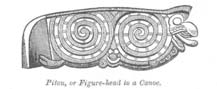
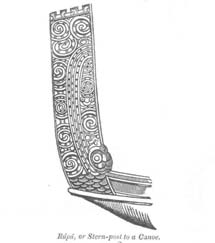
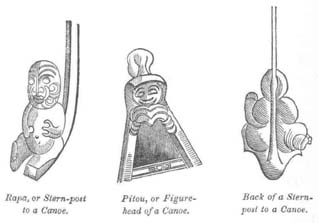
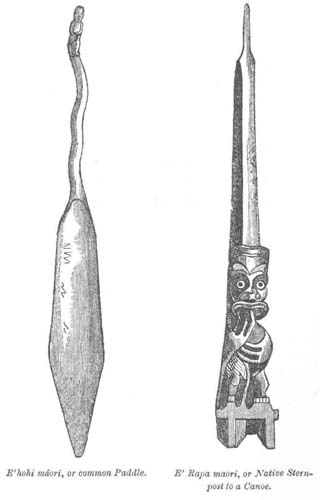
The Pitou and Rapa, as figured below, notwithstanding the projection of the former, and the height of the latter, are simply made fast to the head and stern by flax-cords without the aid of dovetailing, wooden pins, or nails, and yet withstand the heavy assaults of the sea when pitching forwards.
The pitou , or figure-head, is neatly fitted and lashed to the bows, projecting four feet beyond the hull, and three or four feet in height. The rapa , or
[Image of page 220]
ornament for the stern, is often eight feet in height, and even higher, two inches thick, and eighteen inches in breadth.
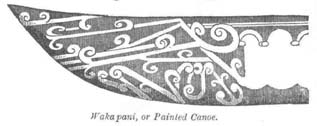
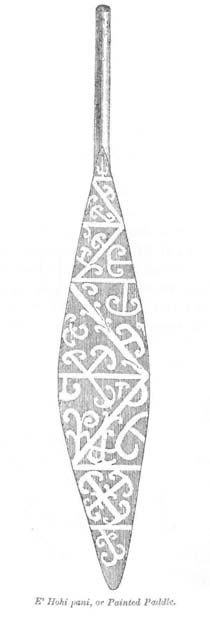
On gala days, garlands of divided feathers, stripped from the plume of sea-birds, are appended from the stem and stern, and assisted by the red mixture of kokowai , altogether presents an imposing and beautiful appearance on its native element. The carvings are often most grotesque. In addition to which, a variety of hieroglyphics, resembling tattooing, adorns the hull, painted in white or black on a red ground. The paddles for pro-
[Image of page 221]
pelling a canoe are principally shaped from the kaikatoa , and when dry are extremely light, and fitted to bear a heavy strain of water. They are made extremely neat, the centre of the blade is the broadest part, tapering to a point. A carved paddle
[Image of page 222]
is rarely seen, and is used by its owner as a truncheon to be displayed on gala days, when the chiefs stand up in the canoe, shouting and waving to the rowers to incite them to exertion, or as the solos which are responded to by a chorus, and the exact keeping of time effected by beating the paddle in the water, which propels the canoe with great velocity. Paddles are generally four or five feet long, and those made use of for steering are six feet, and form the only rudder that the peculiar shape of a canoe can admit of as serviceable.
Paddles are almost invariably made of the Kaikatoa tree, (Philadelphus Australis,) a polyanthus, termed the sea-plant, from the leaves possessing the myrtiform appearance of the Chinese herb. It bears a profusion of white and pink blossoms throughout the year, emitting an odour that gives a pleasing fragrance to the vicinity. Similar to the British Ash, it possesses an elasticity that enables the light thin paddle, whose blade at the edges is scarcely the sixth of an inch thick, to resist the powerful waves that impetuously lave the sea-girt shores, whereas paddles formed from a hundred various hard woods of the country, would immediately on trial snap asunder from their brittleness.
[Image of page 223]
[Image of page 224]
Outriggers, invariably made use of by the South Sea Islanders, are unknown in New Zealand, and canoes are never or rarely lashed together; nor are platforms raised over the gunwales, and sheds erected on them, as is the usage of the above nations.
As a war (or large) canoe, employs the carpenter, flax-dresser, rope-maker, painter, carver, caulker, and sail-maker; it is regarded in a similar manner as many vessels sailing out of a provincial port in Europe and America, the shareholders (or rather part proprietors) being more numerous in New Zealand, though shares of twenty and even ten pounds are held in ships in the United States. Some canoes are double banked, or two rowers placed on the same thwart to paddle on either side. A canoe can be propelled seven and eight miles an hour, but sailing they are only enabled to proceed before the wind; beating against a head sea or adverse wind being impossible, as these vessels have little hold from their shallowness in the water. Paddling is less fatiguing than might be supposed, and the chorusses alike chanted by free and bond relieve the exertion in a great degree. It is necessary that a canoe be well caulked, as they roll very much, the gunwales at times even with the water. They are found navigating every part of the coast, carefully hugging the shore. As in houses, no food may be eaten in a canoe when paddling in the vicinity of a sacred spot, and more
[Image of page 225]
than once we nearly met with a watery termination to our adventures, by incautiously neglecting to obey this command.
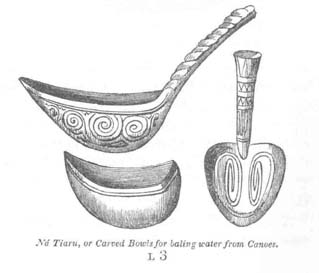
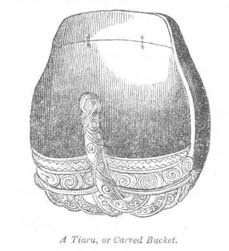
The sails are the most clumsy and heavy articles that could have been invented. In shape they are triangular, formed of bulrushes dried in the sun, and tacked together, the upper edge being cut into vandykes. It is fastened to two poles which serve for mast, yard, &c. The sheets are formed from plaited flax fastened to the head of each pole. To prevent the unpleasant position that the wedge-like bottom of the canoe would occasion to the rowers, a raised floor or grating of small stakes neatly put together, is laid down with openings to admit of the water being baled out, which is performed with an instrument called a tiaru or bucket (called tata to the southward) which is essentially necessary to the
[Image of page 226]
vessel, as in windy weather the canoes are kept in the trough of the sea (as it is termed) and are continually washed by the sprays. The tiaru in its carving generally denotes the invention or taste of the workman, the handles generally presenting some fanciful obscenities or absurdities. In the
absence of canoes, a quantity of dried bulrushes are fastened together, on which the native is enabled to cross a stream by sitting astride and paddling with his hands; these humble conveyances are called moki , and resemble those made use of by the Egyptians in crossing among the islands of the Nile. They are extremely buoyant, and resist saturation for a long period.
Among the early occupants of New Zealand, canoes were entirelv made of the bulrush. We
[Image of page 227]
have seen one of these vessels of olden times, nearly sixty feet in length, capable of holding as many persons, but they are now wholly in disuse. They were remarkably thick, formed entirely of rushes, except the thwarts, and resembled the model of a canoe in every particular. They were remarkably light, like the coracles of the ancient Britons, though many bundles of rushes were consumed in forming them, and were paddled with much velocity, until saturated, when they settled down in the water. These vessels are no longer formed, and specimens are extremely rare, having long since fallen into disuse. Canoes are generally anchored by filling a basket with one or more large stones, or (like the Chinese) a heavy piece of wood; in approaching bad weather they are carefully hauled up, care being taken (as with boats) to keep them even on their keel, to prevent straining.
There are very few rivers on the northward of the country where large canoes are made; to the southward of the Thames and Manukau, lat: 37 degrees 39' S., long: 172 degrees E., the principal portion are built; the most superior are to be found at Wairoa. (Hawkes' Bay) the tribes at that place employ the totarra or red pine, the kouri or white pine being rarely found beyond the Thames (Horake). On the East coast a system of barter is carried on between the natives of Turunga (Poverty bay) with those of Wairoa , the former furnishing blankets.
[Image of page 228]
muskets, powder, &c., in exchange for canoes, sails carvings, &c.
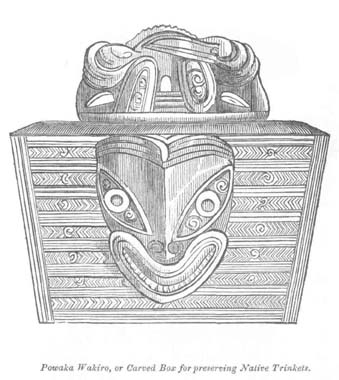
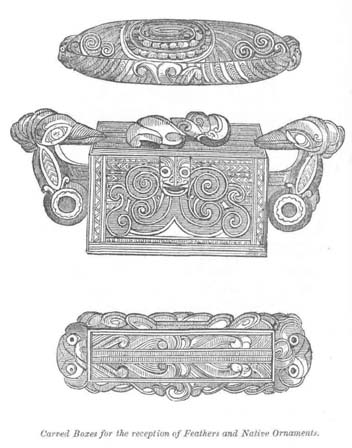
The most celebrated artists in carving, either reside at the East Cape, (Wai Appu) lat: 37 degrees 44' S., long: 178 degrees 36' E., or at Poverty Bay (Turunga ) one degree farther south; the principal feature is an intricacy of design not always confined to moral subjects, but the effect is extremely good, leaving certainly at an immeasurable distance, similar performances further north. The price demanded for a piece of carving was formerly so extremely small, that it is somewhat remarkable that the discouragement an artist met with did not disgust him from continuing to exercise the art. Among other favourite subjects, lizards are continually portrayed, and though we have seen many articles whose carving was at once a memento of ability, industry and perseverance, yet the generality of the designs were unlike any created thing known at the antipodes or either "in the heaven above, or in the earth beneath, or in the waters that are under the earth." The most elaborate carvings are bestowed on the boxes (powaka ) that serve to enclose feathers for decorating the head on gala days, and other portable trinkets. But the art is not confined to articles of native manufacture only, as we have obtained elaborate carvings on pistol and gun-stocks, bowls, and similar implements of European manufacture.
[Image of page 229]
These boxes are cut from the red pine, and some months are consumed in one of these performances, some of these boxes are heir-looms in a family, and considering the frequent fires that take place and consume in a very brief space whole villages, it is surprising that so many articles should be extant among them. A stone adze was once shown to us, whose carved handles had been destroyed in a succession of fires.
[Image of page 230]
On the death of an esteemed warrior all his favourite vessels are buried with him, such as his canoe, paddles, baler, arms, powder, clothing, and boxes, &c. which is another method of consuming these articles, as even to touch them after being once tapued is strictly interdicted.