CHAPTER IV
[Inserted picture page]
[Image of page 55]
CHAPTER IV.
PROVISIONS --- ANIMALS ---- VEGETABLES --- NATURE OF THE COUNTRY----SUPPLY OF PROVISIONS---PRICE OF PROVISIONS--- RENTS AND WAGES----SHIPPING---CLIMATE AND WEATHER---EUROPEAN POPULATION.
In New Zealand there are not, at present, with the exception of a few in the possession of the Missionaries, any cattle or sheep, belonging to the early settlers,---those persons in various parts who had been on the islands some time before the accession of the Colony to the British Crown. This may be attributed to the scarcity of natural food for them. It is true that a few head of cattle may, in some particular spots, find subsistence from the young sprouts of the fern and shrubs; but there are no natural prairies of rich pasture for herds or uplands of short herbage for flocks.
Pigs are the only animals on the islands, available for the food of man, and which, from the inexhaustible abundance of fern root, their favourite food, they multiply exceedingly in the bush, where they have been allowed to run wild by the natives, who when they require them, soon catch them with their native dogs.
Goats are likewise domesticated by the natives, but there are but few comparatively on the Islands,
[Image of page 56]
VEGETABLES.
and milch goats sell readily, now, for four and five pounds each.
Among some of the natives Poultry are reared, but not to any great extent, although all kinds thrive and increase surprisingly. The climate seems particularly congenial to them, and the swarms of insects and flies, afford them the food they so much seek and desire. As the Colony becomes more populated, and proper attention is paid to the breeding and rearing of them, they will be an abundant and cheap resource of food for the settlers.
Of Vegetables,---Kumeras, Maize, Taro, Water-Melons, Pumpkins and Potatoes, are cultivated by the natives. Kumeras require very great pains, care and attention: in cleansing the ground for the seed root, then protecting by fences and hedges the young plants from the winds, and during their growth, continually clearing the field from all weeds, and keeping the plants free from the large caterpillar, which is so destructive to them. Maize, according to the native system of cultivation, requires more space than trouble, for the plants are more than three feet from each other, which they contend is indispensable for the nourishment of the root, as well as for the circulation of air and exposure to the sun, for the growth of the plants and ripening of the corn. These native plantations are most beautiful when they have attained their full growth and height, and the ears of corn are set. The corn when quite young and green is an excellent substitute for green peas, and most nutritious food. The
[Image of page 57]
NATURE OF THE COUNTRY.
natives cultivate maize for winter stock of food for themselves, and in many districts also for trade with the Europeans. For their own food, they steep the grains of ripe dry corn in fresh water for some days, until it becomes almost putrescent, then draw off the water and steam it over hot stones.
Taro, water-melons and pumpkins are merely temporary food in their season. Potatoes are their chief vegetable, on which they depend for their winter stock of food. The soil and climate insure certain and abundant crops twice a year; but the natives would have greater produce and larger and better roots, if they planted the seed root deeper, and did not take them out of the ground until they were perfectly ripe and full grown.
The exaggerated statements circulated in England of the Colony, and its productions, soil, and climate, have led generally to the very erroneous impression and opinion, that the necessaries, and even more, as regards food, would be abundant and cheap. But New Zealand has neither a tropical climate, nor is it a country in which edible vegetables and fruits, indigenous to such regions, grow and flourish spontaneously and abundantly, nor is it a land inhabited by native animals adapted for the food of man, and easily obtained by the toils or chace.
The Islands of New Zealand are uncultivated wastes,---either of mountains covered with dense forests,---of plains and lowlands covered with impenetrable high fern and shrubs,---or of swamps and
[Image of page 58]
NATURE OF THE COUNTRY.
marshes covered with rush and flax,---without any open spots of grass land for pasturage, or of verdant downs and hills for sheep.
In these vast tracts there is not to be seen a living animal, wild or domestic. The traveller's path in the woods is never crossed by the bounding deer, for his rifle to replenish his supplies, nor is his nightly bivouac ever disturbed by the howl or the dread of visits from more savage and ferocious animals. All is perfect silence and solitude in the extreme. The woods are comparatively destitute of the feathered race. The pigeon, the parrot, and the tui, in certain localities, are the only species that abound. Monsieur D'Urville, when he visited the coasts of New Zealand, appears to have been forcibly impressed with this stillness and solitude.
"Du reste a ces faibles hauteurs le regne animal semblait lui-meme frappe d'impuissance. Plus d'oiseaux, point d'insectes, pas meme de reptiles de la plus petite espece. Aussi en resultait-il un silence lugubre et absolu, une immobilite profonde qui font eprouver un voyageur les sensations les plus singulieres. On dirait une nature morte et petrifiee, une terre ou nul etre ne peut vivre, si ce n'est quelques plantes rabougries."
(Voyage Pittoresque autour du monde, par M. D'Urville.)
Whatever is produced from the soil in New Zealand, for the food of its population, either of grain from arable land, or of stock from pasturage, must
[Image of page 59]
SUPPLY OF PROVISIONS.
be the work of time, by great labour and at much expence.
It will be thus evident how small are, and will be the resources of food from the actual produce of the Islands, either animal or vegetable, for the subsistence of any great number of settlers, until they themselves bring the land into cultivation and pasture, and import from New South Wales, to stock it with cattle and sheep to supply their wants. The impossibility of the first settlers being able to obtain land on their arrival in the Colony, and the length of time, twelve months, after the formation of the Government settlement on the Waitemata, before any land was for sale, completely prevented them from commencing operations for raising supplies for their own consumption, while the continual accession to their numbers, tended to increase their wants and dependence on the natives, and other extraneous sources for the daily necessaries of life.
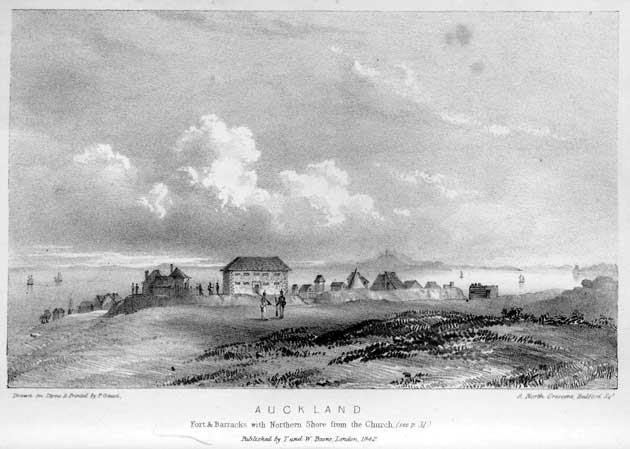
In the early days of the settlement at Auckland, pork and potatoes were the only fresh provisions that could be obtained cheaply from the natives, but the great influx of settlers, in addition to the troops and government officers, and artisans, very soon increased, greatly, the consumption of all the necessaries of life.
The natives were not slow, in acquiring the knowledge of the enhanced value of their produce, or backward, in demanding high prices for what they chose to dispose of.
The small craft connected with the settlers and
[Image of page 60]
PRICE OF PROVISIONS.
natives on the coast, likewise benefitted by this new market. But it may well be conceived, that to supply, for so many months, such an increasing population, on the shores of the Waitemata, who actually had nothing within themselves, would reduce, very considerably, the stocks in the immediate vicinity, and consequently, unless the supplies, from more distant sources, were regular and ample, that provisions in Auckland would frequently be very scarce and very dear.
Such was the natural consequence, in a very few months, in Auckland, and in July 1841, provisions were scarce and very dear, as the annexed table will indicate.
Occasionally a few sheep are brought from Sydney, but they are scarcely saleable for the want of enclosures and pasturage, and after a sea voyage they are not in condition for the butcher. Beef has been also sometimes brought ready slaughtered, from the Bay of Islands, but the price places it beyond the purchase of persons of moderate means. Pork is the only fresh meat generally to be obtained. Fish was plentiful and cheap, supplied by the Europeans.
PRICE OF PROVISIONS AT AUCKLAND, July, 1841.
| Beef per lb.
|
1s 4d
|
Tea per lb.
|
10s 0d
|
| Mutton
|
1 0
|
Coffee
|
2 6
|
| Pork
|
0 7
|
Sugar, Brown
|
0 6
|
| Flour
|
0 5
|
Do. Refined
|
1 0
|
| Bread
|
0 7
|
Rice
|
0 4
|
| Cheese, English
|
2 0
|
Potatoes per cwt.
|
8 0
|
| Butter, Irish
|
2 6
|
|
|
[Image of page 61]
RENTS AND WAGES.
In all new colonies, the wages both of servants and mechanics, bear no analogy to those of England. The same observations may apply to lodgings and rents of houses, all of which should be considered by those who leave their native country, and some accustomed trade or service. Such was the scarcity of accommodations for new settlers, as well as the demand for labour, that the following are not the highest rates paid at Auckland in September 1841.
RENTS AND LODGINGS.
| Wooden Houses
Unfurnished
|
Two small rooms and kitchen, £60. to .£80. per annum.
|
| Lodgings Unfurnished
|
One small room, £1. per week.
|
| Board & Lodging.
|
Board, being without malt or spirituous liquors, and Lodging, a bed in a room with others, £2. per week.
|
WAGES
| Carpenters
|
16s. to 20s. per day.
|
| Brickmakers
|
10s.
|
| Labourers
|
8s.
|
| Men Servants
|
£4. per month, and board.
|
| Maid Servants
|
£36. per annum, and board.
|
| Boys
|
10s. per week, and board.
|
On Wednesday the 1st September, 1841, the sale of crown lands took place, comprising suburban, cultivated and small farms, the details of which will be found in the succeeding chapter.
[Image of page 62]
SHIPPING.
The settlement of Auckland, as the seat of Government, has naturally occasioned a resort of shipping, increasing with the numbers and wants of the settlers, as will be shewn by the list of arrivals of vessels in the Waitemata for one year, ending 30th September, 1841; and it must be remembered that there had been during that period no arrival of emigrants direct from England to Auckland, but that all the settlers there had come at their own expense, either from the neighbouring colonies of New South Wales, Van Diemen's Land, and South Australia, or had removed from other parts of New Zealand to Auckland.
ARRIVALS OF SHIPPING,
In the Harbour and Port of Auckland, New Zealand, from 12th September, 1840, to 30th September, 1841, from the Official Returns of the Harbour Master, Captain David Rough.
| Month.
|
H.M. Ships.
|
Ships.
|
Barques.
|
Brigs.
|
Schooners
|
Cutters.
|
Total.
|
| 1840.
|
|
|
|
|
|
|
|
| September
|
---
|
---
|
2
|
---
|
3
|
1
|
6
|
| October
|
2
|
---
|
---
|
---
|
2
|
---
|
4
|
| November
|
---
|
---
|
---
|
---
|
6
|
---
|
6
|
| December
|
---
|
---
|
---
|
2
|
7
|
---
|
9
|
| 1841.
|
|
|
|
|
|
|
|
| January
|
|
---
|
---
|
2
|
8
|
---
|
10
|
| February
|
---
|
1
|
---
|
10
|
11
|
---
|
22
|
| March
|
1
|
---
|
---
|
2
|
9
|
---
|
12
|
| April
|
---
|
2
|
1
|
1
|
12
|
---
|
16
|
| May
|
1
|
1
|
---
|
1
|
14
|
---
|
17
|
| June
|
---
|
2
|
---
|
1
|
11
|
---
|
14
|
| July
|
---
|
---
|
---
|
4
|
17
|
3
|
24
|
| August
|
1
|
---
|
2
|
2
|
17
|
1
|
23
|
| September
|
---
|
---
|
2
|
5
|
11
|
---
|
18
|
| Total
|
5
|
6
|
7
|
30
|
128
|
5
|
181
|
[Image of page 63]
CLIMATE AND WEATHER.
| First Six Months.
|
|
Second Six Months.
|
|
| Men of War
|
3
|
|
2
|
| Ships and Barques
|
3
|
|
10
|
| Brigs
|
16
|
|
14
|
| Schooners
|
46
|
|
82
|
| Cutters
|
1
|
|
4
|
|
|
69 vessels.
|
|
112 vessels.
|
This number of 181 vessels is exclusive of numbers of smaller craft and decked boats of small draught of water, that are employed in the rivers and on the shores of the coast, adjacent to Auckland.
The climate and weather, in New Zealand, varies according to the locality, which will be easily conceived, from the great range of latitude between the North Cape, 34 deg. 30' south latitude, and Cape South in Stewart's Island (New Leinster), 47 deg. 10' south latitude, being nearly 800 geographical miles distant from each other.
In addition to this, the strong winds which always occur at the change and full of the moon, and which always blow on the coast, either from the north-east or south-west, unless affected by any line of coast or straits, such as Cook's Straits, where the prevailing winds are north-west and south-east, render places on either coast, particularly in the neighbourhood of mountains, more subject to heavy rains.
In the interior the weather is more equable, but colder, and by the high ridge of mountains, on each coast of the North Island, the valleys are completely sheltered from all winds, and heavy rains are not so
[Image of page 64]
WINDS AND TIDES.
frequent. In the winter months, June, July, and August, there are occasionally slight frosts in the night, which sometimes nip the early potatoe crops of the natives, but the rising sun soon changes the temperature.
At Auckland, the easterly gales generally occur about the full and change of the moon, and blow for two and sometimes three days, and in the winter months with great violence; the wind then veers to the westward, and soon moderates.
The most settled weather is with south and southwest winds, which in the winter time are accompanied by frosts. The thermometer rises about 5 deg. with north and north-east winds. It stood lowest (36 deg.) one night in July, and highest (84 deg.) one day in January.
The usual rise of tide, in the springs at Auckland, is about ten feet, but when a very strong easterly gale occurs, at the full or change of the moon, the rise is sometimes as much as twelve or thirteen feet.
[Image of page 65]
METEOROLOGICAL TABLE,
From 16th September, 1840, to 16th September, 1841, kept by Doctor John Johnson, Colonial Surgeon, at Auckland, New Ulster.
| Month.
|
Prevailing Winds.
|
Ave.Ht.
Therm.
|
|
|
Remarks.
|
| 1840
September
16th.to.30th
|
South West
|
Morn
56
|
Noon
59
|
Even
55
|
Five days squally and showery weather. Two days stormy, with heavy rain from the Eastward. Eight days fine weather.
|
| October
1st to 15th
|
South West
|
56
|
63
|
54
|
Nineteen days fine weather. Three days stormy, with rain from the Eastward.
|
| 16th to 31st
|
|
57
|
66
|
56
|
Nine days gales, squalls, and heavy rain from Westward.
|
| November
1st to 15th
|
South West
|
57
|
63
|
53
|
Eighteen days fine weather. Two days stormy, with rain from Eastward.
|
| 16th to 30th
|
|
61
|
66
|
53
|
Ten days fresh gales, squalls, and showery weather from Westward.
|
| December
1st to l5th
|
Easterly
|
63
|
69
|
58
|
Two days strong breezes and rain.
|
| 16th to 31st
|
|
66
|
72
|
80
|
The rest of the month very fine sea breezes;---the sea breeze setting in from the North East in the forenoon, and veering to the Southward in the evening.
|
| 1841
January
1st to 15th
|
Easterly
|
70
|
75
|
64
|
Ten days fresh breezes, squalls, and showers.
|
| 16th to 31st
|
Southerly
|
70
|
re
|
61
|
The rest of the month light winds, sea and land breezes, and very fine weather.
|
| February
1st to 14th
|
Southerly
|
68
|
73
|
63
|
Eight days stormy, with rain.
|
| 15th to 28th
|
South West
|
69
|
74
|
59
|
The rest of the month light winds and fine weather.
|
| March
1st to 15th
|
Easterly
|
67
|
|
59
|
Ten days stormy with rain; the lest of the month brisk breezes
|
| 16th to 31st
|
|
65
|
69
|
61
|
and fine weather.
|
| April 1st to 15th
|
Easterly
|
59
|
68
|
56
|
Two days heavy gales from the Eastward and much rain.
|
| 16th to 30th
|
W.S.W.
|
54
|
63
|
54
|
Seven days squally and showery. The rest of the month fine weather.
|
[Image of page 66]
METEOROLOGICAL TABLE.
| Month.
|
Prevailing Winds.
|
Ave.
|
Ht. of
|
Therm.
|
Remarks.
|
| May
1st to 15th
16th to 31st
|
South West
|
55
50
|
63
58
|
56
51
|
Three clays Easterly gale and much rain.
The remainder of the month brisk westerly winds, and frequent showers.
|
| June 1st to 15th
16th to 30th
|
South West
|
48
50
|
56
58
|
50
51
|
One day Easterly gale and heavy rain. Nine days fine weather.
The rest of the month strong breezes, squalls, and heavy showers from the westward.
|
| July
1st to 15th
16th to 31st
|
South West
|
46
47
|
56
56
|
46
46
|
Seven days fine weather. Five days stormy and rainy from the Eastward and South East.
The rest of the month strong breezes, squalls and rain from the westward.
|
| August
1st to 15th
16th to 31st
|
North East
South West
|
49
50
|
59
58
|
55
55
|
Three days stormy and rainy from the North East. Seven days westerly gales, squalls, and showers,
On the night of the 20th the heaviest thunder-storm that has been experienced since the formation of the settlement.
|
| September
1st to 16th
|
West
North East
|
51
|
58
|
50
|
First five days light showers and fine weather.
Three days heavy gale and much rain.
Six days light winds and fine, with occasional showers.
Two days with strong north easterly breeze, with much rain.
|
The foregoing observations give the following results.
| Month.
|
Corresponding
Month to the season
in England.
|
Mean
Temperature.
|
Month.
|
Corresponding
Month to the
season in England.
|
Mean
Temperature.
|
| January
|
July
|
69.3
|
July
|
January
|
49.5
|
| February
|
August
|
67.6
|
August
|
February
|
54.3
|
| March
|
September
|
65.1
|
September
|
March
|
54.8
|
| April
|
October
|
59.0
|
October
|
April
|
58.6
|
| May
|
November
|
56.1
|
November
|
May
|
58.8
|
| June
|
December
|
52.1
|
December
|
June
|
64.6
|
| Mean temperature of Summer months,
December, January, and February
|
67 deg.
|
|
| Mean temperature of Winter months,
June, July, and August
|
52 deg.
|
Difference of mean temperature of Winter
and Summer months, 15 deg.
|
| Mean annual temperature
|
59 deg.
|
|
[Image of page 67]
METEOROLOGICAL TABLE.
The following tabular statement shews the mean temperature at Port Nicholson; but the meteorological observations from which it has been deduced, were only taken twice a day, 8.a.m. and 5.p.m, therefore the highest, noon, and the lowest, night, are omitted, although perhaps the mean would not have differed much.
METEOROLOGICAL TABLE
Shewing mean temperature at Port Nicholson, deduced from the weekly statements published in the Wellington Spectator.
| Month.
|
Corresponding Month
to the season in England.
|
Mean temperature.
|
| January
|
July
|
67.7
|
| February
|
August
|
65.6
|
| March
|
September
|
63.1
|
| April
|
October
|
59.9
|
| May ....
|
November
|
56.0
|
| June
|
December
|
51.9
|
| July
|
January
|
50.2
|
| August
|
February
|
50.2
|
| September
|
March
|
51.0
|
| October
|
April
|
58.4
|
| November
|
May
|
59.5
|
| December . . .
|
June
|
64.4
|
[Image of page 68]
EUROPEAN POPULATION.
The population of Europeans, thoroughout the three islands at the present time, may be fairly estimated between nine and ten thousand, and their number is increasing daily, not only by the measures of the New Zealand Company to augment their settlements and population, but from the emigration from the adjacent colonies of New South Wales, Port Phillip, Port Adelaide, Van Diemen's Land, in great numbers to New Zealand.
| Auckland and the Waitemata district, including Troops . .
|
2,500
|
| New Zealand Company's settlements, Port Nicholson, New Plymouth, and Nelson
|
6,400
|
| Bay of Islands, Hokianga, Kaipara, and other places on North Island .
|
500
|
| Middle and Southern Islands |
200 |
|
|
9,600
|
[Page 69 is blank]