PART III
ON THE SALE OF CROWN LANDS
CHAPTER I
[Image of page 127]
PART III.
ON THE
SALE OF CROWN LANDS
IN
NEW ZEALAND.
[Page 128 is blank]
[Inserted picture page]
[Image of page 129]
ON THE SALE OF CROWN LANDS.
CHAPTER I.
COLONIAL REGULATION FOR THE SALES OF LAND---FIRST SALE OF TOWN ALLOTMENTS AT AUCKLAND---HIGH PRICES---CAUSE OF HIGH PRICES---LAND JOBBERS---RE-SALE OF TOWN ALLOTMENTS---GOVERNMENT CONTROUL OF SALES --- IMPOLICY OF LARGE AREAS---LETTER OF THE SURVEYOR-GENERAL.
As soon as it became publicly known, that the seat of Government for the Colony of New Zealand was fixed on the Waitemata, numerous persons from various parts of the Islands, as well as from Sydney, Van Diemen's Land, and South Australia, congregated at Auckland, the name of the embryo capital, awaiting anxiously for many months the first sale of town allotments.
By a regulation of the acts of Council in New South Wales, of which, at that period, the Colony of New Zealand was a dependency, no land sale can take place in that Colony, or its dependencies, without three months previous notice in the Sydney Government Gazette.
Although the location of Auckland was taken possession of by the Government in September 1840, yet not an acre had then been surveyed; and as the
[Image of page 130]
FIRST SALE OF TOWN ALLOTMENTS
Surveyor-General was unaccompanied by any assistants on his first arrival, it required some time to project and adapt the ground for a city. Thus, some weeks necessarily elapsed before he had completed a plan of the town, which had to be submitted to Lieut.-Governor Hobson, and subsequently transmitted to Sydney for the approval of his Excellency, Sir George Gipps.
The Lieut.-Governor, in December, 1840, announced in the newspaper published at Kororarika, Bay of Islands, that the sale of town allotments would take place at Auckland, on the 12th March, 1841. This announcement brought at the commencement of the year 1841, increase of numbers from all the adjacent colonies to Auckland; but about a week previous to the date mentioned, the sale was further postponed until the 19th April,--- the reason assigned for such postponement being, that the full three months notice in the Sydney Government Gazette would not have expired by the 12th March, the first notice therein being dated 28th December, 1840.
About a week previous to the sale, intelligence was received that the Colony of New Zealand was no longer a dependency of New South Wales, but a separate and independent Colony. This circumstance occasioned great excitement, raised the ideas of persons as to the value of land in the town of Auckland, and diffused the spirit of competition among the persons assembled in great numbers from all parts.
[Image of page 131]
AT AUCKLAND.
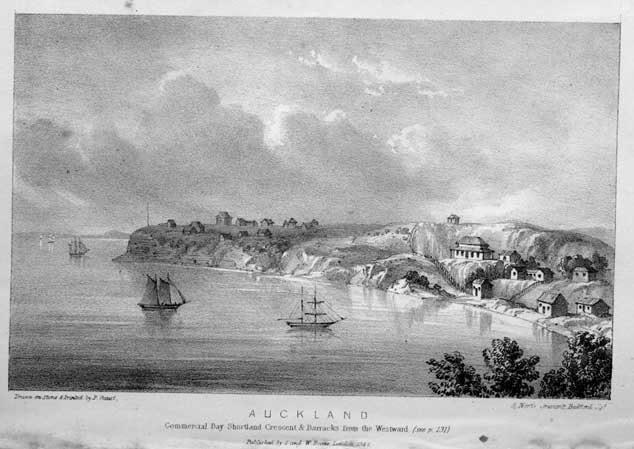
On Monday, the 19th of April, 1841, the first sale of town allotments took place. They were situated principally in Commercial Bay, and on the hill (Shortland Crescent), connecting it with Official Bay. Although three times the number advertised had been surveyed and marked on the plan, yet only 116 lots were submitted to public competition, among numbers, to establish the first city in New Zealand.
The land was put up at 12s. 6d. per perch, and was anticipated to realize from 15s. to 18s. per perch, or at the rate of from £120. to £150. per acre for average allotments; and for some particularly choice situations, £250. per acre.
The first and second lots brought £7. per perch, or the sum of £511. for less than half an acre of land. In the same spirit the sale continued for two days, and one allotment sold for £10. 1s. per perch, and realized £444. for one quarter of an acre, and four perches, being at the rate of £1608. per acre.
The Government officers had the privilege, on their arrival in Auckland, as they were compelled from their official duties to reside there, of selecting any of the town allotments not above, in the opinion of the Surveyor-General, the average value of the allotments in the section in which the selected allotment was situated, and thirteen official gentlemen availed themselves of the privilege.
The following is a correct statement of the sale, with the exact area of each allotment, the purchaser, the price per perch, and the amount paid for each allotment:---
[Image of page 132]
FIRST SALE OF TOWN ALLOTMENTS
SALE OF TOWN ALLOTMENTS
At AUCKLAND, NEW ULSTER, 19th and 20th April, 1841.
| Lot.
|
Ex
|
tent. |
|
Price
|
per |
Perch. |
Purchaser.
|
Amount.
|
|
|
a.
|
r.
|
p.
|
£
|
s.
|
d.
|
|
£. s. d.
|
| 1
|
0
|
0
|
35
|
7
|
0
|
0
|
Simmons, Western, & Co.
|
245 0 0
|
| 2
|
0
|
0
|
38
|
7
|
0
|
0
|
James Williamson
|
266 0 0
|
| 3
|
0
|
1
|
1
|
4
|
6
|
0
|
William McDonald
|
176 6 0
|
| 4
|
0
|
1
|
2
|
4
|
13
|
0
|
Edward Costly
|
195 6 0
|
| 5
|
0
|
1
|
3
|
4
|
5
|
0
|
Fred. Whittaker
|
182 5 0
|
| 6
|
0
|
1
|
4
|
4
|
11
|
0
|
Moses Joseph
|
200 4 0
|
| 7
|
0
|
1
|
9
|
4
|
0
|
0
|
J. C. Crauford
|
196 0 0
|
| 8
|
0
|
1
|
16
|
4
|
6
|
0
|
J. O. Croker
|
240 16 0
|
| 9
|
0
|
1
|
25
|
4
|
19
|
0
|
R. Tod
|
321 15 0
|
| 10
|
0
|
1
|
19
|
5
|
7
|
0
|
Willoughby Shortland
|
315 13 0
|
| 11
|
0
|
1
|
34
|
4
|
1
|
0
|
Henry Tucker
|
299 14 0
|
| 12
|
0
|
1
|
13
|
3
|
0
|
0
|
Want & Andrews
|
159 0 0
|
| 13
|
0
|
0
|
32
|
4
|
3
|
0
|
ditto
|
128 0 0
|
| 14
|
0
|
0
|
32
|
3
|
4
|
0
|
ditto
|
102 8 0
|
| 15
|
0
|
0
|
32
|
5
|
1
|
0
|
ditto
|
161 12 0
|
| 16
|
0
|
1
|
4
|
10
|
1
|
0
|
Robert Tod
|
442 4 0
|
| 17
|
0
|
1
|
4
|
5
|
15
|
0
|
Moses Joseph
|
253 0 0
|
| 18
|
0
|
1
|
4
|
4
|
12
|
0
|
William Mason
|
202 8 0
|
| 19
|
0
|
2
|
10
|
5
|
0
|
0
|
Dudley Sinclair
|
450 0 0
|
| 20
|
0
|
2
|
3
|
4
|
6
|
0
|
Moses Joseph
|
365 4 0
|
| 21
|
0
|
1
|
34
|
4
|
5
|
0
|
Brown & Campbell
|
314 10 0
|
| 22
|
0
|
1
|
27
|
4
|
14
|
0
|
Henry Thompson
|
314 18 0
|
| 23
|
0
|
1
|
20
|
4
|
10
|
0
|
George Graham
|
270 0 0
|
| 24
|
0
|
1
|
20
|
4
|
11
|
0
|
Robert Field
|
273 0 0
|
| 25
|
0
|
1
|
14
|
4
|
4
|
0
|
James Watson
|
226 16 0
|
| 26
|
0
|
1
|
7
|
3
|
6
|
0
|
Willoughby Shortland
|
155 2 0
|
| 27
|
0
|
1
|
14
|
3
|
4
|
0
|
Robert Donovan
|
172 16 0
|
| 28
|
0
|
1
|
c
|
4
|
7
|
0
|
Alex. Kennedy
|
213 3 0
|
| 29
|
0
|
1
|
19
|
5
|
0
|
0
|
New Zealand Bk. Comp.
|
295 0 0
|
| 30
|
0
|
1
|
19
|
4
|
6
|
0
|
George Cooper
|
253 14 0
|
| 31
|
0
|
1
|
20
|
5
|
6
|
0
|
S. A. Wood
|
318 0 0
|
| 32
|
0
|
1
|
32
|
2
|
16
|
0
|
J. Lord & A. Brown
|
201 12 0
|
| 33
|
0
|
1
|
g
|
2
|
19
|
0
|
ditto
|
144 11 0
|
| 34
|
0
|
1
|
c
|
2
|
11
|
0
|
W. Kendall and S. Mark
|
124 19 0
|
| 35
|
0
|
1
|
12
|
2
|
11
|
0
|
F. Hamilton
|
135 4 0
|
| 36
|
0
|
1
|
16
|
2
|
9
|
0
|
E. Costly
|
137 4 0
|
| 37
|
0
|
1
|
26
|
2
|
0
|
0
|
E. O'Neil
|
132 0 0
|
| 38
|
0
|
I
|
36
|
2
|
7
|
0
|
J. Craufurd
|
178 12 0
|
| 39
|
0
|
2
|
5
|
3
|
0
|
0
|
J. Lord & A. Brown
|
255 0 0
|
| 40
|
0
|
1
|
29
|
1
|
17
|
0
|
Felton Mathew
|
127 13 0
|
| 41
|
0
|
1
|
32
|
2
|
1
|
0
|
A. Hepburn
|
147 12 0
|
[Image of page 133]
AT AUCKLAND.
| Lot.
|
Extent.
|
|
|
Price
per
Perch.
|
|
|
Purchaser.
|
Amount.
|
|
|
a.
|
r.
|
p.
|
£.
|
s.
|
d.
|
|
£. s. d.
|
| 42
|
0
|
1
|
5
|
3
|
15
|
0
|
J. Cunningham
|
168 15 0
|
| 43
|
0
|
l
|
4
|
3
|
3
|
0
|
T. F. Dawson
|
138 10 0
|
| 44
|
0
|
l
|
4
|
5
|
4
|
0
|
James Coates
|
228 16 0
|
| 45
|
0
|
1
|
6
|
4
|
0
|
0
|
Peter Williams
|
184 0 0
|
| 46
|
0
|
1
|
5
|
4
|
15
|
0
|
J. Lord & A. Brown
|
213 15 0
|
| 47
|
0
|
l
|
5
|
5
|
1
|
0
|
H. Thompson
|
227 5 0
|
| 48
|
0
|
1
|
5
|
5
|
1
|
0
|
Felton Mathew
|
227 5 0
|
| 49
|
0
|
l
|
5
|
5
|
1
|
0
|
ditto -
|
227 5 0
|
| 50
|
0
|
l
|
5
|
5
|
0
|
0
|
J. Lord & A. Brown
|
225 0 0
|
| 51
|
0
|
1
|
5
|
5
|
2
|
0
|
ditto
|
229 10 0
|
| 52
|
0
|
1
|
5
|
5
|
5
|
0
|
J. Craufurd
|
236 5 0
|
| 53
|
0
|
1
|
8
|
5
|
6
|
0
|
Heale, Sinclair, & Co.
|
254 8 0
|
| 54
|
0
|
1
|
7
|
3
|
1
|
0
|
George Cooper
|
143 7 0
|
| 65
|
0
|
l
|
7
|
3
|
2
|
0
|
W. Greenwood
|
145 14 0
|
| 56
|
0
|
1
|
11
|
3
|
15
|
0
|
J. Lord & A. Brown
|
191 5 0
|
| 57
|
0
|
l
|
25
|
2
|
4
|
0
|
J. Harris & W. Gordon
|
143 0 0
|
| 58
|
0
|
1
|
30
|
2
|
0
|
0
|
George Benson
|
140 0 0
|
| 59
|
0
|
1
|
29
|
2
|
3
|
0
|
W. Mason
|
148 7 0
|
| 60
|
0
|
l
|
19
|
3
|
1
|
0
|
James Coates
|
179 19 0
|
| 61
|
0
|
2
|
11
|
1
|
13
|
0
|
John Johnson
|
150 3 0
|
| 62
|
0
|
1
|
36
|
1
|
18
|
0
|
James Rule
|
144 8 0
|
| 63
|
0
|
1
|
31
|
2
|
0
|
0
|
George Benson
|
142 0 0
|
| 64
|
0
|
2
|
7
|
3
|
1
|
0
|
Willoughby Shortland
|
265 7 0
|
| 6.3
|
0
|
1
|
25
|
2
|
1
|
0
|
George Cooper
|
133 5 0
|
| 66
|
0
|
1
|
31
|
2
|
16
|
0
|
Dudley Sinclair
|
198 16 0
|
| 67
|
0
|
1
|
31
|
2
|
11
|
0
|
Francis Fisher
|
181 1 0
|
| 68
|
0
|
1
|
9
|
2
|
1
|
0
|
Robert Wigmore
|
100 9 0
|
| 69
|
0
|
1
|
32
|
2
|
2
|
0
|
J. Lord & A. Brown
|
151 4 0
|
| 70
|
0
|
1
|
32
|
2
|
15
|
0
|
ditto.
|
270 0 0
|
| 71
|
0
|
1
|
6
|
3
|
19
|
0
|
J. L. Campbell
|
181 14 0
|
| 72
|
0
|
1
|
6
|
3
|
0
|
0
|
George Mitford
|
138 0 0
|
| 73
|
0
|
1
|
38
|
3
|
5
|
0
|
Felton Mathew
|
253 10 0
|
| 74
|
0
|
1
|
38
|
4
|
1
|
0
|
Willoughby Shortland
|
319 16 0
|
| 75
|
0
|
1
|
10
|
5
|
1
|
0
|
W. Goodfellow
|
252 10 0
|
| 76
|
0
|
1
|
4
|
3
|
1
|
0
|
W. Buckland
|
147 8 0
|
| 77
|
(1
|
1
|
10
|
4
|
0
|
0
|
W. Turner
|
200 0 0
|
| 78
|
0
|
1
|
8
|
2
|
15
|
0
|
J. Swanson
|
132 0 0
|
| 79
|
0
|
1
|
8
|
2
|
2
|
0
|
J. Hellyer
|
100 16 0
|
| 80
|
0
|
1
|
8
|
2
|
0
|
0
|
P. Sharkey
|
96 0 0
|
| 81
|
0
|
1
|
8
|
2
|
0
|
0
|
W. L. Staudinger
|
96 0 0
|
| 82
|
0
|
1
|
8
|
2
|
17
|
0
|
T. Wright
|
136 16 0
|
| 83
|
0
|
1
|
1
|
2
|
12
|
0
|
J. Brown
|
106 12 0
|
| 84
|
0
|
1
|
1
|
2
|
18
|
0
|
John Johnson
|
118 18 0
|
| 85
|
0
|
1
|
6
|
5
|
5
|
0
|
E. McLennan
|
241 10 0
|
| 86
|
0
|
1
|
17
|
3
|
1
|
0
|
B. J. Stone
|
173 17 0
|
[Image of page 134]
FIRST SALE OF TOWN ALLOTMENTS
| Lot.
|
Extent.
|
|
|
Price
per
Perch.
|
|
|
Purchaser.
|
Amount.
|
|
|
a.
|
r.
|
p.
|
£
|
s.
|
d.
|
|
£. s. d.
|
| 87
|
0
|
1
|
16
|
3
|
15
|
0
|
Haggard & Pollen
|
210 0 0
|
| 88
|
0
|
1
|
14
|
3
|
9
|
0
|
D. Guillan
|
186 6 0
|
| 89
|
0
|
1
|
12
|
2
|
13
|
0
|
ditto -
|
150 16 0
|
| 90
|
0
|
1
|
8
|
6
|
1
|
0
|
Robert Tod
|
290 8 0
|
| 91
|
0
|
1
|
5
|
4
|
1
|
0
|
T. Russell
|
182 5 0
|
| 92
|
0
|
1
|
5
|
4
|
0
|
0
|
J. Lord & A. Brown
|
180 0 0
|
| 93
|
0
|
1
|
4
|
5
|
0
|
0
|
Dudley Sinclair
|
220 0 0
|
| 94
|
0
|
1
|
3
|
4
|
0
|
0
|
J. A. Brown
|
172 0 0
|
| 95
|
0
|
1
|
3
|
5
|
0
|
0
|
Heale, Sinclair, & Co.
|
215 0 0
|
| 96
|
0
|
]
|
3
|
3
|
0
|
0
|
Frederick Whittaker
|
129 0 0
|
| 97
|
0
|
1
|
3
|
2
|
3
|
0
|
A. Dingwale
|
90 6 0
|
| 98
|
0
|
1
|
3
|
1
|
14
|
0
|
John Nolan
|
72 2 0
|
| 99
|
0
|
1
|
13
|
1
|
16
|
0
|
A. Ross
|
95 8 0
|
| 100
|
0
|
0
|
34
|
1
|
9
|
0
|
Dudley Sinclair
|
49 6 0
|
| 101
|
0
|
0
|
34
|
4
|
4
|
0
|
ditto
|
142 16 0
|
| 102
|
0
|
1
|
0
|
2
|
7
|
0
|
ditto
|
94 0 0
|
| 103
|
0
|
1
|
0
|
2
|
3
|
0
|
ditto
|
86 0 0
|
| 104
|
0
|
1
|
10
|
1
|
18
|
0
|
ditto
|
95 0 0
|
| 105
|
0
|
1
|
7
|
2
|
19
|
0
|
ditto
|
138 13 0
|
| 106
|
0
|
1
|
7
|
2
|
17
|
0
|
J. Lord & A. Brown
|
133 19 0
|
| 107
|
0
|
1
|
7
|
2
|
10
|
G
|
ditto
|
117 10 0
|
| 108
|
0
|
1
|
7
|
2
|
6
|
0
|
W. Brown
|
108 2 0
|
| 109
|
0
|
1
|
7
|
2
|
2
|
0
|
T. Grenier
|
98 14 0
|
| 110
|
0
|
1
|
7
|
2
|
15
|
0
|
J. A. Brown
|
129 5 0
|
| 111
|
0
|
1
|
7
|
2
|
15
|
0
|
Robert White
|
129 5 0
|
| 112
|
0
|
1
|
7
|
2
|
0
|
0
|
J. Mills & Condon
|
94 0 0
|
| 113
|
0
|
1
|
7
|
2
|
1
|
0
|
J. Brown
|
96 14 0
|
| 114
|
0
|
1
|
7
|
3
|
6
|
0
|
Dudley Sinclair
|
156 2 0
|
| 115
|
0
|
1
|
3
|
3
|
0
|
0
|
G. P. Dawson
|
129 0 0
|
| 116
|
0
|
1
|
3
|
3
|
0
|
0
|
G. Mitford
|
129 0 0
|
|
|
35
|
1
|
7
|
|
|
|
|
£21,499 9 0
|
[Image of page 135]
AT AUCKLAND.
Statement of Reserved Allotments selected by Government Officers, to be paid for at the average selling price of the Section on which they are situated.
| Extent of Reserve.
|
Average Price
of Section.
|
Name of Officer.
|
Amount.
|
| a.
|
r.
|
p.
|
£.
|
s.
|
d
|
|
£. s. d.
|
| 0
|
1
|
34
|
4
|
11
|
9 3/4
|
Willoughby Shortland
|
339 14 I 1/2
|
| 0
|
1
|
30
|
4
|
11
|
9 3/4
|
Henry Tucker
|
321 7 10 1/2
|
| 0
|
0
|
29 1/2
|
4
|
1
|
1 3/4
|
G. Mitford
|
119 13 10
|
| 0
|
1
|
30
|
2
|
7
|
4
|
John Johnson
|
165 13 4
|
| 0
|
1
|
13
|
2
|
7
|
4
|
J. Coates and W. Mason
|
125 8 8
|
| 0
|
2
|
34.
|
2
|
19
|
8
|
Felton Mathew
|
340 2 0
|
| 0
|
2
|
33
|
2
|
19
|
8
|
Francis Fisher
|
337 2 4
|
| 0
|
1
|
30
|
2
|
19
|
8
|
J. J. Symonds
|
208 16 8
|
| 0
|
2
|
31
|
2
|
19
|
8
|
W. C. Symonds
|
331 3 0
|
| 0
|
2
|
33
|
2
|
19
|
8
|
Matthew Richmont
|
337 2 4
|
| 0
|
1
|
30
|
2
|
19
|
8
|
David Rough
|
208 16 8
|
| 0
|
1
|
4
|
3
|
4
|
3 3/4
|
W. Grimstone
|
141 7 11
|
| 5
|
3
|
11
|
|
|
|
|
£2,976 8 9
|
TOTAL SALES.
| |
Lots.
|
|
A.
|
R.
|
P.
|
£
|
s.
|
d.
|
| Public Allotments |
116
|
Contents....
|
35
|
1
|
7
|
21,499
|
9
|
0
|
| Government officers... |
13
|
" "
|
5
|
3
|
11
|
2,976
|
8
|
9
|
|
|
129
|
|
41
|
0
|
18
|
£24,475
|
17 |
9
|
| |
|
|
|
|
|
|
|
| The highest price given was
|
£1,608 per acre.
|
| The lowest price
|
£235 per acre.
|
| The average of the whole sale was
|
£595 per acre.
|
These enormous prices, unprecedented in the annals of colonization, excited the greatest surprise. By some, the result of the sale was considered as earnest of the rapid progress and success of Auckland and its vicinity ; as well as certain test of the opinion and estimation of the public of the value of property in New Zealand.
[Image of page 136]
CAUSE OF HIGH PRICES.
The Government congratulated themselves on the large amount to be received into the treasury, anticipating proportionate returns at future sales, and considered the resources of the Colony were thus established. But it is very problematical whether the extraordinary high price of the town allotments will not militate against the rapid progress of Auckland and the ultimate prosperity of the Colony. It may be, that the coffers of the Colonial Treasurer were deeply replenished, but it is equally true, that the majority of the present population of Auckland were proportionately impoverished, by such unexpected large drains and abstraction of their capital. A little reflection and consideration of a few facts will prove that instead of benefitting the permanent and industrious settler, or being the basis of stable increasing revenue to the Government, it has put a forced, consequently fictitious, value on the land in Auckland, and only enriched land jobbers and monopolists---a class of men, until of late years, very little known in the Colonies---men who go from one new settlement to another, as they are formed, for the sole purpose of monopolising, jobbing and enriching themselves at the expense of the poorer yet more industrious emigrant.
The primary cause of this fallacious state of things in Auckland was, the neglect of the Local Government in not submitting more allotments for public competition. It is the bounden duty of Government, to counteract to the utmost, the schemes and operations of land-jobbers, the baneful effects
[Image of page 137]
CAUSE OF HIGH PRICES.
of whose proceedings are notorious and apparent in the youthful settlements of Adelaide, Port Phillip, and in the mushroom townships and villages daily advertised in the Sydney papers for sale, in various parts of New South Wales. The wants of emigrants and settlers, for land of any description, should be promptly met, or rather anticipated, by Government. By not offering sufficient land for sale, either for public competition or at a fixed price, they become auxiliaries to these land jobbers, and thus capital is abstracted from the Colony, at the expense of the real settler and loss to the Government, for, as the active capital of the colonist is lessened or abstracted, so will be the diminution of the revenue.
Far better for the Colony and for the Government, ultimately, if double the quantity of land had been sold for the same sum. The original cost of the land from the Natives to Government, only a few weeks previously, was, comparatively, nothing; therefore it was immaterial what quantity they distributed to the public, provided it realized more than the upset price, which is always understood to be its fair value, as well as their expectation of its proceeds. The future prosperity and wealth of a Colony will not arise, or be produced, from a high price primarily paid for the land, either in the towns or in the country. Common sense and experience, through all time, prove the reverse to be the truth.
That the land should be actually given away is not here contended, although it may be observed
[Image of page 138]
CAUSE OF HIGH PRICES.
that gratuitous grants of land to enterprising settlers in the colonies of New South Wales, Van Diemen's Land and Canada, have tended to increase rather than diminish the general properity of the Colony.
Let the Government receive fair, but not immoderate, compensation for their right in the soil, so that, in the towns, the necessaries of life are not daily taxed, to pay for high rents, occasioned by the enormous sums paid to Government, by their injudicious management of the public sales, or to land jobbers for town allotments; and in the country so that the farmers may expend their capital in cultivating the land and bringing it into abundant and cheap production.
In addition to this primary cause, it must be remembered, that persons had arrived during the preceding seven months from New South Wales, Hobart Town, Adelaide, and various other parts of New Zealand, with the determination of establishing themselves permanently at Auckland, as merchants, storekeepers, &c.
Previous to the sale all persons, not in the service of the Government, were forbidden to land and locate, either in Official, Mechanics Bay, or any other place, except Commercial Bay, the spot of the first allotments: consequently the whole of the settlers had temporary native huts or tents, with all their property and merchandize surrounding their dwellings. Although it may be said that the high prices paid for the town allotments were voluntary, yet with these persons, who had come from afar to
[Image of page 139]
LAND JOBBERS.
make Auckland their abiding place, there was but one alternative, either to buy at any price, or leave,--- and then it became a mere question of the amount of loss, or sinking of capital, by either leaving the Colony altogether, or by purchase of an allotment at an exorbitant price.
Further was assembled the phalanx of land jobbers, attracted by the hopes, from the limited number of allotments, and the greater number, in proportion, of settlers, that by the power of their purses they should reap a golden harvest. These men are conversant with colonial affairs, and generally consist of two classes---one, being possessed of real property, and who for what they purchase can actually pay and hold;---the other, a class of adventurers, with scarcely any means, who if they can muster the deposit of ten per cent, trust to the chance of re-selling, by division and sub-division of their allotments, at a good profit, before the month expires, for the payment of the balance of the purchase money.
Another impulse to competition was given by the fact of the impossibility of another sale, however great the demand, by the arrival of settlers, for town allotments, taking place under six months, from the necessary promulgation in the Sydney Government Gazette.
All these circumstances occasioned the extraordinary result; but as might have been anticipated from such prices, which at the time seemed to paralyse with astonishment the majority of persons assembled, the greater number, sixty-eight allotments,
[Image of page 140]
RESALE OF ALLOTMENTS.
were purchased on speculation, and only forty-eight by actual occupants. In a few days, subsequent to the Government sale, began the resale of allotments, sub-divided into small areas, merely sufficient for a house and shop, and those who could not afford to purchase a plot, that would have given them a house and garden, were compelled to give a large profit to the original purchaser for a piece of ground according to their means.
At this first sale, it would have been far more productive to the Land Revenue, if the town allotments had been half the area, and would equally have militated against the operations of the land speculators.
A quarter of an acre in the centre of a town, particularly a sea port, is more than sufficient for any shipping or commercial establishment, however large and much smaller area than an eighth of an acre is sufficient for stores and shops in the streets close to the beach, at which all the trade of the place is transacted. It must be remembered that the earliest real settlers in the new towns of the infant Colonies are persons engaged in trade, storekeeping, &c. whose capital is limited and absorbed in their stock.
These persons cannot afford two or three hundred pounds of their capital to sink, in ground rent, which the purchase money is, in fact,---for a small area, in addition to the further expense and outlay of capital, in erecting a dwelling, &c. Consequently, if the same area of land, sold by the Government in 116 allotments, had been divided into three hundred, the
[Image of page 141]
GOVERNMENT CONTROUL OF SALES.
persons who were compelled to buy, subsequently, of land jobbers, a portion of an allotment, at an advanced price, would have been original purchasers of Government, and the difference in amount would have accrued to the Government instead of others.
In Auckland, of the town allotments sold---all except seven exceeded a quarter---very many three-eighths--- and ten above half an acre.
At all public sales of Crown Lands in the Australian Colonies, the Government reserve to themselves certain powers, which most effectually prevent any sudden or unexpected depreciation of value or sale at low prices. The Colonial Treasurer has the power of not only fixing the upset price in the Gazette, previous to the sale---but likewise of altering it, at the time of, and during, the sale.
At the sale of town allotments at Auckland, the upset price advertised in the Gazette for some months was ten shillings per perch. When the auctioneer read the conditions at the day of sale, he announced the upset price to be twelve shillings and sixpence per perch. The Colonial Treasurer has likewise the power of stopping the sale altogether, at any time, if he should think that there is a combination among the buyers, or the prices do not equal his expectation.
Thus Government are sufficiently protected, whatever the number of lots might be submitted to public competition; it is obvious, therefore, that a surplus rather than a limited number would be most produc-
[Image of page 142]
IMPOLICY OF LARGE AREAS.
tive to the Government, as well as less impoverishing to the majority of the settlers.
Another great and irremediable evil, has resulted from such large injudicious areas which also, might have been prevented by Government.
In the plan of the Surveyor-General, each allotment had access to it, in the rear, by a lane. The intent was to preserve the uniformity of the principal streets, by enabling the occupier to bring merchandize, &c. into his store, without making gateways, across the footpaths, in the front of the premises.
The allotments were not squares but parallelograms, with frontages of one chain---66 feet to a street, with great depth, extending to the back lane.
The consequence has been, that experienced Land Jobbers bought two adjoining allotments---then by taking six or eight feet from the frontage, of each in the centre, to the principal street, made a narrow street, directly through both to the lane. This plan not only gives two frontages, in some instances, above three hundred feet in length each---but it also makes two corner allotments, which are always considered extremely valuable. This small street would sub-divide into forty allotments, each thirty feet square, and are sold or let to mechanics and labourers, realizing to the original purchaser enormous profits. But this has caused the principal streets of Auckland to be intersected by narrow lanes and alleys, and will quite prevent the uniformity and beauty of the town.
[Image of page 143]
IMPOLICY OF LARGE AREAS.
To ensure the progressive and uniform building of a town to the original plan, it is therefore evident that the allotments should not be of such magnitude as to be capable of, or profitable by, alteration, and further, it should be one condition of the sale, that every allotment should be enclosed within a short time; some building erected within a further period, and any breach of such stipulations should be liable to a heavy fine in the first instance, and a further tax for every subsequent month.
It is a practice with the experienced trafficker in land, as there is no such enactment, purposely to leave his ground unenclosed, for if the allotments on each side are bought by actual settlers, he is saved the expense of enclosure on the two longest boundaries of his area. Under the present system, the allotments bought on speculation, which, as at Auckland, are generally the greater number, remain unenclosed and unoccupied, waiting for the period of increased value; and thus the places intended to be well defined lines and uniform streets, are merely a number of houses, placed without order or regularity, with intervening spaces, which become roads and foot-paths to more distant dwellings.
For some months there had been urgent enquiries for country land, either to purchase at a fixed price, or to take occupation, to run the risk of competition at public sale; but the Surveyor General's staff was so few that no country land, it was stated by Government, could be offered for sale before the month of July.
[Image of page 144]
LETTER OF SURVEYOR-GENERAL.
This inefficiency of the surveying department was most injurious to the settlers at large, as well as to the Government. The Surveyor General, Felton Mathew, Esq. was fully sensible of the evils consequent, as will be seen by the following extract from his letter to the Colonial Secretary, which is here given, as his profession imparts value to his observations, and his accurate description of the country, and of the class of emigrants to whom it is more particularly adapted.
"Russell, 2nd September, 1840.
"I feel it a duty incumbent upon me, previous to my departure for the Thames, to request that you will have the goodness to direct the attention of his Excellency the Lieutenant-Governor, to the very defective and insufficient means provided for carrying on the duties of a Survey Department in this Colony.
"In a country such as this, where the demands for land are likely to be so numerous and extensive, and where the local difficulties are of a nature so trying and severe, it is not to be expected that the labours of a solitary individual, however well directed his efforts, or however strenuous his exertions, can be attended with any important results, or in any degree keep pace with the wants of a daily increasing community; in a country too, which from its very nature must become almost an agricultural one, and whose resources can only be developed by a numerous labouring agricultural population.
"I need scarcely observe that in a country so
[Image of page 145]
LETTER OF SURVEYOR-GENERAL.
remarkably deficient in natural pasture, as to present in its primitive state, the most scanty supply for the food of animals, even in the most favoured situations, and over many extensive tracts of country, not a blade of vegetation on which sheep or cattle could subsist, the class of emigrants whose labours will be most valuable, consist of those who, possessing a small capital, will seek to locate themselves on farms of moderate extent, which they will cultivate and improve by their own exertions, aided perhaps by three or four labourers.
"The public attention has of late, in the agricultural districts of England, been so strongly directed to New Zealand, that numbers of people of this description will, I have no doubt, ere long be flocking to these shores; and when I consider the utter want of a survey force, adequate even to meet the most ordinary demand for land on this Colony, I confess that I cannot but entertain the most serious apprehensions for the result.
"Emigrants of small capital, finding on their arrival that no provision is made for supplying their wants, and that little probability exists of their attaining the object they have in view, will either quit the country in disgust, for the less genial soil and climate of Australia, or if induced to linger on, in hope that their wants may be supplied, will speedily expend that capital which ought to be employed in improving their own condition, and in bringing into play the resources of the country. My attention has been the more forcibly attracted to this subject from the
[Image of page 146]
LETTER OF SURVEYOR-GENERAL.
circumstance of several cases, such as I have alluded to, having recently fallen within the scope of my own observation, in which, parties who came hither with every intention of settling on the land, and in hope of finding immediate employment for their capital, in agricultural pursuits, finding that there was no prospect of their being able to obtain land for an indefinite period, have quitted the country disappointed."