CHAPTER XXV: NATURAL HISTORY
[Image of page 394]
CHAPTER XXV.
NATURAL HISTORY.
THE Natural History of these islands, compared with that of other countries, appears very defective; excepting a rat, which is now almost exterminated by the imported one, there are only reports of a kind of beaver, of whose existence we are not yet quite certain, although, very probably, it does exist in the Middle Island. 1
[Image of page 395]
NATURAL HISTORY.
The kiore, or native rat, is not above half the size of the Norway rat (mus ratus); it once abounded everywhere; it chiefly fed on the mast of the tawai, a species of beech. It was formerly valued as an article of food. The English or Norway rat is called by the natives pou hawaiki, kiore pakeha, kainga rua.
The kuri, or native dog, was found when Cook arrived, and the natives state it came with them from Hawaiki, when they first landed in New Zealand. It was a small long-haired dog, of a dirty white or yellow color, with a brushy tail; it has now become quite extinct. It does not appear to bear any resemblance to the Australian dingo, but is more probably of the same species as those still found in the Polynesian Islands.
New Zealand probably possesses two kinds of bat; the pekapeka (vespertilio tuberculatus); the common one is very small, of a yellowish brown, with diminutive rounded ears.
The seal, mimiha or kekeno (fam. Phocidae), appears to have once been very numerous, as their bones are met with in considerable quantities along the coast, mingled with those of man. In the Middle Island, the rapoka, or sea-bear, was not uncommon: the natives formerly captured it, by throwing sand in its eyes, and whilst it strove to free itself from the annoyance, they fell upon and killed it. It is now seldom met with.
The sea-lion, wakahao (Phoca jubata), or morse, once frequented the shores of the Middle Island. The natives describe it as being about the size of the cow. It is said to have been of a red color, and to have gone inland to breed, and as having been very savage and powerful. One of their chief warriors, named Te Wera, was put to flight by this animal, although attended by seventy of his followers--hence the
[Image of page 396]
NATURAL HISTORY.
saying, "Te hoa hakari o te Wera he wakahao"--"The enemy of te Wera is the sea-lion."
Whales were very numerous in the New Zealand seas (fam. Balaenidae). The sperm whale (paraua), is found of different colors, some being white, others black, or of an ochreous or dingy red, and frequently of a mottled color. The tohora (balaena antipodum) or right whale, was very abundant. The dead black whale is said always to drift to the leeward, whilst the sperm, on the contrary, goes to the windward.
The fin-back (balaena physalus) is found chiefly on the northeast shores of the North Island.
The most remarkable of the New Zealand birds is the apterix Australis, or kiwi (fam. Struthionidae), which is supposed to be one of the last surviving members of a very large family. This remarkable bird is still abundant in several parts of the country. In size, it is not larger than a common full-grown fowl, yet it lays an egg not more than one-third less that of the emu, for it is eight inches in circumference across, and twelve lengthwise. There are two varieties of the kiwi, one being rather larger than the other, and of a darker color, this only lays one egg; the other, or common red one, lays two, which are of smaller dimensions. This bird has a rudimentary wing, which is terminated by a slender claw; the bill is long and
[Image of page 397]
NATURAL HISTORY.
slightly curved, having the nostrils at the extremity; its feathers, which are tipped with a kind of claw, are much prized in forming cloaks, which are only worn by the highest chiefs. 2
The kiwi forms burrows, and deposits its eggs in them, generally at the root of the rata. It is said to be three years before they are hatched, and oftentimes the hole is so grown up with roots, that the young bird cannot make its way out, and thus perishes. The kiwi parure is the largest kind, and the kiwi hoihoi the smallest.
The kiwi is a night bird, and finds its food by smell, feeling its way by means of its large whiskers, inserting its bill into the earth in search of worms with great celerity, making at the same time a snuffing noise; it then appears very animated. It kicks with considerable force, and expresses its anger by a hissing or grunting noise. It is easily tamed. The cry it makes is very similar to its name, which is probably thus derived. The kiwi is an unsightly bird, having short thick legs, with very strong nails; it has no tail. In very wet weather, it is often driven out of the forest, and compelled to seek the plain. When at rest, it supports itself upon its beak. The natives always tie a feather or two of this bird to their pana, or fish-hooks. It is good eating, and tastes more like tender beef than a bird; the principal fleshy parts are the ribs and legs.
There is said to be another bird of this family in the Middle Island, weighing as much as eighteen pounds; it is so strong that it cannot be held with one hand, and if the captor be not very careful, it will escape, as my informant said, by shaking itself out of its feathers, which it frequently does. It is highly probable that many varieties of this remarkable bird will be found in the islands north of New Zealand.
Toko eka, a kind of kiwi, larger than the turkey, and found in the Middle Island, at Dusky Bay, and on the snowy mountains; by others, it is described as being of a bright red
[Image of page 398]
NATURAL HISTORY.
plumage, and only found on the tops of the highest mountains. It was caught by spreading a white garment on the ground, which it mistook for snow. The natives speak of an immense bird which lived on the tops of the mountains of the Middle Island. They called it the powakai; it laid only two eggs-- one became a male and the other a female. It devoured men. This bird is alluded to in several of their traditions.
The natives speak of another member of this family, which they name the kiwi papa whenua, a still larger species, which they describe as having been full seven feet high; it likewise had a very long bill, with which it made large holes in the ground, in search after worms. This bird is now extinct, but there are persons living who have seen it. Rauparaha told me he had eaten it in his youth, which might be about seventy years ago, and when that Chief died, his corpse was said to have been ornamented with some of its feathers.
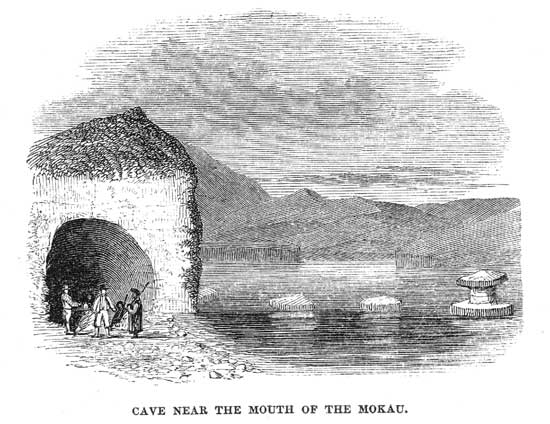
But of all the birds which have once had existence in New Zealand, by far the most remarkable is the moa, dinornis of Owen; perhaps it was the largest bird which ever had existence, at least during the more recent period of our earth's history; and it is by no means certain that it is even now extinct. I first discovered its remains in 1839, at Tauranga and Waiapu; but in 1844, I met with a very large collection of the bones of this bird mingled with those of the seal. They were laid in little hillocks at the mouth of the Waingongoro; each heap was composed of the bones of several species of the apterix. They are abundant on almost every part of the North Island, south of Mokau, and throughout the Middle Island, but have not been discovered further north, probably because there were no grassy plains there for it to feed over.
Wherever the remains of the moa are found, there is generally a small heap of round quartz pebbles, about the size of walnuts, which were doubtless swallowed for digestion. It is probable that this wonderful bird was not much less than sixteen feet high, and its bones arc half the size of the elephant's.
The Fam. Rallidae, is rather an extensive one, though
* The word Moa in the islands, is the common name of the domestic fowl.
[Image of page 399]
NATURAL HISTORY.
several members of it are extinct. The largest kind is the ocydromus Australis, the weka, or wood hen of the settlers. The breast is of a slate color, the back brown, and speckled; it is strongly made, and about the size of a half-grown fowl: it is very abundant in the Middle Island, and the southern part of the North Isle. The name is taken from its cry.
The pukeko, or rauhara, (porphyrio melanotus,) is a fine bird, about the size of a pullet; it has long red legs and toes, with a bill and protuberance above of the same color, somewhat like the guinea-fowl: the back is black, and the breast of a bright mazarine blue; the under feathers of the tail are pure white, which forms a fine contrast with the black of its short tail. This bird has a strong shrill cry, resembling its name, flies slowly and heavily, and is a great thief, making much havoc in the cultivations. It abounds in swamps and along the sides of rivers. The flesh is dry and coarse, seldom eaten by the natives, but much esteemed by Europeans, who say, that when kept it is exquisite eating.
Closely allied to this bird is the takahe, the notornis of Owen, a large heavy bird of the Middle Island, very rare; it stands about two feet high, and is nearly as large as the kiwi. It has a short thick beak, and strong legs; the back is black, and its neck and body of a dark blue, shaded with green, and gold on the wings. The tail is scanty, and white underneath. One specimen only has reached this country, which is to be seen in the British Museum.
There are several smaller kinds of rail. Of these is the katatai, (raulus assimilis,) of a ferugineous color. The rallus dieffenbachii, is about one-third less than the weka; it is peculiar to the Chatham Isles, and is a fine bird. Its native name is the moeriki.
Patatai, or popotai, is a small rail, about the size of a sparrow, but of a very delicate shape; it is of a light brown color, the back spotted with black and white, the breast is of a slate colour, beak bright green, eye black, with a red circle; it has a very small tail, which is black underneath, with white bands; the legs are of a pale green.
The moho periru, or motarua, a small dark brown rail of
[Image of page 400]
NATURAL HISTORY.
uniform color, with red legs, black eye, red circle, black bill, small tail, black underneath, spotted with white, the breast and front edges of the wings are of a dark bright blue.
Totoriwai is a small black rail; the moko is also of a black color, formerly very abundant, but now seldom seen.
The koitareke, or kokoreke, koreke, and koutareke, (coturnix novae Zealandi,) is a small quail, with short legs, nearly approaching to the quail of Australia, in its general features.
In the fam. Falconidae, is the kahu (falco harpe), a fine large hawk, which is very destructive to poultry, and will not hesitate to pounce on even a full-grown hen. The wings are nearly four feet across when expanded, but the body of this rapacious bird is very small, being a dark yellow, spotted with brown, and the breast of a lighter color, spotted.
The kaiaia, or karewarewa, kaitaua, (falco brunnea.) This is an elegant bird, very similar to the English sparrow-hawk; it has a very shrill cry, which is regarded as an omen of the weather: if heard on a fine day, it is a sign it will rain; if on a rainy day, that it will be fine.
There is also a night-hawk, very similar to the sparrow-hawk in plumage. Fam. Strigidae.
The koukou, or ruru (Athene Novae Seelandiae, strix fulva). It is called more pork by the settlers. This small owl is the only one yet known in the islands; it is easily killed with a stick in the day time.
Fam. Alcedinidae--the kotare, (halcyon vagans). It closely resembles the English kingfisher in plumage, but, if anything, is rather inferior to it in beauty, and is a third larger.
Fam. Upupidae--the huia, (neomorpha gouldii). This is a beautiful bird, with small wings; it is about the size of the jay, of a bright glossy black, with four large tail feathers, tipped with white, which have a graceful curve, with a small white tuft tinder the root of the tail; the male has a long slender bill, of a bright yellow color; the female has a thicker bill; the eye is of a leaden color; it has two little yellow fleshy lappets on each side of the head, which look like two wafers stuck on the cheeks. The legs and feet are long, slender, and of a bright yellow. Its hop is very singular, like
[Image of page 401]
NATURAL HISTORY.
most of the kangaroo. The natives highly prize the skin, which is an article of barter. This bird is chiefly found to the south of the Ruahine mountains, in the North Island, especially on the Tararua range, and the natives send the skins to the north carefully packed between pieces of bark. They receive sharks' teeth in return. A good skin is valued at one pound.
The following are honey-birds: --
The tui, koko, (Prosthemadera, Novae Zeal:). Cook named this beautiful and lively bird, the parson and mocking bird. It acquired the first name from its having two remarkable white feathers on the neck, like a pair of clergyman's bands; and the latter from its facility in imitating sounds. Though not of gaudy colors, there is something very chaste and elegant in its plumage. It is of a black bronzed color, with delicate white hair feathers round the neck; it is a sweet songster, and full of activity, incessantly flying up and down, and uttering its varied and joyous notes. In the spring it may be seen in the yellow kowai trees, brushing out the pollen from the flowers with the greatest rapidity. When tamed, it readily imitates every kind of sound, and soon forms an attachment with any one who notices it, so that it is a general favorite.
The tui becomes extremely fat in winter; it is then caught in great numbers by snares; but in that season it is also taken by marking its place of roost on a frosty night; in the morning its legs and wings are so benumbed with cold, that it is easily shaken from its perch, which it has not strength to leave before the sun warms its half-frozen body; this seems to prove that the climate has become colder than it was formerly.
When the tui becomes so extremely fat as to be uncomfortable to itself, it is said to peck its breast, and thus cause the oil to exude, which completely saturates its feathers; this it appears to do to lighten itself, when caught it is found covered with the marks of its peckings, and thence acquires the name of koko, or pecking.
The tui is said to breed three times in the year; it begins in September, or early spring, and then lays three eggs; in December it lays five eggs; and in March, or autumn, it has six or seven, of a pure white color. It takes little more than
[Image of page 402]
NATURAL HISTORY.
a fortnight to hatch. The unfledged bird is called a pi, afterwards it is named a pikari, and when fledged a purehe. But, full-grown, it is a tui, and when it becomes very fat, it is a koko. The flesh of this bird is highly esteemed as a very great dainty, and it certainly is so; but its lively song is far sweeter to those who admire melody, and such will regret that this will not save it from the Maori oven.
The kotihe (ptilotis cincta). This beautiful honey-bird has a velvety black head and wings, with a tuft of white feathers on either cheek and wing; it has a bright yellow circle round the lower part of the neck and wings. The back and tail are of a yellowish grey. It is about the size of the bullfinch. The male is much larger than the female, which has not so fine a plumage. Its legs are strong, and its tail slightly forked. It lays four eggs. The notes are pleasing, but few, which, when it has sung, it hops away to another bush.
The korimako, or kokorimako (anthornis melanura). This bird is the sweetest songster of New Zealand, but is not distinguished by its plumage, which is of a yellowish olive, with a dark blueish shade on each side of the head; the rest of the body being of a dingy yellow-greenish color; it has a long forked tail, and strong wings; the legs are of a puce color. It lays seven eggs, spotted with blue, upon a brown ground. The male is larger, and its plumage is rather brighter, with more green in it than the female. In the early dawn, when the vocal songsters of the grove assemble by mutual consent on some tree, to sing their morning hymn, the note of the korimako is heard above all the rest, and gives the greatest harmony to the whole; indeed, nothing can exceed the sweetness of this concert, which is only heard for a short time, and then ceases for the rest of the day, until the birds begin to koro, or intimate the day has closed, and then in some parts of the south they again assemble to sing their evening hymn; but this is not generally done, the favourite time is the morning. I have counted sixteen birds of different kinds thus perched together on one branch, in the greatest harmony. It is also called kopara. To this genus belongs the anthornis melanocephala of the Chatham Isles.
[Image of page 403]
NATURAL HISTORY.
Fam. Luscinidae. --The matata, or koroatito (sphenoeacus? punctatus). It is a small dark brown bird, with a white and brown spotted breast; it has four long and four short tail feathers, similar in structure to those of the emu and kiwi; it is a swamp bird, flies low, and for a very short distance, amongst the rushes and fern, with a long shrill cry; and is easily killed with a stick. Formerly, it was a sacred bird, and offered in sacrifice when a party returned unsuccessful from the war.
Riro riro, the wren. This most diminutive bird is of a greyish yellow color; the male has a dark blue crest; it is very tame.
Fam. Turdidae. --The piopio (turnagra crassirostris), a bird about the size of a thrush, with a short thick bill, red tail, yellow breast, and brown back. It is a bird of passage from the south. Piopio wirunga nga tau ko Matatua te waka. The piopio came on the bow of the Matatua, one of the original canoes, from Hawaiki, so says the proverb.
Fam. Muscicapidae. --Piwaka waka, tirakaraka, the fan-tailed fly catcher, a pretty little restless lively bird; very sociable, and fond of displaying its beautiful little fan-tail. It has a head like the bullfinch, with one black and white streak under the neck, coming to a point in the centre of the throat. Its wings are very sharp and pointed. It is very quick and expert in catching flies, and is a great favorite, as it generally follows the steps of man. It was sacred to Maui.
Miromiro, (miro albifrons.) A little black and white bird, with a large head; it is very tame, and has a short melancholy song; it generally flies about graves and solitary bushes. The miro toitoi, (muscipeta toitoi,) or the ngirungiru, is a bird not larger than the tom-tit. Its plumage is black and white, having a white breast, and some of the near feathers of each wing tinged with white.
Fam. Corvidae. --The kokako, or New Zealand crow; it is about the size of a small pullet, with long legs, and remarkably short wings; its eye is of a lavender colour; the head is very small. It has a strong black beak, a little curved, and a small brilliant light-blue flap hanging down on each side the ear. It is a sly bird, very thievish, and
[Image of page 404]
NATURAL HISTORY.
timid. The flesh is bitter, but when skinned and steeped in water a short time previous to cooking, it becomes more palatable.
Fam. Sturnidae. --Tieki, (Creadion carunculatus.) This is a beautiful black bird, with a chestnut band across the back and wings; it has also a fleshy lappet on either side the head. The tieki is considered a bird of omen: if one flies on the right side, it is a good sign; if on the left a bad one.
Fam. Fringillidae. --Pihoihoi, wioi kataitai, (alauda, Novae Zeal:) This little bird is very similar to the ground lark, but has no song. It is of a grey color, the breast white, with grey spots. It makes its nest on the ground, and greatly resembles its English namesake.
Fam. Psittacidae. --The kakariki, or pouwaitere, (platycercus Novae Zeal:) is a pretty light green parrot, with a band of red or yellow over the upper beak and under the throat. This elegant little bird is about the size of a small thrush; it flies very fast, and has a very quick note: it is excellent eating. The one with red on the head, is called kakariki matua; the other with yellow, is called kakariki porere: they are different species.
The kaka (nestor meridionalis). Its general color is a dark brown, with a reddish shade; the breast is also red and brown, with bright red feathers under the wings. The bill is very large and curved; the cry is remarkably strong and harsh. When the other birds hold their morning concert, the kaka generally puts a stop to it with his harsh shrill note when he thinks they have sung long enough. It has a fine black eye. This is a large bird, little inferior in size to a duck; it is easily tamed, and taught to speak. The natives make mokai or pets of them, and generally use them to decoy wild ones. This bird is eaten, but it is very dry, and, excepting the breast, rather strongly flavoured. It makes its nest in holes of trees, and lays two, four, and sometimes seven eggs. Generally, three of these birds are found in the same hole, a male and two females; and their nests are so close, that either bird can cover the eggs of her neighbour, and thus give her leave of absence. The natives have a saying, that the kaka never alights on the maire tree. One kind has a larger bill, this is
[Image of page 405]
NATURAL HISTORY.
called kaka huripa; the one with a smaller one is called kaka motaraua. Some kaka make their nests in the soft sand cliffs; these are of much lighter color, the back and wings being of a dirty cream color, and the breast of a bright red. This may be the platycercus auriceps, or trichoglossus aurifrons koroko.
The most remarkable bird of this family is the kakapo, or tarepo, (Strigops habroptilus,) the night parrot. It is as large as a hen, of a light green and yellow color, banded with brown, with large black whiskers, and frequents mountains and precipices, and though possessing wings, seldom uses them; it is gregarious; one generally keeps guard, and so carefully, that it can never be approached on the windward side. In appearance it resembles the owl. The natives say, there are two kinds, one of which is as large as the kiwi; it is extremely rare, and will be soon extinct in the North Island. I have only seen two caught there: it is very delicate eating. This remarkable bird is more abundant in the Middle Island.
Fam. Cuculidae. --The kohoperoa, kawekawea, koekoea, (eu-dynamys taitensis.) This is a bird of passage, and one of the New Zealand cuckoos; it has a long tail, of the same color as the sparrow-hawk, and altogether not unlike it; the body is short and thick, with short legs and strong claws. It is a sweet singing bird, but is only heard during the warmest months of the year, when it sings all the night. Its appearance is a token for the planting of the kumara, and its departure, that it is time to dig them up. Some have an idea, that this bird hibernates under the water. The Taupo natives think that it creeps into holes, where it turns into a lizard, and loses its feathers; on the approach of summer, it crawls out of its hole, its feathers then begin to grow, the tail drops off, and it again becomes a bird. In its lizard form, it is called he ngaha, but in Wanganui, he piri rewa, or tree lizard. The natives say, that always before the wind is about to blow from the south, the kohoperoa ceases to sing, and does not commence again till the west wind blows, or till a breeze springs up from the north. When a child is deserted by its parents, it is said to be "Te parahaka o te koikoea,"--"An egg left in another's nest."
[Image of page 406]
NATURAL HISTORY.
The piwarauroa, (chrysococcyx lucidus, cuculus nitens,) is the other cuckoo, which is also a bird of passage. Its breast is white, the feathers being fringed with green and gold; the back is green, gold, and bronze; the feathers under the tail are white spotted with brown. It has a very peculiar shrill note. When first heard in August, its cry is feeble, kui kui te ora, complaining it is cold; but as the summer advances, and the sun becomes warm, its note changes to witi ora, witi ora, I am warm. There is a saying, if it continues to cry kui kui, it will be a cold summer; but if it sings witi ora, witi ora, it will be a warm season. These two birds of passage are said to divide the year between New Zealand and Hawaiki, arriving in September and leaving in March.
Fam. Columbidae. --Keriru, kukupa, (kuku carpophaga, Novae Zeal:) the wood pigeon. This is a very fine large bird, the size of a duck: the upper part of the breast is green and gold; the lower a pure white; legs and bill red. It is a heavy flying bird, and very stupid, which makes it an easy prey to its enemies. If two birds are on one tree, and one be shot, the other seldom flies away. Its chief food is the fruit of the miro when in season, and then it is good eating; at other times, it feeds on wild cabbage, and in spring on the young leaves of the kowai, when it is not considered wholesome. The natives preserve large quantities in calabashes, taking out the bones; these are called kuku. It is in season at the beginning of winter, when it becomes very fat, and the natives extract oil from it. There is a saying, the pigeon never alights on the rata tree. I have only met with one species of this bird.
Fam. Tetraonidae. --Kokoreke, koutareke, koitareke, (coturnix Novae Zeal:) The quail is a very rare bird; it is smaller, but otherwise closely resembles the Australian; it is more abundant in the Middle Island.
Fam. Charadridae. --The torea, (haematopus picatus,) a black sea bird with red legs and bill. 3
[Image of page 407]
NATURAL HISTORY.
Fam. Ardeidae. --Mataku urepo, (botaurus melanotus.) The bittern is very generally spread over the whole of New Zealand; it is of a buff color, with brown spots, and lighter under the breast; it utters three hollow sounds, and then ceases for a short period before it commences again. When it stands at rest or sleeps, it elevates its bill to the heavens, which gives it a very singular appearance.
The mataku (herodias mataku) is of a bright ash color. The top of the head is covered with slight bristles, and the back of the skull is of a red color, perfectly bald; its neck and legs are long. The female lays two eggs of a pale blue color, about the size of a turkey's egg. It is a very shy bird, and seldom seen; it flies gracefully, with its long legs stretched out like a tail.
Kotuku, [Herodias flavirostris,) the white crane; a beautiful and rare bird; it has a yellow bill, and dark green legs. Though sufficiently abundant in the Southern Island, it is seldom seen in the Northern, so that there is a saying, kotahi ano te rerenga o te kotuku, that is, a man only sees the white crane once in his lifetime.
Fam. Scolopacidae. -- Tarapunga, (himantopus Novae Zeal:) a white breasted bird, black wings, back and head, red bill slightly curved upwards, with long red legs; it is found on the Taupo lake, with several other varieties of sea birds.
Fam. Anatidae. --Parera, turuki, (anas superciliosa,) the duck, very similar to the wild duck of England. Those in the interior appear to be of a larger kind.
Putangitangi, (casarca variegata,) the paradise duck. This fine bird is confined to the southern part of the Northern Island, but is very abundant in the Middle Island. The colors of this bird are very distinct, the breast white, and the wings of a yellowish red, or dark orange, with partly colored back; it is easily tamed.
Wio, (hymenolaimus malacorynchus,) the blue duck, is found abundantly in the mountain streams of the south part of the North Island, and in the Middle; it takes its name from its cry. This bird has a remarkable membrane attached to its bill; it is highly prized by the natives; climbs up rocks by
[Image of page 408]
NATURAL HISTORY.
means of the joints of its wings, which are bare of feathers, and horny, and uses its short strong tail as a support. There are many varieties of teal, widgeon, coots, &c.
Fam. Alcidae. --Korora, (spheniscus minor,) the small green and white penguin, formerly very abundant; it lays two white eggs in the crevices of rocks and holes near the sea-shore.
Hoiho (eudyptes antipodes). This penguin is double the size of the former, the back is dark brown, and the breast white; it is very rarely seen in the Northern Island.
Fam. Procellaridae. --Titi, (pelecanoides urinatrix,) a dark grey sea bird, with white breast, which goes inland at sun-set, and flies about in the dusk for a short time, with great noise; it lays one egg in the holes of rocks, and is very fat. It is supposed to deposit a store of food for its young when hatched, and then to abandon it; hence the saying, "He manu wangainga tahi,"--"A bird that only feeds its young once."
Toroa (diomedea exulans). --The albatross is found in the New Zealand seas; the feathers are highly prized by the natives as ornaments, especially the under wing feathers, which are pure white, and the down, tufts of which are worn in the lobe of the ear. The wing bones also are used as neck and ear ornaments.
Fam. Pelecanidae. --Kauwau or karuhiruhi, (graucalus varius vel carunculatus,) a black, or black and white bird, abounding in rivers and harbours. They are sociable birds, and build their nests in great numbers on the same tree, overhanging the water; the smell of one of these colonies is almost insupportable.
The totoara is a slate-colored bird, with a few little white feathers near the bill; it is the New Zealand robin, and a very grave but social tame bird, always following the steps of man.
There are several birds omitted in this list, which are not classed, but the most interesting are here given.
Fam. Scincidae. --New Zealand formerly possessed many species of lizards, and if native accounts may be depended upon, many of these were of very large size. Even when Europeans first visited the islands, they were far more numerous than they now are; their decrease may be attributed to
[Image of page 409]
NATURAL HISTORY.
the frequent fires, and to the introduction of the cat, which greedily preys upon them; they are therefore now, comparatively speaking, seldom seen. The chief lizard still existing is the ruatara, (tiliqua Zealandica,) the guana; it is about eighteen inches long; the head is large, with a fine benevolent eye; it has a row of white serrated points on the back, with similar dark ones on the tail; the teeth are rounded, and the tongue triangular; its toes are slender; it lays on its back when basking in the sun, and burrows. It is now only found on the small islands in Cook's Straits, or on the eastern coast of the North Island. It is of a dark brown color, intermingled with yellow. The natives have a great horror of it, although it is perfectly harmless.
Kakariki (naultinus elegans) is a beautiful bright green lizard, about eight inches long; it has the power of contracting or dilating the pupil of its eye. The natives are much alarmed at the sight of it, and especially if they should hear it laugh, (so they call the noise it makes,) which they say is a sure sign of death to the person who hears it. The natives imagine that all diseases are caused by this lizard crawling down their throats, when they are asleep. The male is perfectly green; the female has a longitudinal line of white spots running down the lower part of each side.
There are several other kinds of lizards, one is beautifully spotted and of a black velvet color; another is of a flesh color under the neck and belly, and dark brown on the back. 4
Ord. Amphibia. --Fam. ranae. --Until lately the frog was not supposed to be in New Zealand, for although Polack stated he could not sleep for the noise of their croaking, no other traveller has met with such annoyance, though many have traversed the country far more frequently and entirely than he ever did,
[Image of page 410]
NATURAL HISTORY.
without even seeing anything of it. The discovery of the frog in New Zealand was reserved for the gold-diggers at Coromandel Harbour, where, in 1852, three small ones were found in their pits; and afterwards, I heard, that one had occasionally been turned up by the settlers in the vicinity of Auckland. With these exceptions, I have not seen any, or heard of others seeing them; they must be extremely rare, and had not I heard from the natives that there is a large frog on the Island of Mana, I should have been inclined to think those at Coromandel had been casually imported from Sydney. The natives describe a large frog, which they call, moko mokai, a maru te ware aitu, as having once been very abundant on that island; they say it was as large as a small pullet, and in the tadpole state was more than a foot long; they also affirmed there was a smaller one found in the same locality; but the existence of the bullfrog at present rests on their report.
No snakes have ever been found, although there are reports of their having been introduced by the Sydney shipping. Many of the earth-worms are almost like snakes, being considerably more than a foot long; some of these were formerly eaten, and esteemed very good: this was the case with the toke tipa, a very long large worm, which feeds on roots. There is a saying, that the reka, or sweetness, of this worm remained in the mouth for two days after it was eaten.
The fish of the New Zealand seas are plentiful, and not deficient in variety. I shall endeavor to give a brief account of the principal kinds.
Aihe, is a large fish, twenty-four feet long, having a small
[Image of page 411]
NATURAL HISTORY.
head like the porpoise, with similar teeth; it probably belongs to that order, and is synonymous with rarihi.
Awa, is a small tidal-river fish, resembling the roach; the settlers call it the herring, which it only resembles in shape. It is synonymous with takeke.
Araara, a fish about a foot and a half long, very broad and flat, having remarkably large scales, and its dorsal and caudal-fins covered with scales. [See plate.]
Hapuku, or whapuku commonly called the cod, but a much richer fish in flavor: externally, it more resembles the salmon, and is known in New Holland as the Dew or Jew fish; it attains a large size, and is considered the best sea fish of New Zealand.
Kahawai, (centropristes trutta), or mulloides. --It is generally from fifteen, to twenty inches long; is taken with a hook and a piece of the haliotis shell: the flavor is rather sour, but its great abundance renders it very valuable as an article of food.
Kirikiri, and pakirikiri, a rough-skinned fish, having two spines on the back, which it can elevate at pleasure; it is a short but broad fish (labrus poecilopleura).
Koputaratara, kopuawai, papati, and totara: these are all names for the diodon; this is a round fish, covered with spines; it possesses the power of inflating itself, when it looks like a ball; the dorsal and caudal fins are very small; it has no teeth, but an upper and lower rim of bone; it contains a double-shaped air vessel, which is used as a bottle by the natives.
Kanae, a fish abundant in some parts of the coast, and also found in the Wangape, a fresh-water lake, seventy miles inland, near the Waikato.
Kumukumu, is a red fish, with a hard horny skin; it derives its name from the noise which it makes.
Manga, or paro, a long narrow fish, with very minute scales, from two to four feet in length, like the blade of a sword; the back dark green, the belly silvery white, having a dorsal fin running nearly its entire length. It is never caught, but is said to be killed by the frost, as it swims near the surface; on a frosty morning, numbers are thrown upon the shore; it is highly esteemed.
[Image of page 412]
NATURAL HISTORY.
Fam. Scyllium. (squalus lima). --Mango, this name is given to the dog-fish as well as the shark; it abounds on the New Zealand shores, and is taken in great numbers; some of them attain a very large size, and will snap off a man's leg. Mango pare (squalus zygoma) hammer-headed shark.
Tuatini is a species of shark, often taken ten feet long; it is very savage. The teeth were set in rows, and formerly used as knives for cutting up human bodies for the oven.
Nga, a gelatinous fish, from one to two feet long, somewhat like a thick eel; the whalers call it a squid.
Maroro, the flying-fish; it is sometimes near two feet long, and is considered very good eating. (Exocetus exiliens et volitans.)
Moki, (latris ciliaris,) the haddock. Some call it the rock cod: it is about fourteen inches long, and in flavor more like the cod than the other fish which goes by its name.
Ngoiro, and koiro, the conger eel, is very similar to the European one; it is frequently taken, and esteemed good eating. It is a very savage fish.
Pakaurua, wae, the stingy ray. This remarkable fish is very abundant in shallow waters; it frequently attains a great size, and is often nearly two feet in breadth, has a long tail, and barbed bone beneath, with which it inflicts very dangerous wounds, from the effects of which many have died. (Raia rostrata.)
Patiki, common name for the sole and flat-fish; the latter is found in rivers, but decreases in size as it retires from the sea; at one hundred miles inland, it is not more than two inches in diameter. (Rhombus plebeius.)
Ngehe, a rock fish, curiously spotted white and brown.
Pihapiharau (the lamprey), is almost eighteen inches long, of a silvery color; there is a saying, "No Rangiriri te pihapiharau," "The lamprey comes from the fountain of Rangiriri." The name of the fish is derived from its many gills. It is taken in large quantities by pas, or weirs.
Rari, is a large fish, with two long white appendages to its lower jaw, it is about the size of the cod, and much resembles it both in appearance and flavor.
[Image of page 413]
NATURAL HISTORY.
Takeke, is the smelt, which is much the same as the European.
Papaki, is a kind of cat-fish, having two curious projections like feet, and the ventral fins united.
Tamure, kouarea, (the snapper) is a large fish like the bream: it is very abundant, and the most generally taken of all.
Puraruraru, is a red fish streaked, with spines on the back and fins: it is not eaten.
Tawatawa, is about the same size as the kahawai, or mackerel, which it closely resembles in color and general form. There is a saying of this fish, "Me te kiri tawatawa ka takato o te tangata nei, "--"As the skin of the tawatawa when caught, so is the skin of the man when slain."
Raumarie, a beautiful fish, shaped like a mackerel.
Tuere, a kind of lamprey, about two feet long; it has several small feelers attached to the head, and has a broad flat tail; the color is dark brown; the body is of uniform thickness, the same as the Pihapiharau.
Uku oru, a variety of the ray, tutuira.
Warehou, warehenga, a fish found on rocky coasts; it attains a length of two feet by eighteen inches in width; it resembles the kahawai, but is much superior to it in flavor.
Hako, a large fish like the salmon (brosmius venustus.)
Hoka, a fish about two feet long, of a reddish color, with small scales.
Puhaiao, a small black and red fish. There is a saying, if this be taken, the hapuku is sure also to be caught.
Matawa, a large fish, nearly twenty feet long, narrow in proportion; very oily.
Huranga, a large oily scaleless fish, resembling the shark.
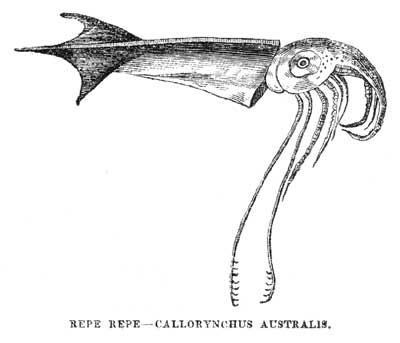
Fam. Chimaeridae, (callorhynchus antarcticas,) repe repe.
New Zealand has no large fresh-water fish. The only exception is the tuna, or eel; there are many varieties of it, and almost all the other fresh-water fish partake more or less of a similar character. The number of names given to this fish, and the careful way they have noticed every little difference between one and another, clearly shows the great value the natives put upon it. The eel attains a very large
[Image of page 414]
NATURAL HISTORY.
size, but I believe it is a different kind from the smaller one. The largest eels are called ruahine; they were originally fed and regarded as inferior gods. There is an eel found in marshy ground called a tuoro, which is said to have a large head, and to attack men.
Taiharakeke, a red eel, found at the roots of the flax plant.
Hoho, kokopu, a large fresh-water fish, having a very great head and mouth; it is about two feet long, and nearly one thick; it makes a loud noise, which can be heard at some distance. It is scaleless, and resembles an eel. I have not seen it.
Inanga, a small fresh-water fish, abounding in most of the lakes, especially Taupo and Rotorua. It is from three to five inches long (eleotris basalis).
Karohi, a very small transparent scaly fish, two inches long, found in tidal rivers.
Koaro, a small fresh-water fish, three inches long, much esteemed; this is found in most rivers and lakes.
Kokopu, a scaly fish found in every fresh water stream. It is from five to ten inches long, and rather thick in proportion.
Pangohengohe, papangoke, a fresh water fish, from four to eight inches long, and scaleless: syn. papangoko.
Poko tohe, porohe, a small fresh-water fish of the Waikato, one and half inches long.
Takaruwha, a fresh-water fish a foot long, and thick in proportion, found in the Waingongoro; this is called the eel trout, and rises at the fly.
Takeke, a small fresh-water fish, syn. tikihemi. It is an oily fish.
Totoronga, a small fish found in tidal rivers, with scales.
Tuaweta, a variety of the Inanga.
Tangariki, a small fresh-water fish, from two to three inches long.
Tohitohi, a small fresh-water fish, about two inches long.
The varieties of the small fresh-water fish are also distinguished by many names, though to ordinary observers, no difference is discernible.
Amongst the Crustacea is the koura, which is the general
[Image of page 415]
NATURAL HISTORY.
name for both the sea cray fish and the fresh water; the former is nearly two feet long, and abundant on all the rocky shores; the latter is from four to eight inches long. The Rotorua lakes abound with the largest, but near Paparoa, on the Wanganui, I met with one nearly a foot long.
Wae rau potikete, is the sea spider, about one and a half inches across the carapace; it is covered with sharp spines, and is used as a bait for the shark.
Papaka, the crab: the largest is about two and a half inches across the carapace; a small crab, called the rerepari, abounds in the salt marshes. There is also a small crab found in the mussel, which has a very round red body and short legs. I have met with a little fresh-water crab, seventy miles inland; it is not above half an inch across the shell, delicately formed, of a dusky green color. There is no lobster in New Zealand.
Kowitiwiti moana, is a very small sea shrimp, about an inch long, abounding on the sandy beaches.
Mamaiti, is a larger kind; there is also a land insect nearly approaching the shrimp in form and habits.
Tarekihi, a beautiful flat silvery fish, with a black spot on the back.
Hippocampus abdominalis, the sea-horse. I have met with two kinds of this singular fish, one being straight and narrow. It is chiefly found in the north part of the island.
Patangai, is a star fish with twelve rays.
Weki, is one with a very small body and five long rays.
Tori tori, and ko toretore, are sea anemone.
Ongaonga, sea nettle, a mollusca.
Pungoungou, or pungorungoru, or papa taura, are varieties of the sponge; some of these are equal to the best Turkish ones.
Poti poti, Portuguese man of war. Phasalia, a beautiful mollusca, of a fine dark blue or purple.
The common name for all fish is ika, or ngohengohe; of all univalve shells, pupu; and of bivalves, pipi and anga, which includes both kinds. It is remarked by Dr. Gray, that the shells of New Zealand, like those of other parts of the southern ocean, are many of them of a larger and brighter color than the species found in the same latitudes of the northern hemi-
[Image of page 416]
NATURAL HISTORY.
sphere, and this is particularly the case with the terrestrial groups: some of them belong to genera which are only found in the warmer parts of the northern half of the world. The genus Struthiolaria, is peculiar to New Zealand.
The following are a few of the most beautiful kinds: --
Fam. Muricidae. --Putotara, (triton variegatum.) This beautiful shell is often nearly a foot long, and is used as a trumpet; it is only found at the extreme north of the Northern Island, but appears formerly to have been more generally diffused.
Fam. Volutidae. --The (voluta magnifica) is only found near Cape Maria, Van Diemen, and the North Cape; it is the largest and finest volute found in New Zealand. Pupu kari kawa, is a large spotted volute.
Fam. Trochidae. --This is a numerous family. Ngaruru--is a very large kind. This name is also given to the (trochus imperialist) Miti miti is a small trochus.
Fam. Haliotidae. --Pawa, the (haliotis iris,) or mutton fish. This beautiful shell is found of considerable size; it is used for the manufacture of fish hooks. The fish is both eaten raw and dried by the natives: it is very tough. There are several varieties of this shell found in different parts of the islands. There is also a small land shell, nearly allied to the haliotis; it is about an inch long, of an olive color, and pearly lustre inside. The slug on which it is found is of a dark chocolate color (haliotoideae, Wanganui).
Fam. Patellidae--Ngakapi, the limpet. Many varieties are found, some very large, others of a star form; some sessile, others pierced at the apex.
Fam. Chitonidae. --Papa piko (a large chiton): this is also a numerous family.
Fam. Helieidae --Pupu rangi, (helix Busbyi), a large flattened shell, with a thick olive colored shining periostraca: the inside is blue. This fine shell is sometimes nearly three inches in diameter; its habitation is the tops of lofty forest trees, from which it is shaken by storms; the natives therefore call it the shell of heaven. It is not found much south of Auckland in the North Island, but Sir G. Grey found a broken specimen in Massacre Bay, Middle Island. Bulimus hongi pupu harakeke,
[Image of page 417]
NATURAL HISTORY.
is chiefly found near the North Cape; it is there abundant amongst the flax plants. This fine shell is of a dead chocolate color, with either a white or bright orange interior; it is nearly four inches long. The bulimus fibratus, is said to abound on the three kings.
Fam. Mesodesmidae. --Pipi. --This is more abundant, and larger in the north, occasionally black pearls of considerable size are found in them.
Fam. Mytilidae. --Kuku, (mussel,) is very abundant in the north of the island, where it is frequently found ten inches long; this is called kuharu. In the south, one is found with a thick bright green periostraca, and a reddish color outside; another with a thin periostraca, and a tuft of a kind of flustra springing from the upper shell. The smallest kind is called kukupara. The mussel of the Middle Island is striated.
Fam. Unionideae. --Karo, kakahi. --There are several distinct varieties of the unio; one found at the Waimate, Bay of Islands, is remarkable for its flatness; another at Taupo is short and round, with a very dark periostraca; another, which is common in the south, is long, narrow, and indented in the centre, with a thick shell; but, by far the most beautiful variety of this shell is found in the Lake Waikari; it has a clear bright yellowish green periostraca, and is of an oval form, about three inches in length.
Fam. Pinnidae. --Kokota (pinna Zelandica). This shell is nearly a foot long; part of the inside is of a purple pearly lustre; it is extremely fragile, and seldom obtained perfect.
Fam. Pectinidae. --Piwara, kuakua, the largest kind is eaten; some of the smaller are very beautiful. One is of a bright yellow; another of an equally bright red color.
Fam. Ostreidae. --(Tio,) ostraea, the rock oyster, is the cockscomb, and is identical with the Australian. If taken from below the low water mark, it is extremely good, and far superior to the mud oyster, which is generally large, and has a strong taste.
Fam. Terebratulidae. --A large smooth terebratula is found in Cook's Straits. Another striated one, (terebratula recurva,) and a smaller smooth one, (terebratula sanguined,) of a bright
[Image of page 418]
NATURAL HISTORY.
red color, are also found: bunches of the latter are frequently attached to the same point and to each other.
Fam. Sepiadae. --The sepia, or cuttle-fish, is found of considerable size, and is used as a bait for fish.
Fam. Spirulidae. --Pipi, (venus intermedia,) this is much prized as an article of food.
RADIATA. --(Echini.)--He kina, the sea egg, or hedgehog. There are several varieties; one kind attains a large size, and is of an orbicular form; another is quite flat; and a third is of an oval form: all have remarkably small spines.
On the east coast, the paper nautilus muheke, is frequently found. Some specimens are very large and beautiful. A small chambered nautilus is abundant on all the coasts; also several varieties of a deep sea purple helix. The rori, a large black slug, abounds on rocky coasts; one has an oblong white shield, about three inches long and one and a half wide; another is without it; both are eaten.
ANNULOSA. -- Class Myriapoda. --Hara (scolopendra). This centipede is of a dark yellowish green, of large size, frequently nearly six inches long; it is quite as large as the Australian one, but not so dangerous. I have never heard of any one being bitten by it, although I have seen boys repeatedly handling it.
Class Arachnida. --Punga werewere, puawere, is the general name of the spiders of New Zealand. I have remarked, they always select their habitation on a ground of similar color to their own. A green spider will be found on leaves, a brown one on the bark of trees.
There are several large spiders, but only one poisonous one, called a katipo; it is black, with a red cross on its back; the bite causes immediate inflammation, and much pain; it is generally found in tufts of grass near the sea side.
There is a small insect found on the sea shore, closely resembling the scorpion in every respect but that of having no tail; its bite is not much more irritating than that of the flea.
Diptera, namu (simulium,) a small black sand-fly, is also
[Image of page 419]
NATURAL HISTORY.
a very troublesome summer guest: it is, however, easily destroyed.
Musca, (sarcophaga, laemica.)--Rango pango, Patupaearehe, the blue bottle fly; it produces its young alive, and the female makes an intolerable noise until she is delivered. The male is smaller and much quieter. I have seen a female when killed, devoured by her own progeny. This fly is considered as an aitua, or omen of death, and very naturally, for being a meat fly, it scents diseased persons, who being never washed as they approach their dissolution, become most foetid.
(Musca), rango tua maro, the large yellow-bodied meat fly; this is similar in its character to the former.
There is also a very fine large forest fly, covered with great bristles; it is rarely seen. It is doubtful whether the meat flies are not of Australian origin; both the English and Australian house flies have been introduced.
The mosquito, (culex,) waewae roa, is also very abundant, and annoying; the natives say it was introduced by the Europeans.
Homoptera. --One of the largest insects is the weta, which is found in the forest, amongst decayed timber; it has powerful serrated legs, with which it seizes its prey, and crushes it in its joints, wounding with its sharp spines; it is otherwise harmless.
There are many varieties of the grasshopper (locustidae), mawitiwiti, some of these attain a very large size; one of the largest, pakauroaroa, is of a bright green color: there is also a small black one.
Cicada, Zeal: --There are four varieties of the tarakihi (locust); these lively and noisy insects are only heard in summer: one is very beautiful, being of a light green color, streaked with silver bands, and all have three bright red spots on the forehead, disposed in the form of a triangle, which shine like little rubies.
The Wairaka, ro, (mantis,) also abounds; some of these interesting insects are of considerable size, and of a bright green color. The case of the imperfect insect is curiously made of little twigs glued together, forming a kind of sack, which the inmate has the power of moving about at pleasure, from
[Image of page 420]
NATURAL HISTORY.
place to place. It is called kopi, from its power of shutting itself up in a bag.
Orthoptera. --The blatta (Americana) has been introduced; a kind indigenous to New Zealand, closely resembles the Australian one. The kekeriru (cimex nemoralis) is a large black one chiefly inhabiting the forest, but found in wooden and raupo buildings. The smell of this insect is intolerable. It is also found in the Isle of France, where it is called the kakerlac.
Neuroptera (libella). --Kapokapowai, kekewai, a large dragon fly; in summer, it is frequently seen in great numbers on the sea shore; probably when a swarm of them are exhausted, they fall into the sea, and are thus washed on shore by the tide. There is also a small blue and red dragon fly, similar to the English kinds.
Hymenoptera (formica). --Pokorua and popokorua. There is a large red ant, and a minute small one; a large black kind, with another extremely diminutive. The white ant is also found. But none of these are in sufficient abundance to be troublesome. I have likewise met with the formica leo in several localities; it is, I believe, identical with that of Australia and Europe.
Hemiptera. --Kiri whenua, a garden bug: several varieties are found in the woods and in the fern.
Lepidoptera. --Pepe. There are perhaps twenty varieties of the butterfly, but so thinly scattered, that, excepting a few kinds, they are seldom seen; the rarest are found on the mountains. Amongst the most beautiful of the butterflies found in the North Island are the Vanessa Gonerilla, Vanessa Itea, Cynthia Cardui (the painted lady). It is remarkable that this beautiful insect is identical in New Zealand, Australia, and Europe; the precise number of spots is found in each. The Polyommatus Edna also closely resembles one of our European butterflies. In the Middle Island, a fine large butterfly is found which somewhat resembles the purple emperor; a blue argus is also seen on the high mountains. Two sphinx moths also are found; one is very common, feeding on the kumara leaves (convolvolus batata). There is no white butterfly in New Zealand. Amongst the moths, by
[Image of page 421]
NATURAL HISTORY.
far the finest is the Hepialus Rubroviridans, which measures nearly six inches from the tip of one wing to the other. Another smaller kind of the Hepialus is very abundant in summer evenings. The Hepialus Virescens is also a beautiful moth; so likewise the Pari kori taua. The Nyctemera is also found in New South Wales.
Coleoptera. ---Mumutaua, a large beetle found on the sand hills. The elytra are remarkably soft. This beetle is frequently attacked by a fungus, which takes possession of the entire insect.
Papa papa, a small brown beetle, very abundant on a summer's evening.
Mumu, a large green beetle, found in the forest.
Kiri wai manuka, a small green beetle, abounding in the summer amongst the manuka trees (leptospermum scopiarum); it is striped with green and red.
Kapapa, (prionoplus reticularis,) a large cerambix, whose grub is very destructive to fruit trees. There are several beautiful varieties of the curculio. The nemocephalus barbicornis brentus is nearly three inches long. The ancistropterus quadri spinosus is a very beautiful insect, and also several of the species scolopterus.
Kokopurangi, (sanguis uga,) a small water leech. There are also several kinds of land leeches; a bright red one; another of a dark chocolate color, and a white one: they abound in damp humid localities.
[Image of page 422]
NATURAL HISTORY.
THE BULRUSH CATERPILLAR.
Description of the Bulrush Caterpillar (Sphaeria Robertsia;
Native name, Aweto-Hotete).
This singular plant, which is a native of New Zealand, may be classed amongst the most remarkable productions of the vegetable kingdom.
There are birds which dispossess others of their nests, and marine animals which take up their abode in deserted shells; but this plant surpasses all, in killing and taking possession, making the body of an insect--and that, too, very probably, a living one--the foundation from whence it rears its stem, and the source from which it derives its support. It certainly forms one of the most surprising links between the animal and vegetable kingdom yet noticed, and, as such, merits as circumstantial a description as our present imperfect acquaintance with it will allow.
The aweto is chiefly found at the root of the rata (metrosideros robusta). The plant, in every instance, exactly fills the body of the caterpillar, in the finest specimens it attains the length of three inches and a half; and the stem, which germinates from this metamorphosed body, is from six to ten inches high; its apex, when in a state of fructification, resembles the club-headed bulrush in miniature. There are no leaves---a solitary stem comprises the entire plant; if any accident breaks it off, a second arises from the same spot. The body is always found buried, and the greater portion of the stalk as well; when the plant has attained its maturity, it soon dies away.
These curious plants are far from being uncommon. When fresh, they have the flavor of a nut. The natives eat them, and likewise used them when burnt as coloring matter for their tattooing, rubbing the powder into the wounds, in which state it has a strong animal smell.
When newly dug up, the substance of the caterpillar is soft; and being divided longitudinally, the intestinal canal is distinctly seen. Most specimens possess the legs entire, with
[Image of page 423]
NATURAL HISTORY.
the horny part of the head, the mandibles and claws. The vegetating process invariably proceeds from the nape of the neck, from which it may be inferred that the insect, in crawling to the place where it inhumes itself prior to its metamorphosis, whilst burrowing in the vegetable soil, gets some of the minute seeds of this fungus between the scales of its neck, from which, in its sickening state, it is unable to free itself, and, consequently, being nourished by the warmth and moisture of the insect's body, then lying in a motionless state, they vegetate, and not only impede the progress of change into the chrysalis, but likewise occasion the death of the insect. That this vegetating process thus commences during the lifetime of the insect, appears certain from the fact of the caterpillar, when converted into a plant, always preserving its perfect form: in no one instance has decomposition appeared to have commenced, or the skin to have contracted or expanded beyond its natural size.
A plant of a similar kind was presented to me in 1837, by a Mr. John Allan, who discovered it growing in abundance on the banks of the Murrumbidgee, in a rich black alluvial soil. The insect in some specimens was six inches long, and the plant about the same length, springing like the New Zealand one, from the nape of the neck. In form this plant is quite different from the other, having a thick stem, crowned at the top with a fringe, which, when expanded, assumes the appearance of a full blown flower upon the surface of the soil, the rest being buried in the ground: this top is of a brown velvety texture. Many similar ones were found in the same locality. Numerous empty shells and holes were observed in the vicinity; and, at night, the number of large brown moths was so great as more than once to extinguish my friend's lamp. I sent it to Sir W. Hooker, who has named it Sphaeria Taylori.
I have also met with a large kind of beetle, the "mumutaua," abounding amongst the sandhills in the vicinity of the sea, which frequently undergoes the same vegetative change. The body is completely filled with this nutlike substance; but in no instance have I noticed any plant shooting from it.
[Image of page 424]
NATURAL HISTORY.
A similar caterpillar to the aweto has been found at Taranaki, which perfectly changes into a vegetable substance, but likewise wants the bulrush. This was dug up in great numbers in the garden of J. Wicksteed, Esq., at New Plymouth.
One specimen of a locust was brought to me (Sphaeria Basili), which I have named from its finder, had undergone this change, and had also a perfect plant growing from its neck, very much resembling a small white fungus found on decayed wood.
Insects having a vegetative process of a similar kind, have been discovered in other parts of the world; and, probably, when the flora of each country is more carefully examined, will be found existing in most of them.
Attwood, in his history of Dominica, gives the following account of a vegetable fly found in that island: --"It is of the appearance and size of a small cockchafer, and buries itself in the ground, where it dies: and from its body springs up a small plant, which resembles a young coffee-tree, only that its leaves are smaller. It is often over-looked from the supposition people have of its being none other than a coffee plant; but on examining it properly, the difference is easily distinguished--the head, body, and feet of the insect appearing at the root as perfect as when alive."
In the American Philosophical Transactions, the Rev. Nicholas Collins describes a certain zoophyton in the Ohio county, which he declares is both vegetable and animal; for having crawled about the woods in its animal state till it grows weary of that mode of existence, it fixes itself in the ground, and becomes a stately plant, with a stem issuing out of its mouth.
A small vegetating caterpillar is also found in Britain, the sphaeria entomorhiza. The Chinese also have a similar plant, (sphaeria sinensis) called by them hea tsaou tungehung, or the summer vegetable winter insect. In Van Diemen's Land there is a vegetating caterpillar (sphaeria gunnii); it somewhat resembles the New Zealand one, from which it chiefly differs in having the stem of its vegetating process thicker than the insect from which it arises.
[Image of page 425]
NATURAL HISTORY.
A Polistes attacked by many specimens of a filamentous sphaeria was described by Felton in the Philosophical Transactions under the name of vespa crinita, which he regarded as a new species of hairy wasp, not being aware that it was a sphaeria.
Several species of moths, both English and foreign, especially from the Brazils, are found thus attacked; ants also and curculionidae from St. Vincent's, and the papa of the cicada (spharia sobolifera).
At the Bristol Association for the Cultivation of Science, held in August, 1836, a paper was read by J. B. Yates, Esq., on the vegetating wasp in the West Indies, in which the author was likewise of opinion, that the vegetating process commenced during the life of the insect; and, certainly, a careful examination of these singular caterpillars favors the hypothesis. If this should be the case, it is an instance of a retrograde step in nature, when the insect, instead of rising to the higher order of the butterfly, and soaring to the skies, sinks into a plant, and remains attached to the soil in which it has buried itself.
[Image of page 426]
NATURAL HISTORY.
IGNIS FATUUS.
In travelling through the dense forest which extends from Kaitaia to Waimate, near the Bay of Islands, I encamped, one extremely rainy night, on a small open spot by the side of a stream. The natives who accompanied me, soon erected a large commodious shed, which they roofed with palm leaves, and rendered quite impervious to the rain; the sides of the building were thatched with the same; along the front, which was left open, a line of fires soon warmed our shivering company.
No sooner had my companions composed themselves to sleep, and the fires began to die away, than I observed a light in the corner of the hut next to me, like the moon shining through a chink. Being surprised at the sight, and knowing that it was a moonless night, and very dark, I got up to examine the cause. The object which attracted my attention, appeared like a globe of pale light, attached to the point of a palm leaf, which hung from the roof. The rain was falling in torrents. Whilst steadily regarding this curious sight, I was still further surprised by seeing another ball of light come slowly sailing into the shed, where it was arrested in its course by the wet sleeve of a shirt hung up to dry, to which it adhered. It was not a quivering light, but pale and steady. The air appeared to be charged with these luminous vapours; for while regarding the two in the shed, a series of them floated past, at an elevation of about a yard from the ground.
The first I noticed, had a globular form, having a brighter spot in the centre, or, more generally, at one extremity. Sometimes there were two globes, one about two feet from the other, connected by a luminous band; at other times, the lights appeared like little clouds, rendering the trees near them visible; then they resembled rods, about four feet in length, moving perpendicularly to the earth, and parallel to each other. I counted as many as a dozen of these luminous rods at once, and seldom less than half that number. They all invariably moved in the same direction, from N. to S., which was remarkable, as the rapid river close by, which must have created some
[Image of page 427]
NATURAL HISTORY.
current in the air, flowed in quite a contrary direction, and the wind, if at the time there was any, blew from the west, as indicated by the smoke. At one time, the surface of the earth was, for a few feet, completely illuminated. After watching them for a long time, until the eye was completely wearied, I laid down, when I noticed that the lights were more visible than when I stood up, which might arise from their being so near the surface of the earth, and my seeing under them.
In returning again through the same forest, I had another opportunity of seeing the Ignis Fatuus in the same place. It was then a beautiful moonlight night; but, from the denseness of the forest, little benefit was derived from its rays. In this instance, there were two lights seen hovering over the river, at about two feet from its surface. They were nearly stationary, and shone so brightly, that, although the natives were engaged in fishing with lighted brands, they were not eclipsed. In that neighbourhood there are many large kauri pines, and it is not improbable that the decomposed remains of these highly resinous trees have had something to do with this phenomenon.
The Fens of Ely and Lincoln, were formerly notorious for their unwholsome fogs and miasma, as well as for the frequent appearance of the Ignis Fatuus, which might be seen in all directions every dark night. Of late years, it has been more rarely observed, and during the time I held a curacy in the heart of the Fens, 5 a period of more than five years, I only noticed it twice.
On one of these occasions, a dark, rainy night, in returning home from a distant church in the Fens, I had an opportunity of seeing this singular light. At first, I took it for a man with a lantern, and being anxious to share the benefit of it, as well as to gain a companion, I quickened my step, to get up with him, walking through thick and thin--for the road was deep in mud; but I got no nearer: the light still kept at the same distance from me. I therefore stood still, and listened whether I could hear any footsteps, and was then surprised to see the light dancing about, from one side of the road to the other: sometimes sinking to the level of the earth, and
[Image of page 428]
NATURAL HISTORY.
then rising to a height of eight or ten feet. It was then evident that it was the Ignis Fatuus. Anxious to examine it more closely, I stood still. In a little time, the light seemed to approach; it then gradually increased in size, and appeared and disappeared every instant. Its quivering and vibratory motion most resembled that of a sheet of gold leaf. In a little time, it divided itself into two parts, one remaining on one side of the road (which was bordered with broad ditches), the other on the opposite side, leaving a thin streak of light between, and then uniting again in a moment.
At last, it approached so near that it appeared almost equal in size to the full moon, having a globular form, and emitting a light sufficiently bright to render a gate which stood near perfectly visible. It advanced so rapidly, that it was rather startling, and distinctly touched my cheek, upon which I perceived a sensible glow; but my breath seemed to make it bound away again to a considerable distance.
It appears probable that the Ignis Fatuus is simply a luminous air, or phosphoric light, arising from the oily particles of decomposed aquatic plants, floating on the surface of the drains, and, that it is so feeble as only to be visible on the darkest and dampest nights; or from the gas of the many resinous pine trees which once grew there, and whose remains still lie buried in the peat. Several kinds of decayed wood acquire this phosphorescent appearance, especially if they are buried in wet situations. Portions of such matter in the dark, appear like a mass of pale flame.
I well remember a story of a lad in the Fens, who was sent to milk the cows: as he was returning, he saw "Will o' the Wisp," as it is commonly called, which he took for some supernatural face, staring at him. He was so alarmed that he laid himself down with his face to the ground, where he remained for some time. At last, venturing to look up, and finding the dreaded form had disappeared, he ran home, leaving his milk pails behind him.
I have only once heard of this light settling fixedly on any object. The Rector of Coveney was driving home one dark rainy night from Ely, when he saw a light on the other side of
[Image of page 429]
NATURAL HISTORY.
the hedge, which he thought at first proceeded from a lantern, but it immediately came and attached itself to the ears of his horse, in the form of two globules, where it remained for several minutes. The Lights of St. Helme, or corpus sanctum, commonly called by sailors cormazants, a blue flame, like that of a candle, seen at the mast head, generally during a storm, or soon after it, are frequently observed at sea. The Master of the brig Venture, of Wanganui, noticed as many as five luminous balls at once, settling on different parts of the rigging. The mate was bold enough to climb up, and touch them; he said, they were merely luminous bubbles, which burst when touched, and the lights were immediately extinguished. These marine lights most probably arise from the decomposed remains of fish, raised to the surface by the violent motion of the water in storms. In the same way at Kaitaia, lights were observed hovering over the graves of several recently interred corpses.