CHAPTER VI. THE FALL OF NGATAPA.
[Image of page 77]
CHAPTER VI.
THE FALL OF NGATAPA.
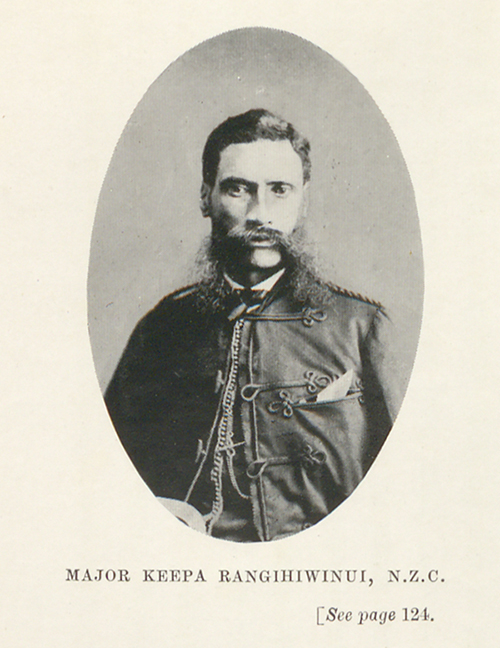
AFTER the massacre Te Kooti remained in the vicinity foraging, plundering, and recruiting from the local friendlies, and removing whatever booty he could carry towards a position he had selected called Ngatapa, some days' march to his rear. By this time the agent of the Government, Mr. McLean, to whom carte blanche had been given by Mr. Stafford, had assembled a horde of friendly Maories from the coast to the north and south. This multitude, to which very few Europeans were attached, slowly pushed Te Kooti back to the vicinity of Ngatapa. While this movement was going on Te Kooti, mustering a few followers, deliberately went round the flank of the friendlies and marching rapidly, succeeded in surprising an escort of ammunition close to Patutahi, close to Gisborne, carrying off a large supply. With this he got back safely to his force, where he was received with acclamations, not only because his foray had been successful, but because it seemed the fulfilment of the prophecy he had made before he marched that he would come back laden with
[Image of page 78]
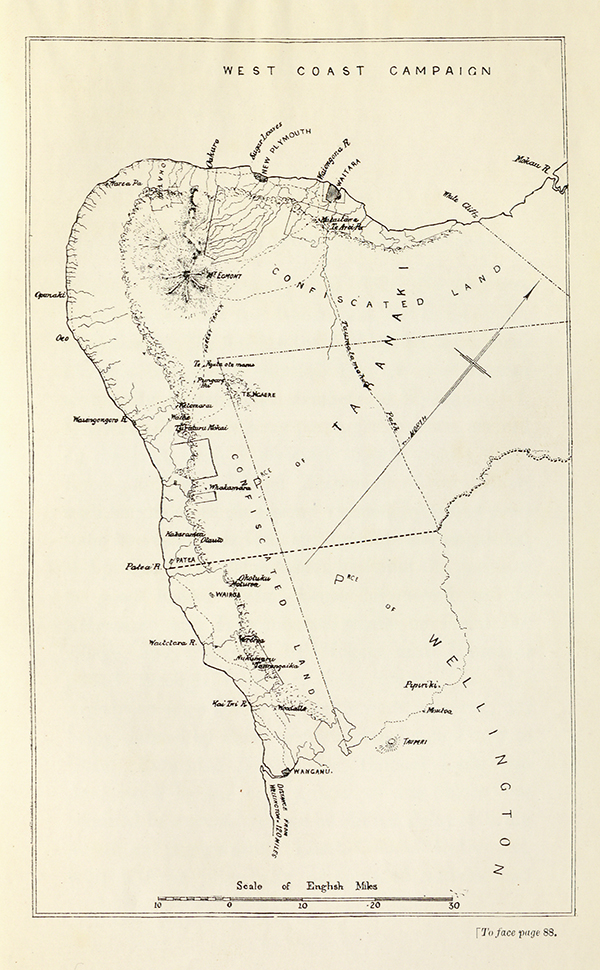
cartridges. Mr. McLean was too well acquainted with the natives not to be aware that a force of nothing but friendlies would prove costly, useless, and unmanageable for prolonged operations, and he therefore now appealed to the Government to despatch as soon as possible an adequate European contingent. I was accordingly despatched by steamer to Poverty Bay; No. 8 Division, recruited among the Arawas and commanded by Captain Grundy, joined me there, together with a few recruits from Canterbury, raising the force to about 300 men. With the force under my command I reached Poverty Bay, and landed on December 4th. At Wanganui the greatest consternation prevailed, notwithstanding the fact that a regular though not as yet very highly trained force of 400 men remained in position on the Kai-iwi between the enemy and the town, which, in addition to its own excellent volunteer cavalry and town and suburban militia, was further protected by two companies of H. M. 2--18th. Regiment. The local militia and volunteers were or should have been 1500 in number, and Colonel McDonnell was authorized, at his own suggestion, to raise an auxiliary force of friendly Maories. Why, therefore, the West Coast should have so strongly objected to afford so small a contingent to aid the settlers of Poverty Bay and the East Coast, from which in its own extremity the only existing force had been brought round to help
[Image of page 79]
them after the Ngutu-o-te-manu, was a question difficult to solve. But the Government wisely refused to be influenced by this clamour, and met the emergency in the only possible manner by remaining on the defensive upon the West Coast, training recruits as they arrived there in the meanwhile, and turning all its efforts to the crushing of Te Kooti if possible before he could do any further harm.
When I landed at Poverty Bay the first report handed to me led me to believe that this object had in a great measure been accomplished. Popular feeling was at the time much excited against the Government, upon whom the blame of the massacre was most unfairly thrown. The agent on the coast, Mr. McLean, who was of course the actually responsible person, escaping the odium, through the circumstances of his position, Mr. McLean being bitterly opposed to the Government. As I was well known to serve the Government with the devotion a military officer is bound in honour to show, there was perhaps no mode of showing hostility, opposition or ill-will that was omitted on the part of very many of those surrounding me when I landed. All were exultant at the Maori success (as it was reported to be), and evinced no jealousy whatever at the accomplishment of the service of native auxiliaries alone. I was assured that the settlement was perfectly secure, and emphatically told
[Image of page 80]
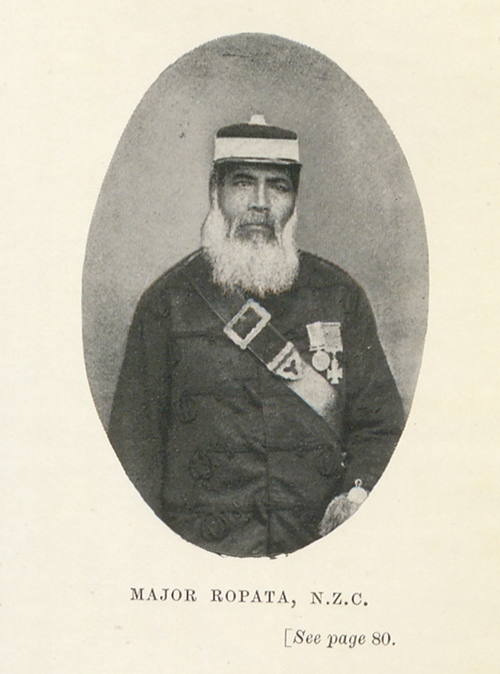
that to the natives and not to the Government the thanks of the settlement were due. But a very few hours sufficed to show that all this congratulation had been premature, and that the locality was by no means as yet in safety. In point of fact a success had been gained at an irregular engagement at Makaretu, where the enemy had suffered a loss variously stated at from fifteen to sixty men. Subsequently, from the accounts of prisoners, the true number was ascertained to be fourteen. From Makaretu, the scene of the engagement, Te Kooti retreated to Ngatapa, a position at that time not fully fortified, and Ropata, the gallant chief of the Ngatiporos, with seventy of his own hapu, followed him up, and gallantly endeavoured to force an entrance. But the Napier natives and the rest of his own tribe left their valiant leader unsupported, and after holding his own till after nightfall, when he found entrance impossible, Ropata fell back, being without food or ammunition. The inflated accounts of this engagement, however, imposed a great deal upon Mr. Richmond, the Native Minister, and myself. We concluded that there must have been more success than a mere repulse of Te Kooti, as the native force had been as four to one in the open field; and when Mr. Gascoigne, who had been sent to reconnoitre, returned and said that Te Kooti had burned his camp and retreated, we felt satisfied at first that the settlement was free of the outlaw for a time.
[Inserted unpaginated illustration]
[Image of page 81]
Therefore when Ropata asked to return to his home and change his men, and the Napier natives pressed for leave to return to their home, I offered no great resistance. Ropata promised to return in a week, and I felt sure he at least would keep his word, for his settlement was far away to the north and beyond European political intrigue, and by a week's time we should know if we had or had not been deceived with respect to Te Kooti's retreat.
The Napier natives left first, but Ropata and his men had not yet embarked when some of Te Kooti's prisoners escaped, bringing me intelligence that the enemy were still at Ngatapa and meant to come down once more on Turanganui. This intelligence decided me to land No. 6 Division, already embarked to return to the West Coast, and to move up towards Patutahi. Ropata brought back his force. But the day (13th) wore on and no sign of the enemy was discovered till 3 p.m., when I received a report that he had made a raid upon Te Arai, where Ihaka Whanga with his Mahia natives, sent by me to patrol that locality, had fired upon him and driven him back. This intelligence decided me to push on, but unfortunately it came too late. The cavalry (sixteen) had been sent on the way to Ngatapa early in the morning, but had discovered no trace of Te Kooti; but at 4 p.m. his force was descried retreating inland towards Ngatapa, about four miles from the entrance of the gorge. Our men had but three miles
[Image of page 82]
to march to anticipate him at the gorge, but such was the speed with which Te Kooti conducted his march that our men were distanced in the race and could only follow and fire upon him as he retired. Our cavalry, however, returning from their reconnaissance, met Te Kooti in the valley, but failing to delay or attack him, and preferring to seek safety in flight, Captain Newland was of no assistance to the column in pursuit.
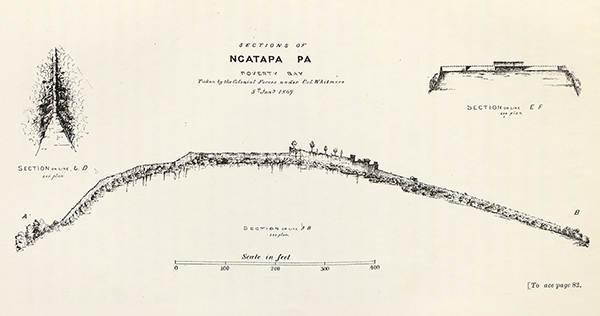
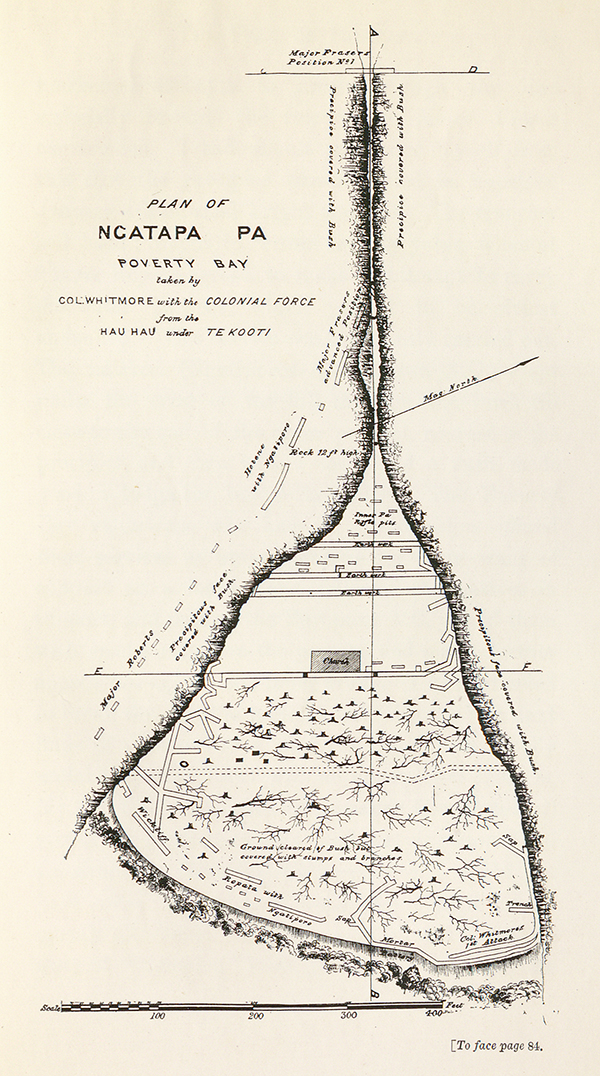
Ropata now left the Bay to collect a reliable force of 300 men, and I prepared to beat up Te Kooti's quarters at Ngatapa as soon as I could prepare a commissariat supply for the operations it was now evident that we must carry out. Pack animals and drivers had to be collected both to feed the force and to bring up ammunition and stores. Some days were occupied in preparation, but we ultimately moved forward and reached the extreme point to which sumpter animals could go on December 27th. This spot I fortified and called Fort Richmond, in honour of the Native Minister whose presence and assistance were of the utmost importance and value to me. From this point the fortifications of Ngatapa were plainly visible. It was what in civilized warfare would be called a hill fort with triple line of enormously strong parapet defences unnecessarily thick, indeed proof against ordinary field artillery, protecting the summit of a conical hill rising some 800 feet from the bottom of a ravine which intervened between
[Inserted unpaginated illustration]
[Image of page 83]
it and Fort Richmond. The descent and ascent of this ravine was too steep for horses, and it was evident that I must rely entirely upon packing all requisites, even ammunition, on the men's backs. The Ngatiporos returned to the day, but their march to Ngatapa was delayed by the illness of their chief Ropata. Mr. Richmond, unfortunately, had not supplied them with ammunition on landing, being provoked at their returning without the supply they had taken to their homes. The great difficulty of carriage made this very embarrassing, for I had to exhaust the reserve I had brought up with so much difficulty in issuing the usual amount per man. Directly Ropata joined me I moved on, halting for the night 700 yards from the fort, and giving orders for the investment or partial investment at dawn next day. My information had been so good that this operation was carried out with the most perfect success, notwithstanding the rugged nature of the ground and denseness of the forest. Before night my headquarters were about 300 yards from the front line of defence, the defenders were cut off from water, and I had concentrated all round the line of investment. I had a Cohorn mortar and some shells with me, and these I used with advantage during what may be called the siege. Unfortunately our force was insufficient for a complete investment, and I had to neglect some fifty or sixty yards of what seemed a sheer precipice. I had relied upon the
[Image of page 84]
Napier natives to complete the investing force, but Mr. McLean had despatched the Napier native force to Puketapu from which Te Kooti had marched two months before, which was found, as might have been expected, unoccupied. Thus the auxiliaries who would have been of infinite value at Ngatapa were many miles away when required.
The enemy being without water, it was hoped the operations would not occupy much time, for the supply of some 700 men under such difficulties was exhausting to the men employed in packing food; but as the night closed in and the parapet of a parallel had been thrown up, it began to rain and rained for three days and nights consecutively. My native force kept up its spirits by continuous firing all day and night, consuming so much ammunition as to threaten serious inconvenience. Mr. Richmond, however, charged himself with bringing up a supply and, together with Captain Twogood, left in the night with that object. At the township no aid could be got, but these gentlemen almost alone did eventually succeed in procuring and bringing up the requisite ammunition in a cart which they drove themselves. Through the rain the Europeans pushed forward their approaches, with great difficulty and some loss. The rebel natives, unable to get rest owing to the intermittent fire of the Cohorn at irregular periods, and beginning to find their position desperate, made several determined, but except on one occasion,
[Inserted unpaginated illustration]
[Image of page 85]
ineffectual attempts to break through the line especially towards the rear where Major Fraser commanded. I had almost persuaded myself from this that the precipice was regarded as hopeless. January 4th dawned bright and fine. The trenches had been brought to within seventy yards, when at 2 p.m., Ropata agreed to make an attempt to carry the outer parapet, which proved to be almost unflanked. This service was excellently carried out. The natives (Ngatiporos and Arawa A. C.) crept under the crest of the hill through the bush till close to the end of the outer parapet, nearest to the precipice, and then with a cheer and a rush made good a lodgment under its shelter. The Poverty Bay volunteers, who had on this occasion offered their services to atone perhaps for their want of support on a former one, followed the natives in support, and part of the European A. C. joined them with spades to secure the position and make further approaches against the inner works. I had intended to break through the parapet and seize the two next lines of defence by a dash, as they were wholly unflanked, when I met with an unexpected obstacle. My 300 Europeans were of necessity distributed all round the position, or employed carrying stores and ammunition. Without their presence I could not have relied on a vigilant watch being kept on the enemy all round, while the painful and laborious duty of "humping" loads up the slippery hill, the
[Image of page 86]
natives absolutely refused to share. Therefore I was compelled to require at least an equal assaulting party from the Ngatiporo; but they, though willing, even eager for the undertaking, still would not move without taking forty rounds of ammunition per man. Unluckily I could not give that supply to them, and by 5 p.m., when I was in a position to do so, the excitement had evaporated, and I was obliged to postpone the assault till dawn. During the night progress was made to secure the second entrenchments, which were seized before midnight, while upon the left the Maories under Wickliffe secured the outer parapet in front of them. Everything promised well for the morning, when, as day broke, a woman calling from inside acquainted us that the enemy had just escaped by the precipice. It was not long before we verified her information, and within a quarter of an hour the pursuit was begun. Ropata undertook this, stipulating that no Europeans should be employed as his men were accustomed to bush work, amply numerous, and as they could go almost naked might not be distinguished from the enemy by the Europeans. Te Kooti had perhaps an hour's start, but was encumbered with wounded, women and baggage, so that in a very short time his rear was overtaken. Throughout the day the pursuit was carried on towards the Uriwera Mountains, and more than 120 were killed, among whom was the only chief of birth, Nikora of the Ngatihineuru, one of
[Image of page 87]
the survivors of the fatal day to that tribe at Omaranui, near Napier, in 1866.
It is not my present object to go into the details of these events. A short sketch of the leading features, already given, being all that is necessary to understand the importance of the Uriwera Mountains as a refuge to the natives, and the danger that that comparatively safe place of retreat constituted to the surrounding settlements.
Te Kooti again wounded at Ngatapa was hurried off by his Uriwera allies and safely gained the protection of the mountains. More than half his force slain and driven out of his chosen fortification, it seemed that he must have lost his prestige and become discredited with his followers. But this man proved to possess an influence over, and to be able to implant, a superstitious fanaticism in the minds of all the tribes with which he came in contact, as singular as unaccountable, and although the heavy losses at Ngatapa served as a lesson and deterred further attempts upon Poverty Bay, Te Kooti was soon again at the head of a formidable band and able to repeat his bloodthirsty razzias upon the coast settlements of the Bay of Plenty, from the mountains.
My force being now no longer needed at Poverty Bay so much as at Wanganui, I withdrew the bulk of the men to the West Coast, arriving myself there on January 16th. Here I found a large
[Image of page 88]
congregation of the purest recruits and matters in other respects much as I left them. Colonel Lyon, who had taken command, had beaten up Titokowaru's quarters, and the local cavalry under Finnimore and Bryce had also reconnoitred and patrolled the country beyond the Kai-iwi as far as Gentle Annie, on the other side of Patea. Except in a very languid way Titokowaru had not asserted himself or taken advantage of his opportunities. Some few small expeditions by inconsiderable war parties had occurred, but practically he had simply held his ground at Taurangahika since I fell back to Kai-iwi, near Nukumaru, plundering and devastating the district.
All this was now to change. The troops were raw, the appliances of war defective, but the force was numerically strong, and the country was groaning under the reverses we had suffered and the stagnation and misery which the loss of the district had occasioned.
[Inserted unpaginated illustration]