CHAPTER IX. CAPTURE OF TE NGAIRE.
[Image of page 135]
CHAPTER IX.
CAPTURE OF TE NGAIRE.
I RESOLVED this time to accompany Kemp myself, as it was far from unlikely that the operations to be successful might continue for some time, and take us to some district so remote from my camp that it would be necessary either to emerge from the bush in another part of the country, or to make arrangements to procure provisions and have them forwarded from another point of supply. In anticipation of this I had already made arrangements at Taranaki, but transport must have been extemporized if I sent requisitions for supplies; and I felt that, independently of my presence probably keeping the bush expedition in better heart, it was essential that my authority should be available to prevent any miscarriage of the expedition from a want of provisions or other necessary requirements.
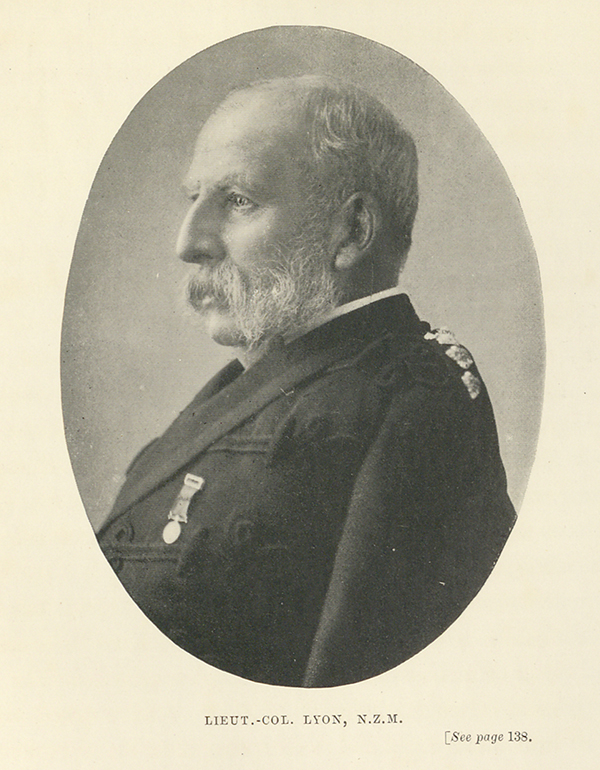
We moved therefore on the 22nd, as I have already said: the corps of Kemp, the Arawa Division under its Captain (Gundry) who had rejoined with a few Northern Ngapuhi natives, with the corps of guides and the Europeans. At Tito-tiro-moana we halted the European force under Lieut.-Colonel Lyon,
[Image of page 136]
and with, the two native corps and guides I pushed on with Kemp, who showed much aptitude in keeping the trail of the fugitives which we soon struck in the forest. Moving on, we came to more than one spot at which they had rested, one being a camp they had fled from in one of their panics, probably at night, for we found in it clothes, blankets, &c. We clearly discovered that Titokowaru had caused his followers to scatter after their panic, but Kemp held to the main line of the retreat, and at length as evening fell we reached the far-famed Ngaire swamp and reconnoitred it, or at least as much of the bank as it was safe to examine without risk of betraying our presence. I now sent back orders to Lieut.-Colonel Lyon to march at daylight, and bring up the European force, whose labour I foresaw would be valuable if I had to bridge the swamp. From Taranaki I now received despatches. A sort of Committee of Public Safety had been permitted to exist there, consisting of the Superintendent of the Province, Mr. Richmond, brother of the Native Minister, Mr. Commissioner Parris, so well known and distinguished in all native matters, with others whose names I did not know. My orders I learned were being carried out by the able officer commanding, Major Browne, and a probability existed that the enemy if defeated by me would be intercepted and destroyed by the force under him. But I was informed by Mr. Parris that the Ngaire was a treacherous
[Image of page 137]
swamp which had engulfed 500 Waikato warriors, who in former times had attempted to cross it, and I was warned very seriously not to trust my force upon its shaky surface. I knew Mr. Parris to be a brave man, and I much suspected that in his own case he would not have allowed a tradition of doubtful truth to discourage him. At all events I resolved not to be turned aside myself. The ammunition horses reached me in the afternoon and Lieut.-Colonel Lyon's detachment in the morning. Meanwhile by further despatches I learned that Major Browne, who had most loyally prepared to assist me by intercepting the enemy, had been prevented by the new Plymouth Committee of Public Safety, and I was further informed that Ahitana, chief of the hapu which resided at the Ngaire, had been promised not to be molested if he remained quiet, and that if this promise was broken the whole Taranaki tribe would resent it and rise. There are moments in war when a swift decision has to be made, and this was one of them. I had no doubt that, friendly or not, Ahitana was at this moment entertaining the enemy, and to hesitate in pushing on would have been a fatal mistake. I regretted the loss of Major Browne's co-operation, for he was a brave man well accustomed to Maori war, and almost sure to intercept the enemy if he escaped. But this, after all, might not be necessary if I was fortunate in surrounding and holding Titokowaru, so I cast all doubt to the winds
[Image of page 138]
and resolved to proceed, as I had before decided, with my undertaking. The words I used in my despatch describing the rest of this affair I cannot improve upon; they were written at the moment, and I have not heard that they have been challenged by any one present on the occasion. One incident, however, I may mention. It occurred directly my plans were ready to be accomplished. It was already growing dark, on the 24th, when my aide-de-camp, Major Swindley, announced that Lieut.-Colonel Lyon wished to speak to me, and I at once went to meet him at my fire. Lieut.-Colonel Lyon everyone knows was a Bayard in soul, and one of the bravest of men. Nevertheless, he had heard of this tradition of the Waikato men being submerged, and was greatly exercised in mind. "Colonel," he said to me, "as your second in command I find it to be my duty to warn you that you are about to attempt a very dangerous adventure--500 Waikatos, &c. --and I think it right to say that under such circumstances you should weigh well the risks."
"Colonel," I replied, "so long as I have had the honour to command this force I have never once asked you or anyone to share my proper responsibility. I have called no Councils of War. I have asked absolute obedience, and have compelled it; therefore, I think it hard that I should, on the eve of an attempt which I have carefully thought out and prepared for, be placed in this position. I bear the whole
[Inserted unpaginated illustration]
[Image of page 139]
burden of the responsibility; why make it more grievous than it is? Whatever happens you are not open to blame; but as you feel your duty compels you to take this course I will not neglect it. I shall to-morrow morning meet the enemy. I may be defeated and my force repulsed. If so I shall not return; and my men may be like sheep without a shepherd. I shall therefore leave you--the second in command--to rally the force and restore order. It will then be your duty."
Poor Lieut.-Colonel Lyon almost burst into tears. He begged me not to do this, but to let him share the perils and glory of the day. That he had only offered a word of caution, &c. I knew him so well, and esteemed him so highly, that I would not take offence at what he had said, so I passed it over, for I believe he had done violence to his own personal feelings in blurting out what he thought it his duty to say, but which after my remarks he saw was out of place and ungenerous to me. Had the result been as definite and as bloody as we expected, Colonel Lyon would either have been one whose name history would have recorded with honour as one of the most valiant of those who fell for New Zealand, or he would have added fresh laurels to a reputation second to none in the annals of this unfortunate and unnatural colonial civil war.
I resume the story of Te Ngaire from my despatch of March 26th, 1869, dated Taiporohenui.
[Image of page 140]
"The swamp, perhaps in winter time a lake, is a rush morass with toe-toe growing on it here and there along its edges. The bank opposite to that on which I first struck it was apparently that of a promontory or island, of which the side nearest to me was cleared, and on it three large kaingas were clearly visible. I did not doubt that I had Titokowaru and his fugitive force before me, and nothing but the physical difficulty of passing the swamp to prevent my at once attacking him. However, as I wished to be prepared to overcome the difficulty, I had brought up Lieut.-Colonel Lyon and the Europeans to assist me if labour was required. This reinforcement reached me at 11 a.m. on the 23rd."
During the night of the 22nd I had caused the swamp to be reconnoitred by a few natives, and ascertained that the surface was really as treacherous as described, and that in places near the southern bank, by the time the enemy had apparently taken, only a very few of the men at a time could pass, without danger. As I felt that in that case I could not justifiably attempt a surprise unless the opposite shore could first be seized and held, I resolved to wait a day and search for a more favourable spot. All the morning of the 23rd was devoted to this object, and I at last decided to send a party across in advance from a spot some hundred yards from an eel-pa (weir) where the swamp was narrowest, to gain the bank and erect an entrenchment while, with
[Image of page 141]
hurdles or ladders, I enabled the main body to cross the swamp, without sinking the regular track.
All the next day the armed constabulary worked hard, and constructed a sort of light hurdle ladders of long poles, joined by supple-jack twinings and cross sticks. As soon as it grew dark, Major Kemp sent out a party of scouts to explore the swamp, but they failed to find the line used by the natives in coming to their eel-weirs. For that day I was therefore compelled to abandon the attempt. Next day, the 24th, I resolved to cross from the eel-weirs, giving up my intention of sending two parties; I therefore caused the natives to clear a track in the bush in that direction to enable us to "hump" our hurdles to the bank, while I sent back the Europeans to clear a better road to my camp for the pack horses I had sent for with further provisions. Towards evening all the hurdles were carried to the eel-weirs, which were about a mile from the main track I had used in my march.
Ever since reaching the swamp the troops had been strictly prohibited from lighting fires by day, and only permitted to make very small ones at night. The utmost quiet was kept, and every man cautioned not to expose himself to view. The enemy apparently took no precautions, and seemed wholly unsuspicious of our proximity. Yet, we were separated by so short a distance that we distinctly heard a man cry out, "Now this evil man will cause
[Image of page 142]
the Wanganuis to come down upon us"--a speech we attributed to one of Ahitana's men, living peaceably at the Ngaire, and who, having refused to join Titokowaru, feared that they might suffer from his being there. The "Evil Man" being, as we felt sure, Titokowaru, our surmises became convictions that he was there. Opinions, however, seemed to differ at the kainga, for later on we heard a woman call out, "Haere mai, haere mai te toa--haere mai ki te kai," ("Come hither, come hither the brave--come hither to the food").
We could also clearly perceive that the natives were carrying timber, evidently for a pah, which seemed to indicate an intention of remaining and defending their position.
At nightfall on the 24th I passed fifty Wanganui and Arawas, under Sub-Inspector Gundry, across the swamp from the eel-weirs, and till 11 p.m. the whole of the natives were employed in carrying the hurdles, and placing them on the line across the swamp. The Europeans then marched up, and while they were divesting themselves of their trousers, and arranging their pouches on their shoulders the natives crossed without accident or noise. The Europeans carried extra ladders to fill up gaps, and in their turn effected the passage of the swamp, the last arriving at the head of the bridge at 4 a.m. on the 25th. I now had all the earlier arrivals silently awakened, and leaving
[Image of page 143]
Lieut.-Colonel Lyon with the last comers to hold the bridge head, and act as a reserve to secure our retreat in case of necessity, I moved on through the bush carefully and without noise. It was growing daylight when we reached the kainga, the force being so disposed as to surround it, as it infallibly would have done but for a most unfortunate occurrence. The Maories of the kainga perceiving us rose, and many began to make off; others, however, ran towards us crying out, "Haere-mai," and holding out a white flag, while those apparently escaping hesitated, and seemed disposed to return. At this moment we discovered Kawana Paepae and Aperaniko, two friendly chiefs, and Mr. Booth, R.M., among the natives before us, and I was embarrassed what to do, especially as those escaping seemed many of them to be women. I therefore myself ran down to Mr. Booth at the kainga, and was met by Ahitana's son, who protested that those in front of me were all either his own people, or another neutral tribe from Oraukuku, a place I had never heard of before. I therefore asked him why he was preparing a pah, and he replied plausibly, that he feared as Titokowaru was "broken" he might be in danger from his pursuers. He admitted the speech we had heard about the "evil man," and said it referred to Titokowaru, who had crossed the swamp three days before. Meanwhile, those sent by me to
[Image of page 144]
surround the pah had halted, and people were creeping, and had crept away by the edge of the swamp, but Tukerangi (Ahitana's son) undertook to bring them back, and sent a man with one of mine for that purpose. As these continued absent, and Mr. Booth had discovered from a seemingly half-witted old man that Titokowaru and his people, or some of them, had been at the kainga, I despatched No. 8, the Arawa Division A. C., to bring in the people who had fled. Unfortunately, nearly an hour had been lost when the Arawas started in pursuit, and as we had seldom been able, with an hour between us, to overtake fugitives, or even come up with the women, and as they were travelling light, having abandoned their food and baggage, the pursuit of the Arawas was fruitless. The trail lay towards Te Ngutu, and was followed to the track of General Chute's march.
It would be vain to attempt to describe the vexation and disappointment of the force, which, after overcoming the difficulties of disguising its presence by so much self-denial and privation, and after bridging and passing the swamp unperceived, believed itself to have been duped out of its reward. The only consolation was that even at the price of losing our opportunity we had kept faith with Ahitana, on whose neutral or friendly disposition it was said that of the Taranakis depended, and who,
[Image of page 145]
being closely related to the Wanganuis, they felt great sympathy for.
It was not much use cross-examining Tukerangi, as circumstances momentarily proved that the escapees were in fact the enemy we were in search of, but for what it was worth I did so. He said Titokowaru meant "to die on his own land" at the Ngutu, where he then was. He admitted, however, that ten of the enemy, whose names he gave, had been at the pah when I arrived, but that he had been afraid to tell me so.
I felt great distrust of this young man and his followers, and a strong inclination to disarm them, and make them prisoners. But I refrained, insisting only that he should show me Titokowaru trail across the swamp. This he undertook, but as he failed to do so I ordered him and his people, under pain of their neutrality being thenceforward disregarded, to remove to Keteonetea, where they have another kainga, and could be under observation. I disbelieved his statements, and felt sure that the women we saw and the men making off were Titokowaru, whose rear-guard at least, if not he himself, had slept the night at Te Ngaire.
Circumstances soon proved that my surmise was right. We at once explored Te Ngutu, which had clearly not been occupied for months, and it was elicited from Ahitana's followers in the course of the next few days that all Titokowaru remaining force
[Image of page 146]
and he himself had been at the kainga when we came up.
I now withdrew my force to Waihi, where I was joined by Wickliffe (Wikiriwhi), the Ngatiporo chief, and a reinforcement of nearly 100 of his tribe. I felt sure active hostilities in the Patea district were over, and I therefore dismissed the Wanganui natives to their homes. From two of Titokowaru women among the Ngaire natives I learned many details of the enemy's retreat. Seventy of Titokowaru people, and all his women, except those whose weakness had succumbed to the fatigues, were at the Ngaire when I surprised it, and subsequently made off to the upper Ngatimaru district. No organized enemy therefore remained, and I resolved to move on to New Plymouth, to ascertain whether a rumoured invasion by the Ngatimaniapoto tribe from Mokau had any probability. The Ngatiporo, wholly unconnected with the natives of the West Coast, and admirable bushmen, I left to patrol the country, and intercept any straggling parties attempting to re-enter it. A sufficient force under Lieut.-Colonel Lyon, whom I proposed to leave in command, I left to guard Patea itself, and form a nucleus for the defence of the district. With the rest I moved in two columns round Mount Egmont, the one to take ship at Opunake, the other to march round the back of the mountain to the Waitara. This latter force, marching on April 5th, easily
[Image of page 147]
reached Mataitawa on the afternoon of the 8th by General Chute's track. No enemy was encountered, nor did anything of any importance occur. A single dead Maori was found on the track who had apparently perished from inanition, while endeavouring to make good his escape to his home with an open bullet wound. Lieut.-Colonel St. John commanded the right column, and reported the road behind the mountain an easy one of not more than forty-five miles. The left column with the drays, ammunition, baggage, &c., marched on the same day towards Opunake, where, on the 7th, the troops and baggage were embarked on board the Sturt, I myself riding on to New Plymouth, where I arrived on the 8th. The drays I sent back to Patea under a native escort. The Hon. Mr. Richmond was at New Plymouth, and on the 9th I accompanied him to Waitara, where all my force was assembled. Thinking it desirable to examine the coast, though disbelieving the rumoured invasion from Mokau, we decided to reconnoitre the coast in the s. s. St. Kilda. We examined the beach closely, and found no trace of an enemy, and, arriving at the mouth of the Mokau, fired some shells in the direction of the native kainga, without discovering any but a few native inhabitants. After considering the subject with Mr. Richmond, it was agreed that the danger on the West Coast was no longer pressing, and that the troops should be moved by the Govern-
[Image of page 148]
ment steamers to the Bay of Plenty. Arrangements were therefore made to make the West Coast safe, some of the A. C. being left--one Division at New Plymouth, another at Patea, and the Ngatiporo Division (No. 9) at Waihi.
I wrote now to the Government to explain my views. I confidently assured them that the war on the West Coast, which had lasted more than nine years, was over, and that nothing remained to be done except to secure the persons of the several fugitive hapus by means of systematic search and pursuit by small parties.
It is said to be unwise to prophesy. The war, greater when I arrived than in the days of the Royal Generals, has never since been re-ignited, and no single pistol-shot in anger has been fired by the tribes.
I am not, therefore, ashamed to recall my forecast on leaving the coast that active rebellion was at an end. Peace has ever since been undisturbed, and if the fanatic Te Whiti did for a time cause considerable alarm, the narrow escapes of the Ngaire and Otautu, the terrible sufferings of the retreat from Waitotara, were still unforgotten, and prevented an outbreak. I say this on the authority of those whose long residence entitles them to rank as experts, and who, in 1879, told me that Titokowaru had constantly declared that he would not fight, even though to maintain his position with his tribe he might make
[Image of page 149]
"bouncing" speeches. Mr. Bryce, participator in the war of 1868-9, acted rigorously in 1881, and perhaps the restless may have been cowed by the force he displayed. But Te Whiti had few arms and little ammunition, and used every effort to restrain the ardour of his followers. For well he knew, and better still Titokowaru, that though the red coats of Her Majesty were no longer to be seen, another set of men, who fought as well, but who were more careless of appearances or forms and less ceremonious in their dealings, were still in the Colony, and that before them they could not stand an hour, and that these men now knew their country better than themselves.
Major Noake and Captain Kells, who raised a veteran company, and Lieut. Bryce most actively carried out the programme I had left to be followed by the troops on the coast, and by their gallant exertions the whole Papakohe tribe was at length brought to Patea and placed under guard. The Ngatiporo, who terrified the Ngatiruanui, soon compelled the Tangahoe to surrender to our loyal chief, Hone Pihama, and having given up their arms were practically prisoners on parole. The Waitotaras, fearing to fall into the hands of Noake, Kells, and Bryce, retreated into the interior, and one month after I left, Taranaki settlement had resumed its ordinary aspect. After Te Ngaire it was safe to ride unarmed from Patea or Wanganui to New Plymouth and, as far as outward appearances went, the great blessing
[Image of page 150]
of peace had once more been restored to that long suffering district, by the operations from February 4th to April 12th, 1869. This since 1860 had never really existed, though for some months in 1867 a lull, precursor of a worse storm than any known before, had been too eagerly welcomed as the forerunner of a permanent peace.