CHAPTER VII. THE MURMUR OF THE SHELL.
[Image of page 23]
CHAPTER VII.
THE MURMUR OF THE SHELL.
Poets have sung of the beauties of the sea shell and scientists have endeavoured more or less intelligently to demonstrate how the murmur came to enter it, but to the old-time Maori, all ignorant though he was of the theory of "sound waves," an explanation was both poetic and feasible, and here it is.
In the ancient days the Maoris were wont to hold functions called "Whakahorohoro," a kind of military tournament. Warriors from far and near gathered to compete in warlike exercises, games of skill and strength like those of the Greeks of classic times. During the progress of these tournaments, a truce of God existed, and it was considered the highest etiquette to bestow marked hospitality toward unfriendly tribes, for the old time Maori was not wanting in chivalry.
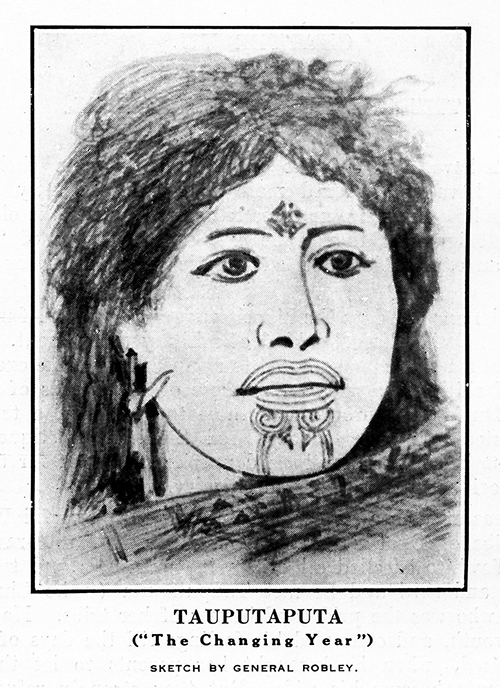
It was at such a gathering, given by the powerful Whakatohea tribe of Opotiki, that a young chief from Turanganui named Tawhito excelled all others in comeliness and trials of strength and skill and he met Tauputaputa ("The Changing Year"), who was the pride and beauty of her tribe. He was a modest youth, and concealed his feelings till the days of grace had expired, when he besought her parents to let the fair Tauputaputa become his wife. But they strongly refused an alliance with the Turanganui tribe on account of long standing animosities.
Tauputaputa, for her part, felt strangely drawn towards the young chief, but she, too, was shy and diffident and "never told her love, but let concealment, like the worm i' the bud, prey on her sun-browned cheeks." Tawhito sadly returned to his home, and a year passed filled with hopeless longings. Long he pondered how he should make the loved one return his passion. At last he consulted the family priest, who instructed him what to do. He went to the seashore, and taking a toitoi shell he
[Image of page 24]
breathed into it a love incantation or spell (a whakaahu wahine) then cast it from him. This charm he repeated four times, throwing the shell to the four winds of heaven. He returned that night to dream of his beloved Tauputaputa.
On the morrow his yearning was so great that he determined to seek her who possessed his soul, and for her sake to brave the hostility of her tribe and the danger of passing through enemy country. He informed no one of his intention, and one night when his people slept, he started forth up the Waipaoa River, and by next night he had entered the great forest which extends toward Opotiki, where, for the present, we shall leave him.
Tauputaputa sighed in hopeless despair for her noble young warrior, and her parents became anxious for her health, and
[Image of page 25]
encouraged the village maidens to come and join in their amusements. One day her mother persuaded them all to sally forth on Awakino Beach, promising that the girl who found the largest toitoi would win a handsome husband. Soon they espied such a shell washed up by the waves, and raced for it. Tauputaputa, being swiftest of foot, outstripped the others, and on finding the shell dead with a hole in it she cast it away in disdain. But that dead toitoi shell would not be denied. Thrice it was cast up at her feet, only to be thrown back in anger far into the sea.
At last, when the shell appeared the fourth time, the girl thought, "Surely this is more than chance." So she went apart from her companions, and taking the shell with her, sat on a rock, when the memory of Tawhito filled her mind with pain and she wept over the hopelessness of her love. Bowing her head on her lap her ear touched the shell. It seemed to say, "Tawhito sent me to tell of his love."
Hope was renewed and the girl gathered leaves of the sweet-scented karetu grass weaving a string, and she hung the messenger shell from her neck. She was a different Tauputaputa when her companions rejoined her. They chided her for wearing such a worthless ornament, but she replied, "You do not know what this toitoi means to me."
For many nights the young girl dreamed of Tawhito, and she determined to seek him, first of all making a confidant of her father's tohunga, to whom she told the secret of the shell. He said it was a favourable omen; that it meant that Tawhito was on his way to meet her, and she must wait. But she became terrified lest he fall into the hands of his enemies, which would mean certain death, therefore she must go at once. The father endeavoured in vain to dissuade her, but finding that she was determined, he said: "It is well, O daughter. " "Whaia e koe te iti kahurangi; ki te tuohu koe me mounga teitei." ("Search out the sacred greenstone treasure, the kahurangi; if you bow down let it be to a lofty mountain.") His meaning was that she was not to let any small obstacles turn her from her bold project. He also taught her a spell or invocation for success, commencing: "I hira mata tao taonga ki te whai ao." ("Open my eyes that they behold the precious treasure of life"), tell her that no matter how dire her peril or distress might be, correct recital of those words would give her her heart's desire. And that night she heard the voice of the shell telling her more insistently than ever that Tawhito loved her.
[Image of page 26]
Though a great storm was raging, the girl sought the war-trail leading to Turanganui. Taking a small basket of kao, or dried kumara, tied to her waist at nightfall on the second day she had reached Motu, Te Wao-nui-a-Tane (the great shade of Tane-Mahuta's forest). She had become hopelessly lost, her small supply of food had been swept away while swimming a flooded stream, the storm still raged, her feet were bleeding, and fainting from hunger she sank to the ground in despair, fearing that she would never more see Tawhito. Suddenly she remembered the counsel of her father's tohunga and she repeated the spell he had taught her. Instantly hope returned to her heart and the blood coursed rapidly through her veins.
The maid sprang to her feet, groping her way through the dense undergrowth. Feeling a smooth surface under her feet, she discovered she had regained the lost trail. This she followed for some distance till she smelled the smoke of a tawa fire and she soon discerned a faint glimmering light. Then a great fear came upon her lest she fall into an enemy's hands.
Cautiously crawling on her hands and knees she drew nearer and espied a solitary figure bowed over the fire. Emboldened, she approached nearer, and who can tell her joy at meeting her lover Tawhito.
Here the curtain falls, and when it is raised again, Tawhito and his wife Tauputaputa are living happily in his pa at Titirangi on the hill above the entrance to Turanganui River (where the town of Gisborne now stands). And she bore him many children whose offspring live on the coast at many places between Mahia and Uawa, and their maidens to this day, when playing on the seashore after a storm, still search for toitoi shells which they press to their ears hoping to hear the message of love which came bringing joy to Tauputaputa of the changing year.
Note.--I first published this story in an Adelaide paper in 1867.