The Taranaki Wars 1860
Page 47
[Page 47 omitted as it remains in copyright]
[Image of page 48]
Nelson, Feb. 4 1860
My dear Eliza,
My hopes of sitting down a week before the departure of the mail to write you a comfortable letter have been sadly frustrated by the unusual event of a sick headache which has assailed me off & on for the last fortnight. I live in an atmosphere of girls, (Sunday School teachers) and seldom exchange ideas with anyone either in the house or out of it.
I wish I cd hail the addition of poor Meysey Turton 1 to our society more cordially than I do, but certainly I never heard anything that gave me the idea of his being a sensible man, however good, & I have not Edmund's confidence in the efficacy of good, foolish people. As a susceptible heart seems to be one of his weaknesses I suppose I may be prepared to welcome a future Mrs. Turton as the result of the voyage, wh is so dangerous a proceeding to susceptible people.
Thank you much for talking of sending at some time Conybere's S. Paul. On the one hand Edmund's impression is that it lowers the subject by giving too much weight to all the human & earthly elements of the subject - on the other, that kind of book is generally I think a great help to one's interest & understanding of the matter.
Nelson, Feb. 27 1860
My dear Eliza
As I write everything from the point of view that will interest my Aunts, (not being able to compose for an abstract public) I chronicle things with a minute detail that is anything but generally acceptable.
Unfortunately I do not possess your family talent for brief sentences & condensed intelligence & if I attempted a laconic style I shd. probably fail of conveying anything that I intended.
Edmund is just now sadly overburthened with parochial details in consequence of a very distressing event. Mr Pritt who was engaged to a very nice girl here had his marriage suddenly broken off under circumstances of some strange & painful
[Image of page 49]
nature, wh. have been revealed to no one but Edmund, 2 & wh. I cannot even guess at - but the result was his leaving this at once & going to Auckland - in spite of his great distress at leaving Edmund thus suddenly, & without help - although Edmund has never said so my conviction is that there is no idea of his ever returning. Fortunately Mr. Tudor is with us still & will not be called away for some time on any long native expedition - & he helps Edmund greatly in visiting & services, though he is not a man of business or method.
Mr. Tudor's chief charge is Wakapuaka, a scattered country district extending along the shore of the bay to the East & running up into little valleys, distant from this from 4 to 10 miles, & beyond that again a Maori settlement of some 40 natives. He is invaluable in his affection for the natives & influence with them, & also in possessing the frankness & ready sympathy that enables a man to deal with people of the lower class -- He does not possess high intellectual powers, nor a talent for predication - but in all the practice of life he is ready & efficient - & in that respect is a thorough contrast to poor Mr. Pritt to whom thinking was far easier than doing.
I feel the claim of the Maories [sic] upon us for improvement is very strong -- but I own if it were left to me to decide I shd. feel that I was undertaking a more useful work in giving my time to a school for white children, either of the middle or labouring class.
The expenditure of labour on the poor Maori girls must be very large in proportion to the return - (it is not right of course to call it waste) for the greater part of these girls after their 3 or 4 years' training must return to squat amongst 10 or 20 brothers, aunts, cousins, etc on the floor of a dark dirty cowshed, where cleanliness order & industry are literally impossible - It seems to me that until you can get them to live in cottages or even separate huts the training of the girls is like pouring water into a sieve - There are two or 3 families here who do live in cottages & practise English habits, but unfortunately in these families there are no girls, children being as scarce a commodity amongst the natives as they are plentiful with the Colonists.
[Image of page 50]
Capt. Blundell's. Waimea Valley.
12 miles from Nelson
Begun 21 May, ended 2 June 1860
[To Lou]
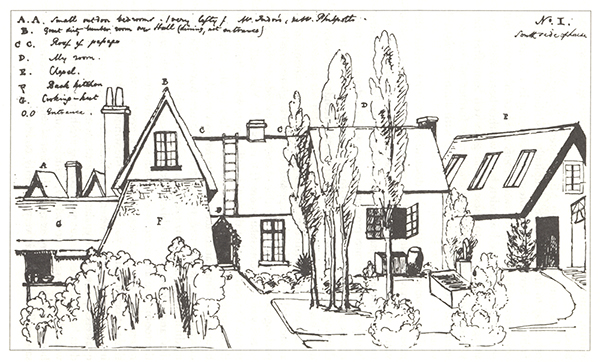
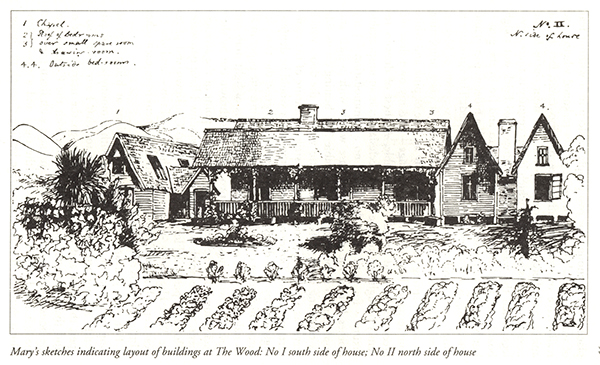
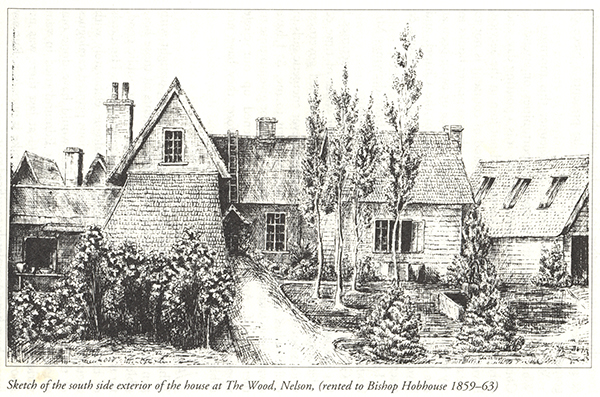
To give you a better idea of [our house's] general aspect than I can in words I send you outlines taken from sketches of the back and front of the house.
No. I is from the gate at which you enter the premises and come up to the entrance door.
No. II is from the garden, the privacy of which we have at length secured by excluding visitors from the old entrance and giving them admittance on the other side of the house. But now, my dear, suppose you come and spend a day with me and see what surrounds us and our manner of going on.
You have landed at the Port, a collection of wharfs, hulks, and warehouses two miles from the Town. You have secured a dogcart with a gigantic and trustworthy Canadian driver, and have driven up the beach road with the sea close to you on your left and low bare hills dotted with houses on your right and as you sweep round the foot of the last hill you are delighted with the view of the little Town and Church perched high up on a knoll in the midst of it, with its background of mountains. But you are not delighted with the perfectly straight roads and streets (the latter being roads with wide wooden houses and little wooden shops ranged more or less thickly along their sides) that cut each other at right angles and score out the whole neighbourhood into frightful squares.
You get into Bridge Street and drive along its whole length which brings you, not to a bridge, but to where a bridge is wanted, and there your careful driver plunges into a shallow river with a stony bed (the Mai-tai) and after much tramping and splashing tugs you up the opposite bank and turns (at right angles of course) down another wide straight road at the end of which you see the sea. You have not gone many yards when another road crosses this, and at the corner of a new fence which skirts the road you see these imposing gates (which I must leave a space for, and draw when I get home) (which I didn't) and
[Image of page 51]
within, innumerable roofs and gables indicating the episcopal abode.
I was amused in reading Miss Austen's Mansfield Park the other day to find our house so capitally described by one of her fashionable heroines who protests against living in a 'scrambling collection of huts, with as many roofs as there are rooms' but she ought to have said wooden huts, weather board walls, and shingle roofs. Well into these grand gates you soon find that you are not going to drive, but a few yards further on you see a small gate for foot-passengers overhung with almond trees and vines.
There you stop and have to descend and coming within the gate you get view No. I. There can be no question now as to which way you should go, for a straight footpath goes right up to the house and a large placard and pointing finger indicating 'visitors entrance' are put up on the wall to deter the most obtuse from going round to the garden and coming to the drawing room window (!) as our landlord's friends were wont to do in his time.
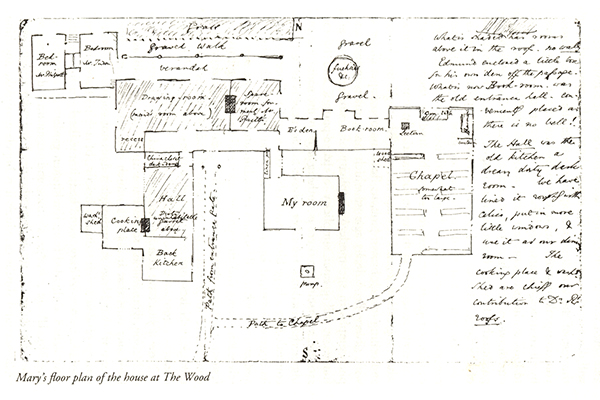
As you approach the house however your attention is attracted by the singular appearance of the great zinc-lined packing case and old barrel that stand side by side at the open window of the peninsular room (D. in No. I). You walk up to them. You perceive that the box is full of pure water, fresh from the neighbouring pump, conveyed doubtless by the tarpaulin hose that reclines at its foot. The barrel on the other hand you observe contains water of a less pellucid nature, but whilst you meditate upon this, your eye glances up through the open window and is [caught] by a blaze of rich Turkey red on the wall of the room. You are seized with a wish to examine it - curiosity I regret to say gets the better of your good breeding and by a very slight effort of agility you get upon the window sill and descend into my room. Now I, when I go back there from my present quarters up the country, shall think to myself as I enter it 'Oh dear how luxurious!' but you, coming fresh from home, or at worst having paused at Sydney, which is just halfway between home and this colony as to civilization - will look round and say 'well really this is very decently comfortable'. In the first
[Image of page 52]
[Image of page 53]
[Image of page 54]
place it is big enough for two people to sleep in it without fear of suffocation, although I have never yet reckoned whether we really have our needful allowance of 1000 cubic feet of air apiece, and therefore always sleep with the door open. In the next place it has a fire-place which in this country is a rare privilege. Then the walls are neither whitewashed brick nor rough boards nor unbleached calico flapping to and fro in the gust - but battened, canvassed and papered (with a hideous paper) and the ceiling is a wooden ceiling cleanly painted. The furniture is simple, and I will not say elegant, with the exception of Messrs. Heal's dark blue enamelled bedstead with gilt vases supporting an acre of spring mattrass covered by an acre of pink and white counterpane. No curtains or hangings - and my own dear old green leather and inlaid writing table. A chest of drawers recently brought out for me by our ecclesiastics is an unspeakable luxury - for until I got this I had no accommodation for my clothes but in the deal packing case which with a shelf and doors put to it forms my dressing table, still bearing on its side its travelling mark of F.15 and a ditto without the doors which serves as a washing stand - But the striking feature of the room certainly is the Turkey red - without which it would be depressingly drabby and dingy - and when you contrast the two pictures which hang over the chimney piece against the paper in all its naked ugliness of huge unmeaning flowers of light drab and dark drab with those on the two side walls thrown out by their background of deep red, you perceive the point of the arrangement. On the north wall opposite the window I have two water colours (a pair) of Florence Cole's of (1) Courtown and of (2) the West Highlands - underneath them (4) Eton - and the (3) dear Peper Harow Cedars - and dividing them from each other 3 little Raphaels one atop of the other.
But now you are getting quite impatient at being kept so long in my room. You look round with a moony air and evidently are not attending in the least to what I am saying so I open the door and conduct you through the narrow neck of land that connects my island bedroom with the Continent of the house -- in plain terms a little passage with linen presses on the left hand and a window on the right and a second door which shuts it off from the passage leading through the house,
[Image of page 55]
[Image of page 56]
and when you have lived in a wooden house for a few days you will discover the comfort of being so thoroughly separated from the rest of the world, so that (putting aside the case of illness) you can speak or move in your own room without being heard by all your neighbours. Well then having stopped for a moment to look at the prints of dear Sir Lowry and Sir Alex. Hope and one or two others which you can scarcely see for lack of light we go into the drawing room. There, in spite of all you have heard of the large families and rapid increase of population in the colonies, you are startled to find 4 big girls carrying on their avocations at ease and you begin to think whether you have 4 cousins to greet but are reassured by finding they are only 'Taranaki refugees'. So then you look critically round the somewhat long and somewhat low apartment with its skirting boards and ceiling of rich brown pine, its flock maroon paper diapered with silvery fleur de lis against which hang many prints and photographs in the modern simplicity of a single rim of gilt frame or still greater simplicity of passe-partout and having satisfied yourself that there is nothing ugly in the room excepting perhaps a large tea-table whose homeliness is only partly concealed by a large blue shawl table cover and will peep out in its square unturned legs, you look out at the French window and exclaim what a delicious verandah, and there we seat ourselves lamenting that though the vines still wreath its pillars and festoon its eaves they have lost their summer luxuriance and that before long 'thick in the blast the dead leaves will fall', though in Nelson one can very seldom say 'the day is dark and dreary'.
Now if you have heard as much as I did of the pretty gardens of Nelson, you will be somewhat surprized to be told as you look over ours that it is just as much of a garden as any other (but one) that I have seen, though it does not contain so great a variety of flowers. It consists briefly, of a bit of rough lawn adorned by one solitary round bed, immediately in front of the verandah, and divided from the kitchen garden, (as seen in outline No. II) by a hedge of roses and common red geranium. The remainder is a square open border filled with a miscellany of flowers and shrubs of which it is hopeless to make anything
[Image of page 57]
ornamental, though of course one is glad to have the flowers there.
About this time the dinner bell rings, alas! at 1 o'clock, for never shall I be reconciled to mid-day feedings. We pass back through the drawing room and crossing the passage enter a dining Hall of highly Colonial appearance. It was a great dark cold uncomfortable kitchen, without any lining whatever to its wooden walls - in fact, a great wooden shed with windows. We have lined walls and ceiling with unbleached calico, hung the old motheaten scarlet cloth curtains of the Clapham dining-room across it to hide the sink and china cupboard, and there we dine and are succeeded by the servants in primitive fashion. The butler is a little damsel of 15 or 16 who is always good-humored, and generally (by dint of my lectures) tidy so we are envied by our neighbours for so valuable an acquisition. As the party assemble for dinner, besides the 4 tall slender girls and their governess who are an accidental appendage, you are introduced to Mr. Tudor the Maori-speaking Chaplain, an excellent honest Welchman of sanguine complexion and temperament, whose absence from the household is always a matter of general regret.
After dinner I long to take you [on] an expedition up the valley of the Maitai enfolded amidst high hills or up on some of the hill-tops, but alas! how? for I cannot walk nor you either so far - and horse or carriage we have none -- so we content ourselves with the verandah and garden till chapel-time and dark come together at 1/2 past 5. Then we go in by what was the old entrance hall, (see No. II) and is Edmund's bookroom, adjoining his den 6 foot square, and there find him scrambling on his surplice all awry. We squeeze past him into the Chapel. And you go into a front seat whilst I slink as much as possible behind a little curtain which partly conceals me and the harmonium from public gaze. It strikes you that this building which was a ball-room and is a Chapel is a good deal more like a wooden barn than either, except at the end where the little reading desk and communion table stand, and that has lately been made very nice by some crimson hangings and a good piece of carpet which Edmund took off the hands of an impoverished
[Image of page 58]
clergyman. So then after chapel, tea, a horridly wholesale sort of proceeding, as I suppose all meals must be in large families where strict economy is observed, though I have not yet adopted the practice of most Colonial houses in regard to breakfast and tea - they no more thinking of asking whether you will have tea strong or weak, with much or little sugar, than you would think of consulting your guests as to the strength or flavouring of the soup that is to appear at dinner. A trayful of cups of nursery wash are filled, and these are distributed with ruthless impartiality. But I shall give you your tea just as you like it, with real cream in it, and out of delicious pure white cups just edged with ultramarine blue and gold. And with such cups and plates, what you eat and drink out of them, will to the truly artistic mind be a secondary consideration.
Well, how to lodge you my dear Lou for the night, when one of our two small spare rooms is occupied by 3 Browns, and the other by a 4th Brown and a governess is a matter of such painful perplexity to me that I must evade the subject altogether. Many excellent people would have no objections to sleep in their clothes on the sofa in the drawing room, so as they could have plenty of blankets and rugs, and get a towel dipped in water to smear their hands and faces in the morning, but you I fear are bound by foolish traditions derived from the mother country on these matters. So I will only suppose you have slept somewhere in the house and are aroused next morning by the sound of sawing and dull blows which lead you to think we have a carpenter at work somewhere in the house. You will see however if you look out of the little window before mentioned in my private passage, that the sounds proceed from Edmund's morning exercise, for you discover him in an ancient coat and no hat chopping and sawing away at the firewood under a little shed constructed in the angle of the chapel wall. Perhaps I, in crimson flannel dressing-gown should be found actively warming his morning cup of coffee, and perhaps I might even offer you a share, but I much fear that in the present state of things I should be more probably found reading in bed and so combining improvement with repose. Since I have had so large a family, to compensate for the additional tax on my energies, I often breakfast in my own room, leaving the task of pouring out
[Image of page 59]
tea to Miss Nicholson, who as well as the girls, is most considerate and kind in her offers of service. And the girls, ranging from 11 to 16, run all my messages, so that I shall feel quite helpless when they leave us.
Ah, dearest Lou if such a vision could but be realised! how the weight would be lifted up from one's exile. I become daily more conscious that it is not the disagreeablenesses nor discomforts of colonial life that affect one, but the long long distance from all those one cares for, and this consciousness which of course never leaves one throws a shadow over everything. I am often aware whilst I am expressing my admiration of the beauties round one here and the charms of the climate, of something dragging at my heart and preventing my admiration from becoming delight. But I hope I shall never fall into the habit which I see many people have of decrying everything here, and denying the beauty of the mountains and the gloriousness of the skies, because they are not happy or comfortable here.
Well the greatest solace I have had has been the constant and detailed communication with home. Of course one's belongings and all their proceedings come before one in somewhat fitful flashes, sometimes emerging into full daylight, sometimes retiring into total obscurity.
Nelson, 28 May 1860, Whit Tuesday
[To Eliza]
'Who have you in the way of society?' Why my dear Eliza you have only to go to the nearest country town wherever you may be, & make acquaintance with the families of the bankers, brewers, attorneys, doctors, & the two or three half-pay officers who are pretty sure to have retired there, & you have our circle of acquaintances, in substance, though with a different set of names.
It has amused me very much to hear of almost everyone in Nelson, in turn that they are of 'very good family' but I now begin to think that all that is meant to be conveyed by that expression is that the parents of the persons so designated did not come out as servants or even shopkeepers. The haute noblesse here are people (of whom there are but two or three
[Image of page 60]
families) of the class of the Richardsons. He as you know was an M.D. and she the daughter of a small clerical squire. I have never found anyone that claimed to belong to any known family in any county of England. The Richmonds are superior to most people in position & manners, for Major R. is an old soldier who has always lived in good society, & who was one of the principal government officials here in former days. His dau[ghte]r, said to be a very charming person, married a br[other] of Sir T. Tancred's & lives in Auckland, & his son is like any young squire who has grown up in the country with not many ideas beyond horses & the farm. In fact Major R. himself is a very superficial man, always in great spirits & good humour & very pleasant in society, but, unless I am much mistaken, nothing more. However he is a man of right views and gentleman-like prejudices, and so is valuable. 'Some day' I always mean to make a general sketch of the Nelson dramatis personae, for the benefit of my friends at home, but that I cannot do at present. As there is little or no general society in the place, one has more time to bestow on particular people. The Greenwoods are on the other side of the Bay, otherwise they would be a resource in a way that no other family is. Still I don't think I should ever make a real friend of either Dr. or Mrs. G.
Old Mrs. Collins again is a lady, & she really does belong to the Shushburgh family, but she is very eccentric & flighty - dresses like a beggar, cooks her own dinner, & being great in charity & small in discrimination, picks up as her associates all unfortunate persons whatever their demerits may have had to do with their misfortunes. Now in a place like this, to which it is evident that people resorted not many years ago as a refuge from the tyranny of public opinion in matters of morality & religion & where in fact there was no standard of public opinion in such matters, the benefit of good Mrs. Collins's universal benevolence is questionable.
[Meysey Turton] is a great help & comfort to Edmund, in spite of his little foibles, & I daresay his melting eyes & affectionate manner will win the hearts of the many people who set immense value on a clergyman's exterior. He has been hold-
[Image of page 61]
ing services most Sunday mornings & to be sure when he walks from the one to the other in his white surplice, crimson hood, & golden beard all glowing in the sun he presents a piece of gorgeous colouring.
We have had a Maori Service & dejeuner this morning - Whit Tuesday - for those whose opportunities of attending Communion are rare, but unfortunately it is a pouring day, and only about 8 or 9 out of 20 came. I did not join in the Service, having little spare time or strength - (and of course it is not to me a Service, as I can barely follow it with two prayer books in my hand, & cannot join in it) but I have once or twice been at the Service Mr. Tudor has had for them in the Chapel, and have wished that white congregations were equally devout & attentive.
I send you 2 sketches done (not by me) from drawings Mr. Codrington took of the 2 sides of this queer house.
Greatly we shall miss the Brown girls, though sometimes I felt the house was rather too full. The utter waste of time & talents too under the regime of a quiet well-drilled governess who is not intelligent enough to interest clever energetic girls in their studies is a constant vexation of spirit to me, & I have always been lamenting uselessly that I could not give up time to them myself. Anyhow they have brightened up our circle wonderfully and as we had no privacy before, they have not robbed us of it.
3 July 1860
Whatever time or strength I have had for sitting upright with pen in hand has been consumed by the contents of those horrible SPCK boxes. 3 I trust they will prove a great public good, for they have certainly been a great private evil to me. Hundreds of halfpenny and farthing tracts to catalogue elaborately with their prices and reference to those mysterious printed catalogues of the society at a cost of labour that would have done our whole library over and over again, but Edmund tried in vain various assistants male and female - and at last there was no resource but that he or I should undertake it ourselves. But my letters have been completely sacrificed to it.
[Image of page 62]
[Image of page 63]
Nelson, 4 August 1860
... I must put in a few lines to bring our domestic history up to date.
On the 18th of last month, a month sooner than I at all expected it, Maria arrived here, having been brought as far as Ceylon by her husband.
[Mr Bowden] is a source of great comfort to me, as I hope he will shortly relieve Edmund of the over-burden of details both diocesan and personal. Mr. Bowden [is] a clergyman who much to his own distress was compelled to devote himself to farming. He and his family are coming down from their farm 13 miles off to live in Nelson where Edmund has arranged a variety of undertakings for him. It was a sad pity to have a conscientious Pastor & excellent man of business wasted on sheep & turnips to wh there is sufficient attention paid by the laity, especially as they did but just feed & clothe his family. 4
I have been undergoing the miseries of a new girl, a successor to Mr. Philpott's fiancee our late elegant housemaid, whom I restored to the bosom of her family for her own advantage and mine. You can appreciate the task of training 'girls' oneself, especially with no prim lady in spectacles to assist one.
[Much of the following letter is concerned with family letters and reports on various shopping commissions carried out for them in England. She refers to her long-awaited piano:]
Nelson, Aug 4 1860
My dear Eliza,
The Piano was frightfully out of tune for weeks after it was unpacked.
Concerning mattrass stuffings - I have no doubt the flax is quite soft enough for school boys. Coconut fibre is not known in this part of the island, but I am happy to say fleas are not known either, in clean houses, except in the occasional way that they attack one in England, & this is one great advantage of the cooler climate of the Southern Island.
I am anxiously winding up everything to go on smoothly during my illness, & clearing off the liabilities wh alas! will accumulate with me from time to time, & I must retreat into
[Image of page 64]
my own room from Synodical hospitalities for my head & pulse will not stand a whirl of people, although I am so much stronger than I was at Oxford that it was only last Sunday that I had to abandon my walk of 3/4 of a mile to Church & the same back - besides our early Communion & afternoon Service in Chapel.
Nelson, Oct 11, 1860
My dear Eliza,
[Edmund's] start yesterday morning for some weeks' tour, of course added to the usual hurry of the approaching mail. I was thankful to get him off, for he had sadly wanted rest ever since the Synod. It is of no use for wives or sisters to remonstrate against over work, but I am in hopes that Meysey T.'s representations that he is doing his best to kill both of them will have some effect.
I am well, but head & back very weak. Son very heavy, & lively at night wh is unpleasant to a sleep loving mother. He is a very Hobhousy baby in looks, in manners and character he seems very decided & not particularly patient, but thank God he is very healthy & strong.
[Image of page 65]
[Page of endnotes]